


EDB allocates US $2 billion to finance sustainable development
Almaty, 26 May 2026.
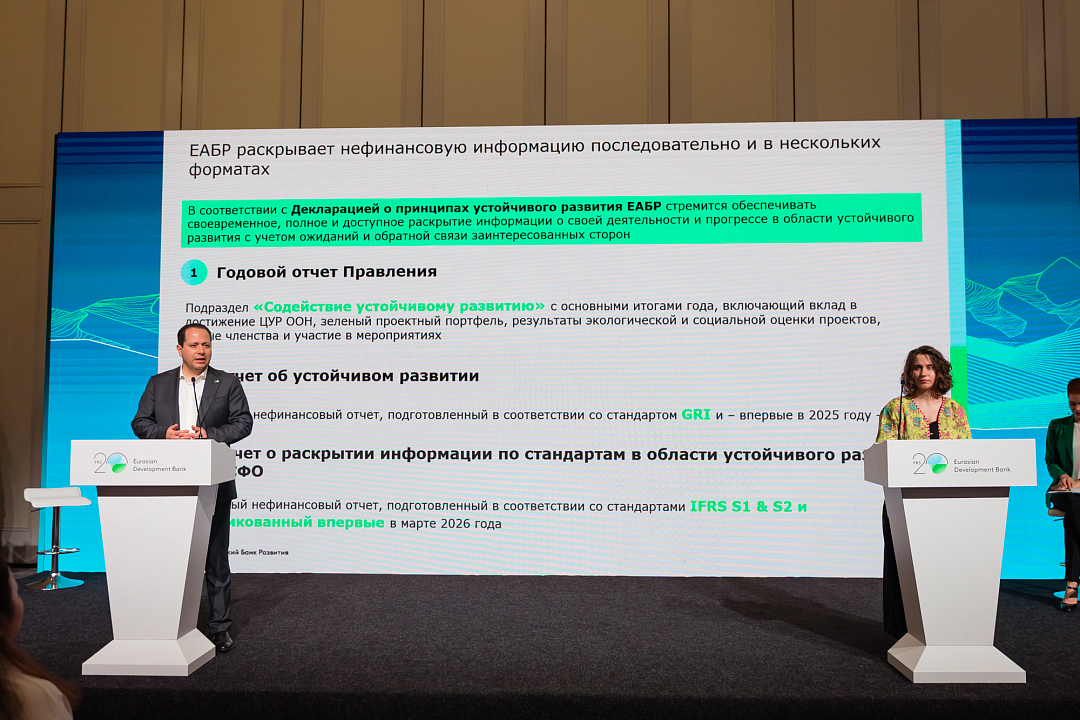
On the second day of the EDB's Annual Meeting and Business Forum, participants discussed climate risks faced by the countries in the region, as well as assessed the results of the Bank's ESG agenda implementation. The EDB also presented its Sustainability Report for 2025.
"ESG reporting helps us become better. We are assessed by investors, rating agencies, and partners, and they demand high-quality disclosure from us. Every year, when preparing the ESG Report, we re-analyse our activities: we introduce new methodologies and standards, assess the results from multiple perspectives, and ask ourselves uncomfortable but important questions. In this sense, the ESG Report is a tool not only for dialogue and external transparency, but also for internal change and continuous development. High independent assessment – for example, an A- rating from the CCXGF agency – confirms that we are on the right track," said Evgeny Vinokurov, Deputy Chairman of the EDB Management Board and EDB's Chief Economist, at the Report presentation.
In 2025, the Bank's experts conducted the first comprehensive assessment of the climate risks of the EDB's investment portfolio based on four climate scenarios, as well as assessed the risks spanning the entire life of a loan. Among the main risks are water scarcity (US $36 million of potential losses), extreme temperatures (US $26 million), and droughts (US $14 million). Overall, the cumulative potential losses do not exceed 1.23% of the EDB’s current investment portfolio. To improve countries' preparedness for the impacts of climate change, the Bank is also developing cooperation with other international organizations. In 2025, a project to develop a business ecosystem for sustainable irrigation in Kazakhstan was launched jointly with UNDP and the Ministry of Water Resources and Irrigation of the Republic of Kazakhstan. The project aims to improve the sustainability of water management and ensure adaptation to climate change. Bank experts, together with the CAREC Institute, also conducted a study on the readiness of Central Asian countries and Azerbaijan to implement carbon pricing mechanisms.
The EDB's current green investment portfolio continued to grow, reaching US $1.08 billion by the end of the year, while the cumulative portfolio reached US $2 billion. Most of these funds were allocated to energy efficiency and RES development projects. Among the key new projects is the construction of a 300-MW solar power plant in Kyrgyzstan's Issyk-Kul region; the facility will be one of the largest SPPs in the CIS. The total share of the Bank's projects contributing to the achievement of the UN Sustainable Development Goals exceeded 25% by the end of 2025.
"We see that the member states' demand for a green economic transformation maintains steady growth. By the end of the year, our current green portfolio exceeded US $1 billion, while the cumulative green investments amounted to US $2 billion. This means that we have more than tripled our green financing in just seven years. Despite the growth of the investment portfolio, the specific emissions per dollar of investment decreased by more than 15% over the year. This means that our portfolio is becoming more climate-efficient," noted Evgeniya Klochkova, Head of the EDB's Office for Sustainability.
During a warm-up session, EDB's analysts and experts from leading international think tanks also discussed the prospects for the development of adaptation financing. Global needs are estimated at US $310–365 billion per year, while actual investment amounts to only US $26 billion. In Central Asia, less than a quarter of climate financing is allocated to climate change adaptation, while 75% of funds are spent on reducing greenhouse gas emissions (non-sovereign investments in such projects exceed US $3.7 billion).
To narrow the gap, session participants proposed increasing the guarantees issued for private investment in adaptation projects, intensifying technical assistance in preparing such projects, and creating a unified climate platform that would unite investment projects being implemented in the region and facilitate the harmonization of their evaluation standards. Creating such a platform would also facilitate the attraction of financing for transnational projects.
Additional Information:
The Eurasian Development Bank (EDB) is a multilateral development bank investing in Eurasia. For more than 20 years, the Bank has worked to strengthen and expand economic ties and foster comprehensive development in its member countries. By the end of December 2025, the EDB’s cumulative portfolio comprised 326 projects with a total investment of US $19.6 billion. The Bank's portfolio consists principally of projects with an integration effect in transport infrastructure, digital systems, green energy, agriculture, manufacturing, and mechanical engineering. The Bank’s operations are guided by the UN Sustainable Development Goals and ESG principles.
As part of its 2022–2026 Strategy, the EDB is implementing 3 mega-projects: The Water and Energy Complex of Central Asia, The Eurasian Transport Network, and The Eurasian Commodity Distribution Network.
The EDB Media Centre:
+7 (727) 244 40 44, ext. 4774 and 2160