


EDB Updates the Eurasian Transport Network: 402 Projects Worth $345 Billion, with Another $100 Billion in the Pipeline
Almaty, 23 July 2026. The Eurasian Development Bank has updated the Observatory of the Eurasian Transport Network Projects. This is a digital platform that collects information on the development of transport corridors across 13 countries. As at 1 July 2026, the database contained 402 projects with a total investment volume of $345bn. In the last year, they have started to build 10 facilities worth $10bn, and 70 new projects worth $74 billion have been added to the existing portfolio.
Key findings:
· Investment has reached a record high. At the moment, there are 402 projects in Eurasia that are executing or planned. These projects add up to a total of $345bn. Another $100bn is for projects that haven't started yet. Transport infrastructure is still one of the region's most important long-term goals.
· Railways are the primary beneficiary. The railway sector is set to receive a significant investment of nearly $150bn, positioning it as a major catalyst for economic growth in Eurasia.
· Central Asia is experiencing a period of accelerated growth. The countries of the region account for over 21 per cent of all investment – $72bn across 114 projects. In 2025 alone, transport infrastructure projects worth $6bn were commissioned here.
· Russia is the key investor, accounting for $225bn in investment, or 65 per cent of the Eurasian region’s total. The largest investment project is the modernisation of the Eastern Operating Domain of Russian Railways.
· Private businesses are actively entering the transport and logistics infrastructure sector. Private capital is involved in 123 projects, almost half of which are in the warehousing and logistics infrastructure sector. A further 27 projects could be implemented through public-private partnerships (PPPs).
· The role of international development banks is growing. They are already involved in 48 projects, and a further 29 promising initiatives are planned for financing with their involvement.
· China is increasing its involvement in transport projects in Central Asia. There are currently more than 20 such projects under way, and the volume of funding raised from Chinese sources exceeds $7bn.
Further details on the report:
The Eurasian Development Bank (EDB, the Bank) has updated its Observatory of Eurasian Transport Network Projects, a unique digital platform that combines a comprehensive project database with an interactive map of transport infrastructure projects across Eurasian region.
The Observatory covers 13 countries — Armenia, Azerbaijan, Afghanistan, Belarus, Georgia, Iran, Kazakhstan, Kyrgyzstan, Mongolia, Russia, Tajikistan, Turkmenistan and Uzbekistan — and provides information on project scope, investment volumes, funding sources, implementation status, timelines, transport modes, corridor affiliation and private-sector participation.
Based entirely on open-source information, the platform enables comprehensive monitoring of transport corridor development, helps identify priority infrastructure projects and supports more informed investment decisions. By improving transparency and coordination, it contributes to strengthening Eurasia’s role as a key transport hub connecting Asia, Europe and the Middle East.
Eurasian Transport Network
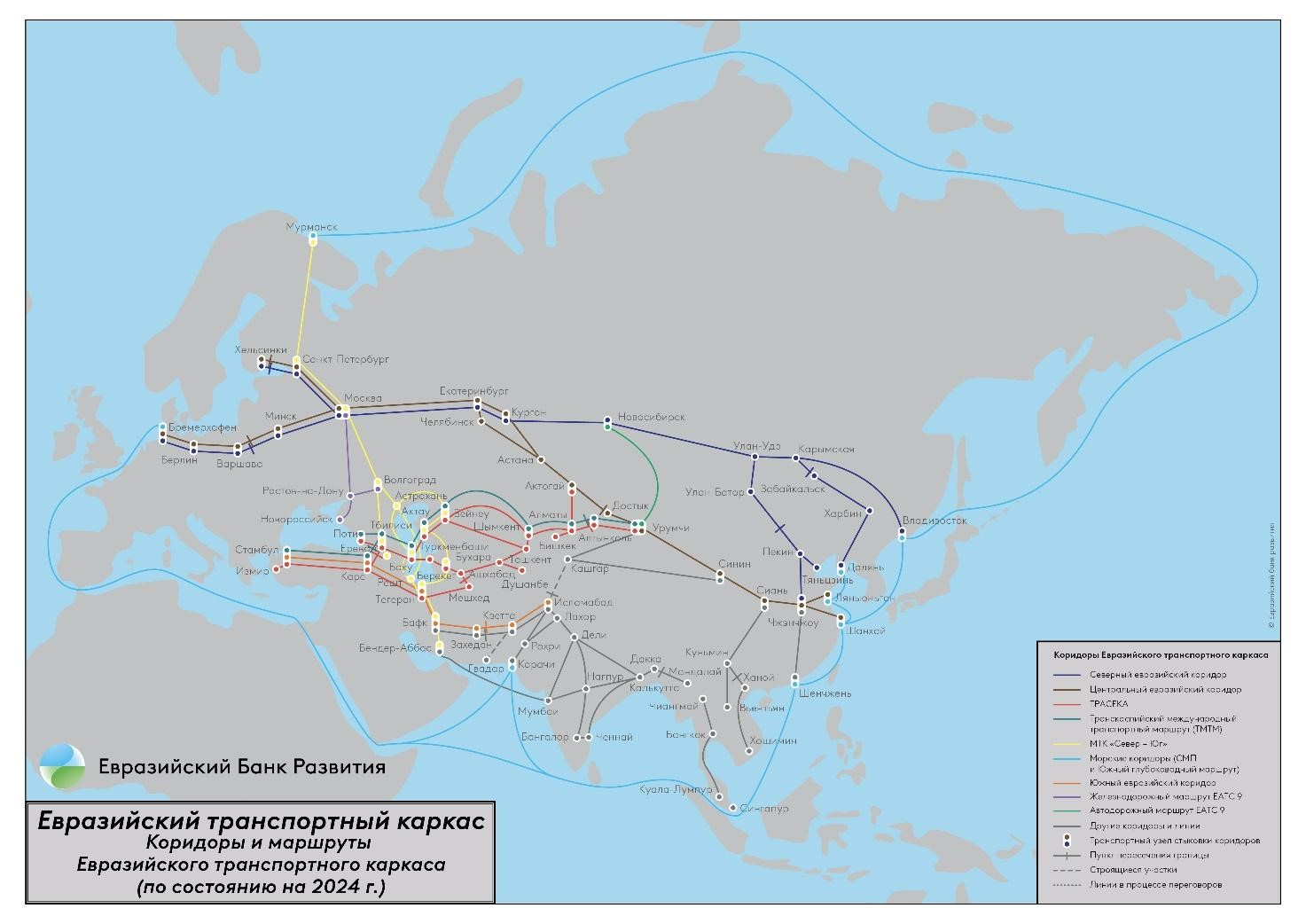
Source: EDB
Since the Observatory’s launch in summer 2025, significant progress has been achieved across Eurasian transport corridors. In 2025 alone, infrastructure projects worth more than $10bn were commissioned throughout the region.
In Central Asia, projects exceeding $6 billion in total investment were completed, including the modernised Dostyk – Moyinty railway line in Kazakhstan, the Ashgabat – Mary – Turkmenabat motorway and the Turkmenbashi – Garabogaz section of the International North – South transport corridor (INSTC) in Turkmenistan, the Kök-Art tunnel in Kyrgyzstan, sections of the Obigarm – Nurobod motorway in Tajikistan, and the electrification of the Bukhara – Urgench – Khiva railway in Uzbekistan, which enabled the launch of high-speed passenger services.
As of 1 July 2026, the Observatory included 402 transport infrastructure projects, both planned and under implementation, with a combined investment value of $345bn.
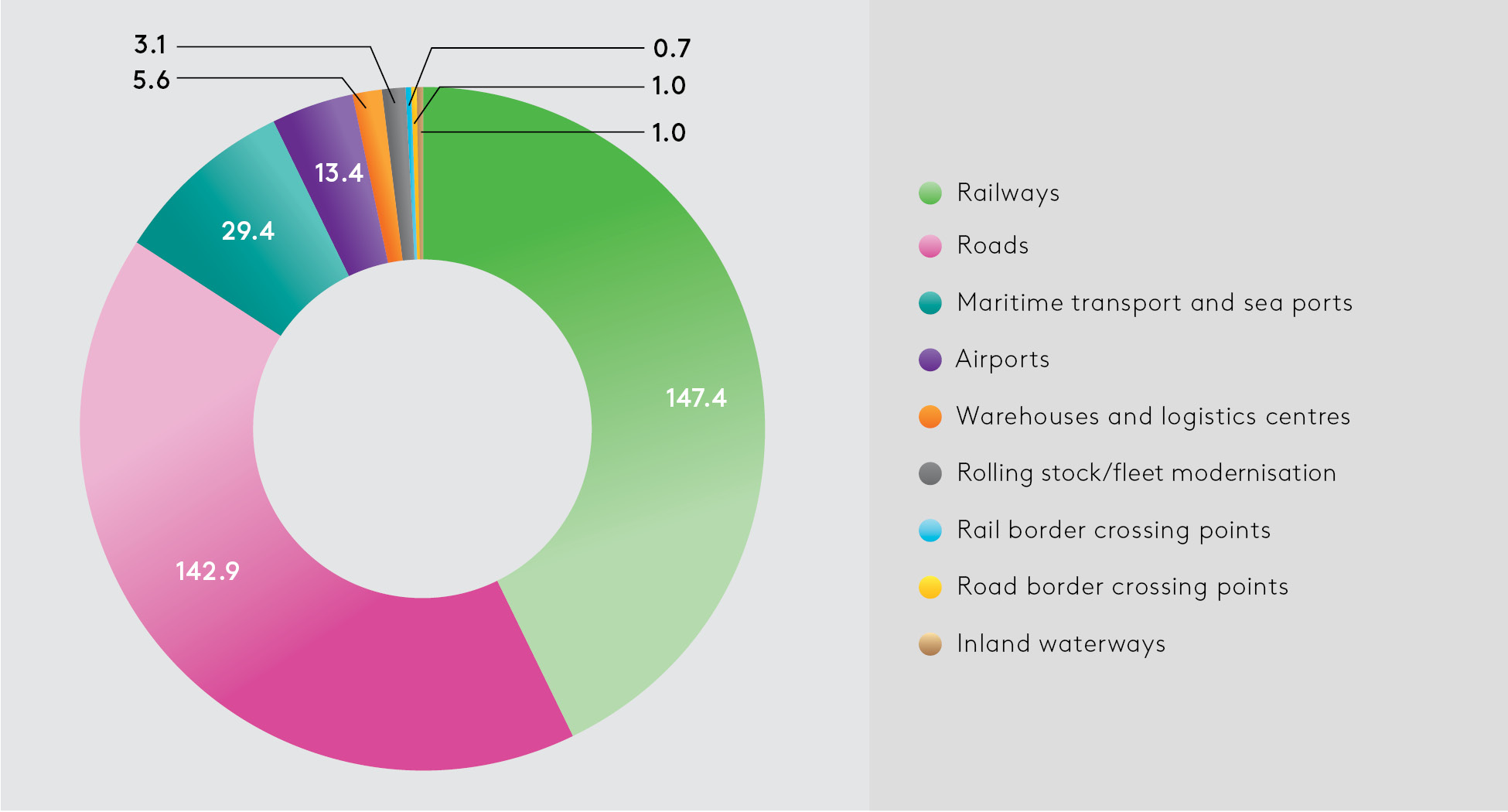
Breakdown of investment in the development of the Eurasian Transport Network by mode of transport, in billions of dollars
Source: calculations by EDB analysts
Railway projects account for the largest share of the portfolio by value, representing 42.8% of all projects. Russia accounts for the largest country share of investment, with projects valued at $225.2bn, or 65.3% of the total. Eight of the ten largest transport infrastructure projects in the Eurasian Transport Network are currently being implemented in Russia.
The Northern Eurasian Corridor remains the most capital-intensive route, attracting an estimated $84.8bn in investment. The development cost of the INSTC is estimated at $52.8bn, excluding the Moscow–St Petersburg high-speed rail (HSR) project.
More than 62% of the total investment volume is directed toward projects currently under implementation, while 9% is allocated to projects in the documentation stage and 29% to projects in the planning phase.
Central Asia accounts for more than 21% of total investment in the Eurasian Transport Network. The region currently has 114 projects, either underway or planned, with a combined value exceeding $71.75bn. Kazakhstan accounts for more than 45% of this investment.
Road infrastructure represents the largest share of investment in Central Asia, attracting nearly 56% of total funding, while railway projects account for 29.8%. The TRACECA, incl. the Middle Corridor, receives the largest share of investment at $42.8bn.
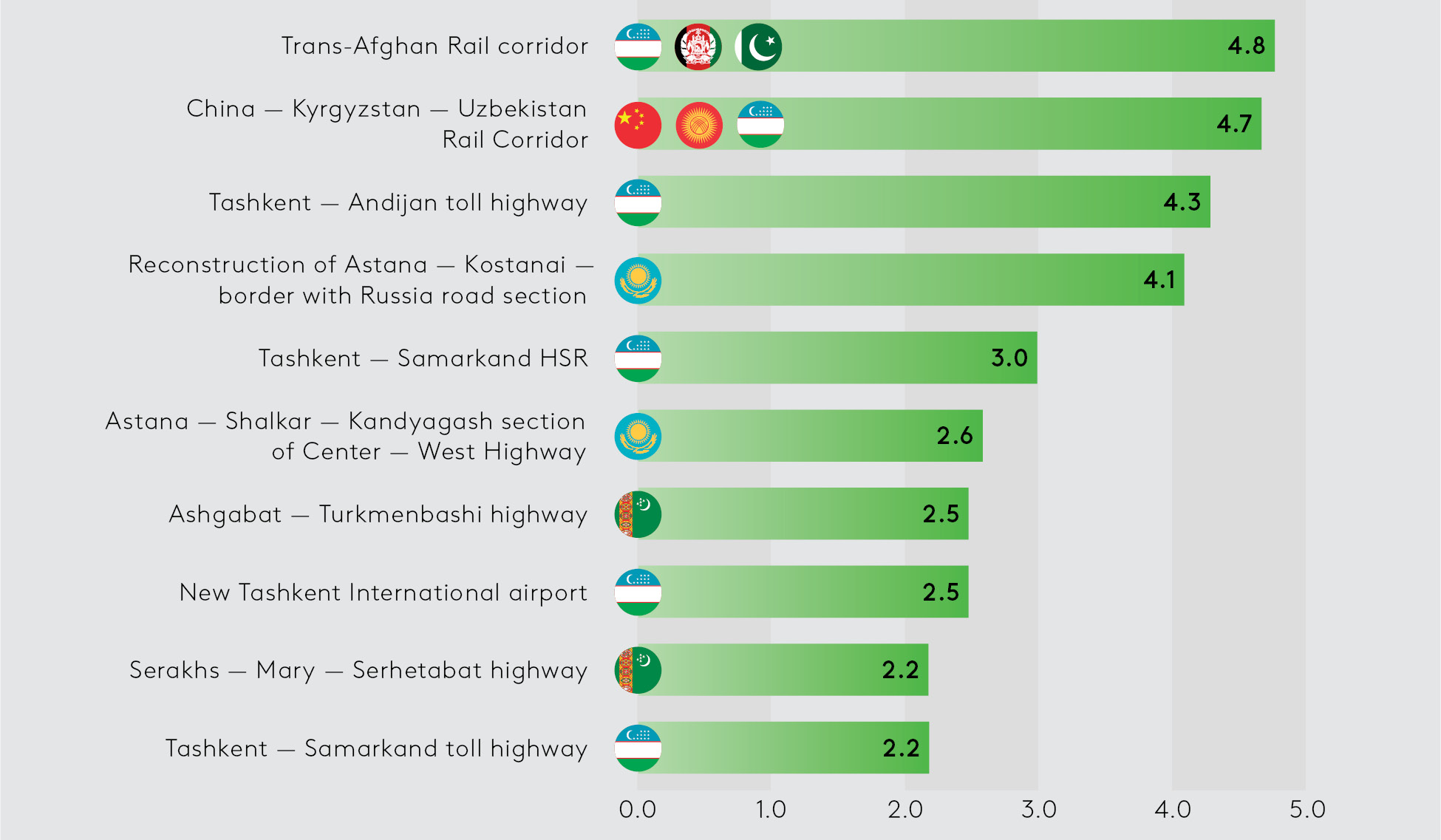
The 10 largest transport corridor development projects account for 42% of the total investment in Central Asia.
Top 10 projects for the development of the Eurasian Transport Network in Central Asian countries by investment volume in 2026, in billion dollars.
Source: calculations by EDB analysts
Evgeny Vinokurov, Deputy Chairman of the Management Board and Chief Economist of the EDB, noted:
“We are witnessing a transition from isolated transport projects to the formation of an integrated Eurasian Transport Network comprising interconnected East–West and North–South corridors. Cross-border transport initiatives are increasing, and infrastructure development is particularly dynamic in Central Asia. By 2035, 114 projects worth around US$72 billion are expected to be implemented or planned. This large-scale infrastructure agenda will improve trade, tourism and mobility for landlocked countries across the region”
Private-sector participation continues to grow. Of the 402 projects included in the Observatory, 123 involve private-sector participation, with nearly half concentrated in logistics and warehousing. Twenty-seven projects are being implemented or considered under public-private partnership (PPP) arrangements, including eight cross-border PPP initiatives.
China also plays an important role in transport infrastructure development across Central Asia. Projects with Chinese participation exceed US$12 billion in total value, while financing from Chinese sources surpasses US$7 billion. Participation ranges from loans and grants to direct investment and construction involvement. Most of the projects involving Chinese participation form part of the Belt and Road Initiative (BRI). The largest project involving Chinese participation is the China – Kyrgyzstan – Uzbekistan railway corridor.
National budgets remain the primary source of financing, accounting for more than 62% of total project investment. International development banks are currently involved in 48 projects, while a further 29 planned projects envisage sovereign or non-sovereign financing from international financial institutions.
The growing number of projects attracting international financial institutions and private investors highlights the increasing importance of coordinated transport planning and regional cooperation in developing international transport corridors across Eurasia.
An interactive map of the projects is available via the link.
More details on the working paper "Eurasian Transport Framework: Project Observatory and Interactive Map" are available on the Bank's website. In addition to the working paper, the site also features a presentation and a link to an interactive map of the ETC corridors and ongoing investment projects for its development.
Additional Information:
The Eurasian Development Bank (EDB) is a multilateral development bank investing in Eurasia. For 20 years, the Bank has worked to strengthen and expand economic ties and foster comprehensive development in its member countries. By the end of December 2025, the EDB’s cumulative portfolio comprised 326 projects with a total investment of US $19,6 billion. Its portfolio consists principally of projects with an integration effect in transport infrastructure, digital systems, green energy, agriculture, manufacturing and mechanical engineering. The Bank adheres to the UN Sustainable Development Goals and ESG principles in its operations.
The EDB is implementing three mega-projects as part of its 2022–2026 Strategy: the Eurasian Transport Network, the Eurasian Agricultural Goods Distribution System and the Central Asian Water and Energy Complex.
The EDB Media Centre:
+7 (717) 255 84 84, ext. 4774, 2160