


Water and Energy Complex of Central Asia
- Kyrgyzstan
- Kazakhstan
- Tajikistan
- Uzbekistan
The Central Asian Water-Energy Complex is an interconnected transboundary system of hydro facilities, reservoirs, power plants, electricity grids, irrigation canals and water-supply infrastructure.
Its resilience determines the development of agriculture and industry, the quality of life and the pace of regional integration. The key challenge of the complex is to reconcile the winter energy needs of upstream countries with the spring-summer irrigation needs of downstream countries.
The load on the system is growing fast: by 2031 water withdrawal in the region may increase by 5–10%, and electricity demand by 40%. To meet this challenge the EDB is delivering a megaproject combining the construction of hydro, solar and wind power plants, the modernisation of thermal generation, the preparation of large hydro cascades, the reconstruction of water infrastructure, and the rollout of digital water metering and modern water-saving technologies.
The goal of the megaproject is to simultaneously reduce water losses, increase the reliability of power supply and create a practical basis for long-term coordination along the «water – energy – food» nexus in Central Asia.
Central Asian Water-Energy Complex
Central Asia
by 2030
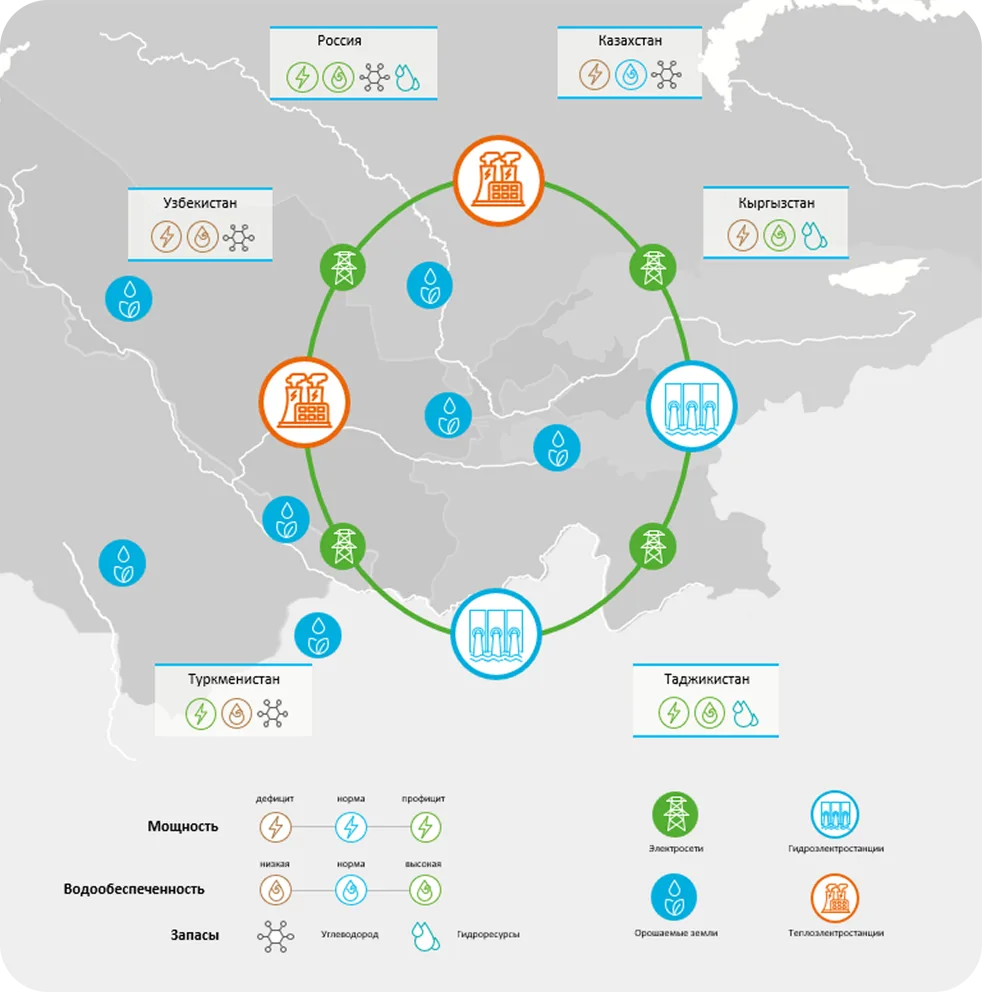
Complex potential
In 2021-2026, under its research programme on the Central Asian Water-Energy Complex, the EDB prepared a series of reports. They model long-term development scenarios, formulate operating principles and conceptual development approaches, identify investment priorities and propose integrated solutions for the complex.
Contribution to sustainable development
The project makes a significant contribution to achieving the Sustainable Development Goals (SDGs):
- SDG 2 «Zero Hunger» – by ensuring the necessary level of water for agriculture amid water scarcity in Central Asia;
- SDG 3 «Good Health and Well-being» – by ensuring the necessary water quality, which underpins public health in Central Asia;
- SDG 6 «Clean Water and Sanitation» – the central goal of the EDB research programme on the Central Asian Water-Energy Complex;
- SDG 7 «Affordable and Clean Energy» – the central goal of the EDB research programme on the Central Asian Water-Energy Complex;
- SDG 8 «Decent Work and Economic Growth» – by providing the necessary water and energy resources to the fast-growing Central Asian region;
- SDG 9 «Industry, Innovation and Infrastructure» – by identifying specific needs and a long-term vision for water-energy infrastructure that underpins the socio-economic development of Central Asia;
- SDG 13 «Climate Action» – by promoting the integration of climate-response measures into national policies, strategies and planning in Central Asian countries.


Facts and figures
Key indicators for the development of the water-energy sector:
Water sector
80%
of water is used for irrigation
40%
is lost in irrigation canals and in the field
50%
of irrigated land is affected by salinisation
9.9 mln people
lack access to safe drinking water
up to 80%
is the wear of water-supply and sewerage networks
20-30%
of annual water savings can be achieved with laser land levelling (while raising yields by 1.3-2.3 times)
12-15%
of annual water savings can be achieved with digital water metering
Energy sector
+40%
growth in electricity demand by 2030 (from 270 to 370 bn kWh)
over 60%
of distribution networks need replacement or major overhaul
15-20%
losses in transmission and distribution networks
up to 70%
of energy infrastructure is critically worn
+63 GW
of new capacity by 2035 under the «middle path» strategy
30-45%
savings on capital expenditure under the «middle path» strategy compared with the «green maximalism» scenario
5 times
lower carbon intensity under the «middle path» strategy compared with the conservative scenario
Projects delivered with the Bank’s support
Preparation of design and cost estimate documentation for the modernisation, expansion and reconstruction of Karaganda CHP-3
Preliminary feasibility study for an integrated agri-food park in the Kyrgyz Republic
Creation of an interactive digital platform to present the Crossroads of Peace initiative
Engagement of independent consultants for the construction and operation of the Kulanak Hydropower Plant
Directions for developing the Central Asian Water-Energy Complex
Water sector
The priority is to modernise irrigation as the largest water consumer in the region while improving the reliability of drinking-water supply in rural areas and cities.
-
1. Renovation of irrigation networks
Rehabilitating canals, drainage and on-farm infrastructure to reduce water losses and preserve irrigated land.
-
2. Digital water metering
Accurate metering, digital monitoring and managed water distribution as the basis for water saving and a new irrigation economy.
-
3. Water-saving irrigation technologies
Modern irrigation, laser levelling and new agricultural technologies for higher yields and water savings.
-
4. Water economics and PPP
Tariffs, water-user associations and PPP mechanisms for sustainable irrigation financing.
-
5. Safe water for rural areas
Groundwater, local treatment and group water-supply systems for rural territories.
-
6. Treatment facilities for cities
Modernising urban water supply and sewerage through new treatment capacity, durable materials and digital control.
Energy sector (under the «middle path» logic)
The «middle path» strategy implies a balanced transition: modernising existing generation, developing renewables and storage, upgrading grids and strengthening regional integration.
-
1. Modernising existing generation
Extending the life of thermal and hydro plants where effective, for reliable and affordable power supply during the transition.
-
2. Flexible capacity and storage
Gas reserves, BESS and pumped-storage hydro to balance renewables, cover peaks and improve system resilience.
-
3. Smart grids and dispatch
Upgrading networks, SCADA/EMS, smart sensors and meters to cut losses and integrate new capacity.
-
4. Gradual growth of low-carbon generation
Phased development of renewables, hydropower, nuclear and distributed generation without losing system reliability.
-
5. New power-market rules
Transparent grid access, PPAs, the development of ancillary-services markets and demand management for a new sector architecture.
-
6. Regional reserves and flows
Joint reserves, coordinated regulation and a regional electricity market for a more resilient system.
Common institutional solutions
Water and energy require a common governance framework: cross-sectoral coordination, strong project preparation, blended financing and phased tariff reform with social protection.
1. Water and energy coordination
Strengthening the mechanism for cooperation between government bodies, regions and operators to synchronise decisions across the two sectors.
2. Central Asian water-energy consortium
A shared platform for delivering large transboundary projects and coordinating with development banks.
3. Strong project preparation
Restoring design and research capacity and building a quality pipeline of infrastructure projects.
4. Blended project financing
A combination of public resources, MDBs/IFIs, PPP and private capital to close the investment gap.
5. Tariffs with social protection
A phased transition to a more sustainable tariff model while maintaining targeted support for the population.
6. Skills and digital management
Training engineers and deploying modern digital systems as the basis for the resilience of both sectors.

