


Between the Scylla of Climate Agenda and the Charybdis of the Conventional Power Generation: the ‘Middle Path’ for the Power Sector
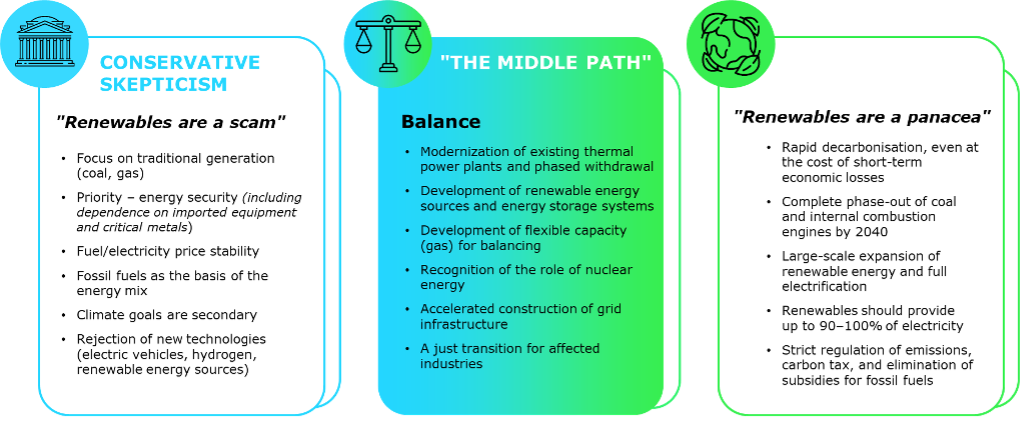
The global energy sector finds itself at a crossroads, facing what appears to be an irresolvable contradiction. Some argue that the worsening climate crisis requires an uncompromising break with the era of hydrocarbons. Others, especially recently, argue that rapid growth in demand — electric vehicles, data centers, and industrial electrification — requires a reliable 24/7 electricity supply that solar and wind power alone cannot provide. Some say, “Renewables are a panacea.” Others counter, “Renewables are a scam.”
I believe that both are dangerous misconceptions that can lead even strong economies to a dead end.
How can this dilemma be resolved?
The global energy sector is undergoing an unprecedented transformation — perhaps the largest in history. In 2024, a record 585 GW of new green capacity was added worldwide, with the share of clean energy rising above 34% for the first time and even surpassing coal. Since 2015, the average cost of solar power has fallen by 70% and wind power by 55%. Renewable energy has become the cheapest option for new generation. Investments in renewable energy and the energy transition have reached $2.2 trillion per year — twice as much as global investments in fossil fuels.
However, there is a downside to these successes. Demand for electricity has accelerated in recent years and is outpacing the adoption of new low-carbon technologies. Global CO₂ emissions rose again to record levels in 2024. At the same time, against the backdrop of digitalization, electricity is becoming a key energy source for the global economy. New demand — from AI, data centers, electric vehicles, and the electrification of industry — requires guaranteed 24/7 power. Only stable, dispatchable sources supported by reliable networks and reserves can provide this. It is not surprising that opinions about the future of energy have divided into two polar camps.
On one side are the green maximalists. They are convinced that renewable energy will not only save the climate, but also give a new impetus to economic growth and energy independence. They cite impressive facts to support their case: solar and wind power are already cheaper than building new coal-fired power plants, most new capacity is now coming from renewable sources, and investment is breaking records. It would seem that the world is ready to switch completely to clean energy.
On the other side are conservative skeptics. They are convinced that the energy transition is excessively expensive, unreliable, and premature. As proof, they point to recent energy crises, rising electricity bills, power outages, and constant subsidies without which green projects cannot yet survive. Their conclusion is clear: renewable energy is not a solution, but a dangerous adventure that threatens to leave countries without reliable power supply.
Who is right? The power industry is highly complex and difficult to simplify — both engineers and energy economists will confirm this. We propose a middle-path strategy. It is complex and not nearly as “sexy” as any extreme view. But I am convinced that this is precisely the approach we need.
Solar panels and wind turbines alone are not enough to power our energy-intensive civilization without serious infrastructure support and backup capacity. The 2021–2022 energy crisis in Europe clearly demonstrated how vulnerable systems can become when they reduce emissions too quickly while underestimating the importance of energy security. When countries faced geopolitical pressure and gas shortages, even the most developed economies were forced to temporarily return to coal and postpone the closure of nuclear power plants. We need developed power grids, flexible capacity, energy storage facilities, and, in general, a technologically mature energy system. In practice, without grid modernization, investment in storage, and proper system balancing, increasing the share of renewable sources above 20–30% can destabilize the system, causing frequency fluctuations and rolling blackouts.
But skepticism about green energy is also unfounded. Renewable energy is a key element of the future. New solar and wind generation is already cheaper. Global CO₂ emissions are still growing: in 2023, they increased by 1.1% to a record 37.4 billion tonnes. This shows that the pace of change is insufficient. But this is not a reason to give up on renewable energy. On the contrary, it is a signal to act even more systematically and decisively. A comprehensive approach is needed: building new solar and wind power plants, improving energy efficiency, modernizing grids, developing energy storage systems, and managing consumption.
Skeptics like to recall how abnormal cold weather in Texas paralyzed wind turbines, forgetting that traditional power plants also went out of service at the same time. In addition, renewable sources already provide more than a third of all electricity in several countries, and with proper integration, energy systems successfully cope with this share. Renewable energy is a fully fledged working tool, the effectiveness of which depends on the maturity of the entire energy system and political will.
So what is the solution? A reasonable balance — an energy “middle path” that combines the advantages of both sides and neutralizes their disadvantages. The middle-path strategy echoes the World Energy Council’s concept of the energy trilemma: environmental sustainability, security of supply, and affordability must all be achieved simultaneously.
The middle path rejects the false dilemma of “green or reliable” and offers a synthesis. Solar power plants, gas-fired power plants, hydroelectric power plants, and nuclear power plants can all work together to strengthen the sustainability of the energy system. Each technology has its place depending on the conditions of a particular country. This approach requires abandoning dogmatism — both environmental and conservative — in favor of flexibility and adaptability. Climate goals must be commensurate with the real state of the energy sector and social realities; otherwise, even good intentions can turn into upheaval.
One point is important to me personally. For more than 20 years, I have been professionally involved in economic integration, primarily at the regional level. This is a difficult, highly politicized field that requires patience: one success can easily be followed by two failures. Yet the energy transition and growing imbalances in power systems are dramatically increasing the demand for regional integration. The ability to balance systems through cross-border flows, especially during intraday peaks, regional electricity markets, interconnectors, and coordinated standards is becoming even more important. By integrating electricity markets and ensuring sufficient power flows, countries significantly increase the reliability of their power supply.
The validity of middle-path principles is confirmed by practice. First, the nominally cheap energy from the sun and wind does not account for the costs of integration into the system. Building a solar power plant is only half the battle; power lines must also be built and energy storage provided. If investments in infrastructure — grids, batteries, and reserve generation — are not made in advance, the “cheap” kilowatt-hour from solar and wind will turn into hidden costs and the risk of interruptions. According to estimates, these reliability costs could increase capital expenditures for the sector’s development by 40–55% through 2035 under the most ambitious green scenario. As a result, the energy transition will be much more expensive if the costs of supporting weather-dependent sources are not factored in from the outset.
Second, in the digital age, the reliability of electricity supply is becoming a matter of national security. As transportation, industry, and everyday life become more electrified, electricity is becoming the “lifeblood” of the economy. It already accounts for about 20% of global energy consumption and could reach 30% by 2040. In 2025, global investment in data centers exceeded $580 billion, while their energy consumption could at least triple by 2035. New technological demand — from artificial intelligence to billions of connected devices — requires guaranteed 24/7 power. This can only be provided by stable and dispatchable energy sources, backed by reliable networks and sufficient reserves. In the world of big data and AI, power outages pose a direct threat of economic paralysis.
As part of this balanced approach, nuclear energy is experiencing a renaissance. Many countries are extending the service life of existing nuclear power plants and planning new reactors. The reason is clear: nuclear power plants provide round-the-clock electricity without emissions, which is especially valuable in winter when solar and wind generation often underperform. According to IPCC assessments, it is impossible to keep global warming within 1.5°C without nuclear energy. Whereas nuclear and renewable energy were previously seen as opposites, they are now increasingly viewed as strategic partners in achieving climate goals. From this perspective, the middle path can reduce greenhouse gas emissions by a factor of five compared with a conservative scenario dominated by fossil fuels.
Natural gas remains an important bridge on the path to clean energy. Gas-fired power plants emit almost half as much CO₂ as coal-fired plants and, thanks to their flexibility, can quickly compensate for shortfalls in solar and wind generation. The European Union has officially recognized gas as a necessary element of the transition period. Of course, gas is not a solution for the ages, especially without carbon capture technology. Nevertheless, in the coming decades, it will help maintain the stability of power systems while renewable energy gains momentum and energy storage facilities continue to develop. The pragmatism of the middle path lies in using gas where it remains indispensable, while gradually reducing dependence as alternatives mature.
Ultimately, the only way to resolve the global energy dilemma without sacrificing either the future of the planet or economic stability is to follow the principles of the middle path. This means rejecting the false choice between “green” and “traditional” in favor of technological synthesis, where renewable sources work hand in hand with reliable gas-fired and nuclear generation. Such a balanced approach, based on pragmatism and the real needs of the digital age, will support sustainable development and protect society from social and economic upheaval.