Eurasian Transport Network
- Armenia
- Belarus
- Kyrgyzstan
- Kazakhstan
- Russia
- Tajikistan
- Uzbekistan
Improving transport connectivity is a top priority for the countries of the Eurasian region, which are landlocked and remote from deep-sea ocean routes. Developing the infrastructure of transport corridors across Eurasia enhances transport connectivity, reduces the transport costs of economic activity and trade, and helps unlock the transit and tourism potential of the region. The Eurasian transport framework is a network of interconnected latitudinal and meridional international transport corridors and routes that ensure the internal and transcontinental connectivity of Eurasian countries. Its backbone consists of international transport corridors running east – west and north – south, linking Asia, Europe and the Middle East.
Linking up the corridors can attract an additional
up to 40%
of freight traffic
The crossroads of latitudinal and meridional transport corridors in Eurasia
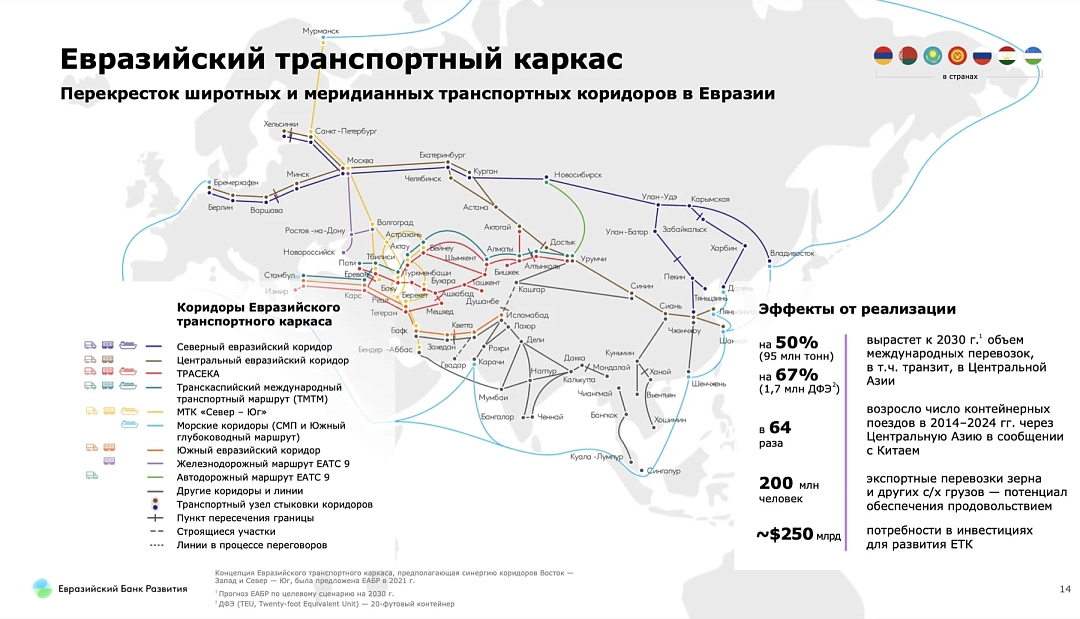
In 2024 a report was published setting out the development concept of the Eurasian transport framework
Contribution to the international agenda
The Eurasian transport framework is the Bank’s contribution to international efforts under the Awaza Programme of Action for Landlocked Developing Countries (2024-2034), as well as the UN Decade of Sustainable Transport (2026 – 2035). Developing the Eurasian transport framework brings together the efforts of all stakeholders – governments of the Eurasian region, business, multilateral development banks, international intergovernmental and non-governmental organisations, and the academic and expert community.

Facts and figures
The Eurasian transport framework is:
50,000 km
of railways along the main routes of five key transport corridors
>30
critical hubs of the ETF (transport hubs, major ports, track-gauge change points)
+23%
growth in container traffic in international services in 2021-2025
x25
growth in the number of container trains to China, including transit, in 2015-2025
>600 mln tonnes
5.8 mln
TEU transported in international services in 2025
Observatory of Eurasian transport framework projects
The Bank monitors and assesses the investment needs of the Eurasian region for the development of transport-corridor infrastructure (the report and interactive map are available in the Analytics section). The overall needs of 13 countries of the Eurasian region (beyond the Bank’s member states, they include Azerbaijan, Georgia, Mongolia, Turkmenistan and others) for the development of transport corridors through 2035 amount to:
Over $324 bn
that is 325 projects
- 60% are at the implementation stage
- 13% are at the design-documentation stage
- 27% are at the planning stage
113
projects envisage the participation of private capital and international development banks. The needs of Central Asian countries for the development of international transport-corridor infrastructure:
90 projects with a total value of 52.8 bn USD
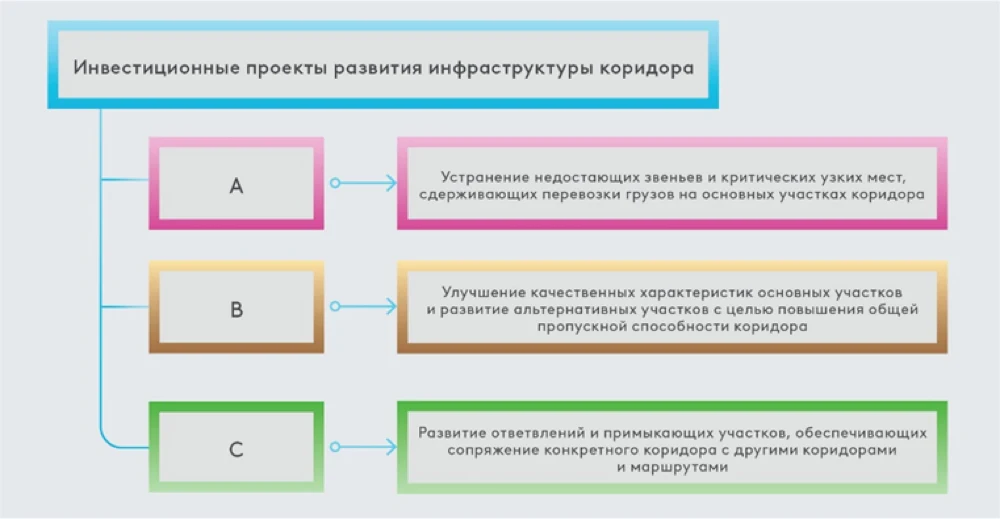
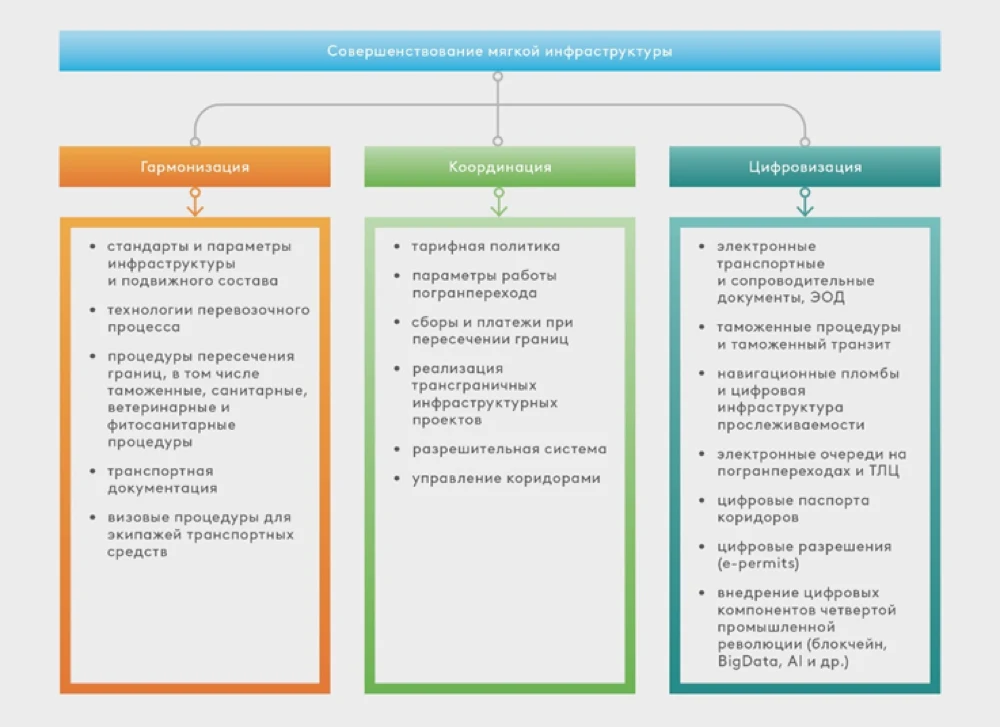
Directions for developing transport connectivity within the Eurasian transport framework