


Warehouse Infrastructure in Uzbekistan: Growth Potential and Investment Priorities
26 November 2026
SUMMARY
-
Warehouse infrastructure improves supply chain reliability and the competitiveness of Uzbekistan’s exports. For a double-landlocked country, modern warehouses link large international shipments with the day-to-day needs of retailers and businesses. They support inventory management, the consolidation of goods from different producers into export consignments, and the preservation of product quality over long transport routes.
-
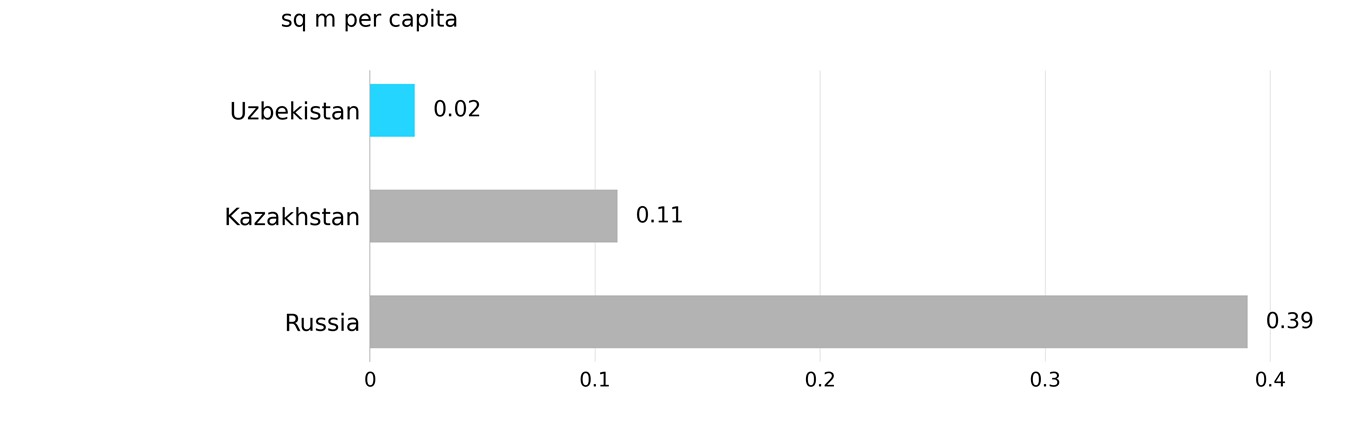
The shortage of modern capacity significantly limits options for businesses. In Q1 2026, the supply of quality warehouse space stood at only 0.02 sq m per capita, compared with 0.11 in Kazakhstan and 0.39 in Russia. Uzbekistan’s figure is 5–6 times lower than Kazakhstan’s and almost 20 times lower than Russia’s, while only 1.5% of Class A space was vacant.
-
Growth in domestic and foreign trade creates a long-term need for investment. According to EDB forecasts, total demand for modern warehouses could reach 5.9–7.6 million sq m by 2040, which is 7–10 times the stock at the end of Q1 2026 (about 0.8 million sq m). Around 80% of projected demand comes from retail and e-commerce, making distribution and fulfilment centres the main priority.
-
A portfolio of national and regional projects with complementary functions offers the greatest potential. The capital hub should be complemented by distribution and sorting capacity in the regions, particularly the Fergana Valley and Samarkand. Agrilogistics and cold-chain facilities close to producers preserve product quality and support exports, while industrial warehouses and transport terminals serve specific enterprises and cargo operations.
-
Despite high market potential, projects are being implemented cautiously. In spring 2026, around 370 thousand sq m of warehouse space was under construction or at the design stage, but many projects are being developed in phases. The first phases of DP World and Silkway Central Asia comprise about 63 thousand and 60 thousand sq m respectively, well below their announced full build-out, while construction of Wildberries’ 180 thousand sq m complex is planned for 2027–2028. This suggests that investors and developers are adding capacity in stages, tying later phases to actual utilisation and confirmed demand.
Warehouses link long-distance supply routes with everyday demand
Uzbekistan is one of only two double-landlocked countries in the world: it is landlocked and borders only other landlocked countries. The overland route to the nearest seaport therefore crosses at least two other countries. Long supply routes involve carriers and border agencies in several jurisdictions. For businesses, this means higher transport costs and a greater risk of delays: a late shipment of components can interrupt production, while delayed deliveries of goods can leave store shelves empty.
Modern warehouses help align large shipments with customers' day-to-day needs. A distribution centre receives large consignments, holds managed inventory and regularly replenishes customers’ stocks. For exports, the center consolidates goods from multiple suppliers, handles sorting and packaging, and prepares shipments for onward transport.
As a result, businesses gain more reliable supply and make better use of transport capacity, while helping to preserve product quality. Growing trade increases demand for these services.
Modern warehouse space remains scarce even by regional standards
The scale of the shortfall is evident in the amount of modern warehouse space per capita. Uzbekistan has 0.02 sq m of quality warehouse space per person, compared with 0.11 sq m in Kazakhstan and 0.39 sq m in Russia. Uzbekistan’s figure is 5–6 times lower than Kazakhstan’s and almost 20 times lower than Russia’s. The country therefore has to handle growing volumes of goods with a much smaller infrastructure base.
Figure 1. Quality warehouse space in Q1 2026, sq m per capita
Low provision is compounded by a limited choice of immediately available space. As of 31 March 2026, Class A and B warehouses totalled 795 thousand sq m; Class A accounted for 43.6%, or about 347 thousand sq m. Only 1.5% of Class A space was vacant. A company expanding its product range or sales network may therefore find it difficult to quickly secure a modern facility of the required size.
Figure 2. Structure of quality warehouse stock, thousand sq m
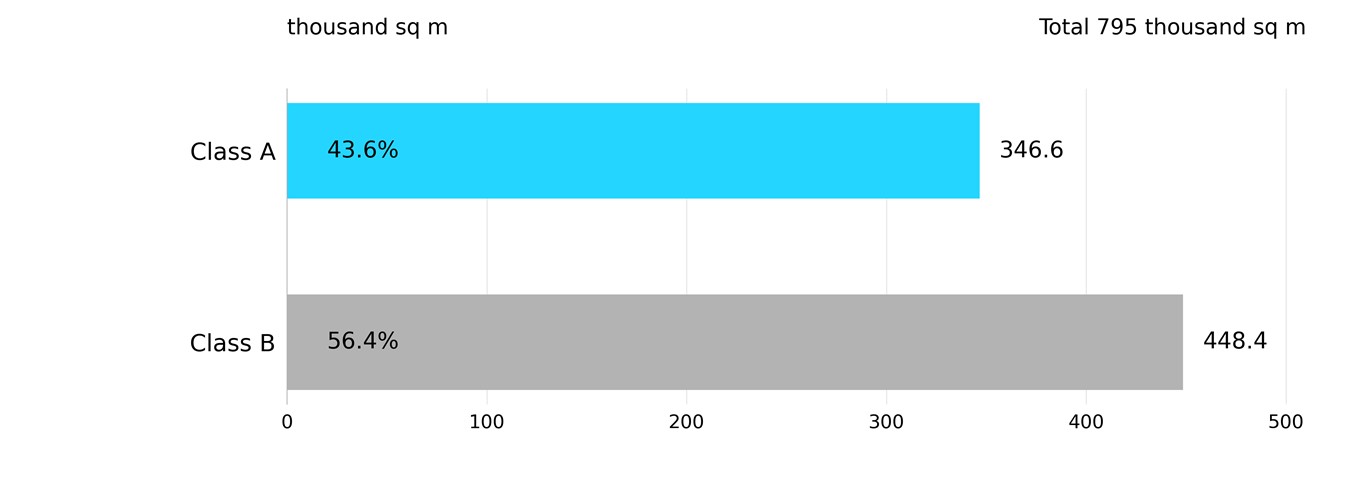
Source: IBC Global, as of 31 March 2026
Asking rents were about USD 12 per sq m per month for Class A and USD 10.6 for Class B, excluding VAT and operating expenses. A further 370 thousand sq m of warehouse space was under construction or at the design stage, equivalent to almost half of the existing stock. As new facilities enter the market, location, service quality and handling costs will increasingly influence tenant choice.
The composition of future demand will largely determine how the market develops. Trade expansion and the shift towards centralised distribution will be the main source of demand for new warehouse space.
Trade growth requires a warehouse system on a new scale
According to EDB estimates, Uzbekistan’s total demand for modern warehouse space could reach 5.9 million sq m by 2040 in the base case and 7.6 million sq m in the optimistic scenario. This is roughly 7–10 times the stock recorded at the end of Q1 2026. Meeting demand at this scale would require a nationwide storage, handling and distribution system, with each facility serving a defined customer base and catchment area.
Figure 3. Existing stock and projected requirement, million sq m
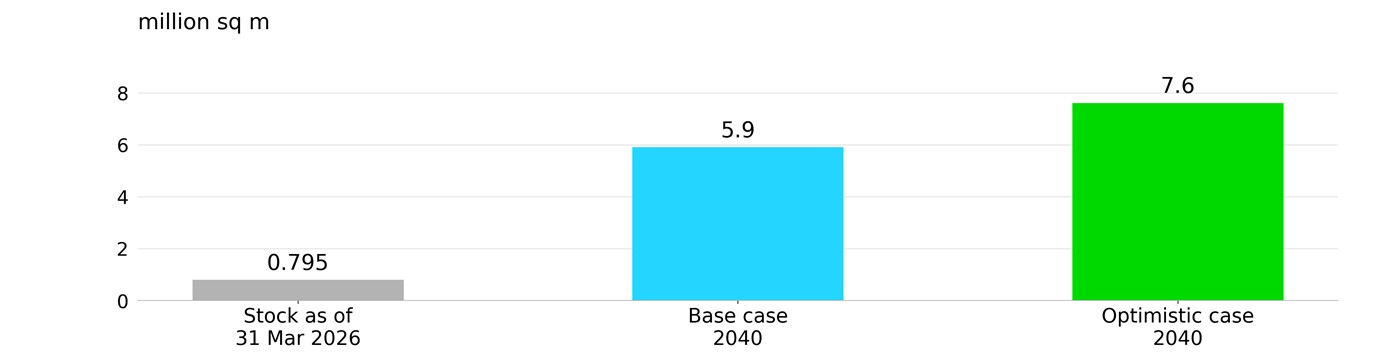
Sources: IBC Global – stock as of 31 March 2026; EDB – 2040 forecast.
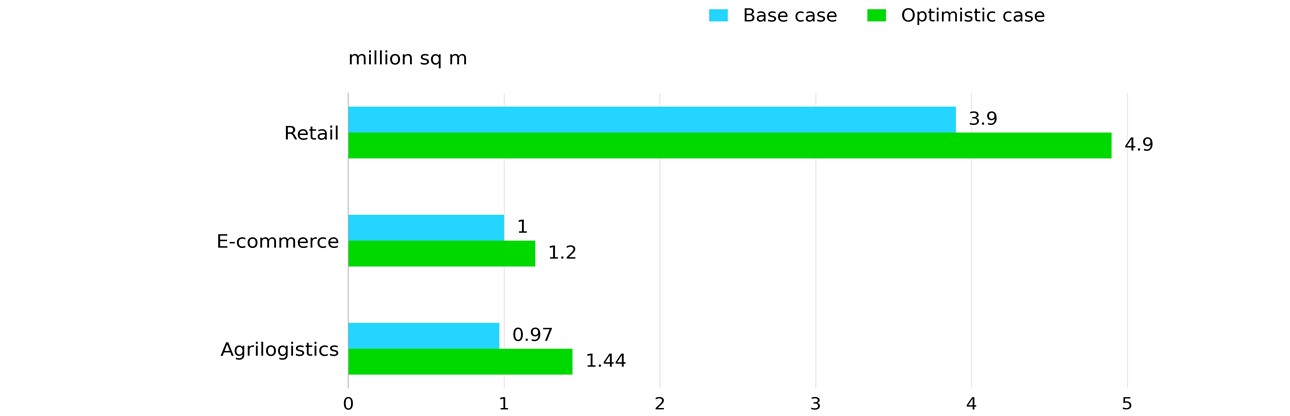
Around 80% of projected demand comes from retail and e-commerce. Retail could account for 3.9–4.9 million sq m and e-commerce for 1.0–1.2 million sq m. Distribution centres for retail chains and facilities for processing online orders will therefore form the core of the investment pipeline. Agrilogistics also generates demand for seasonal storage, product preservation and preparation of export consignments.
Figure 4. Requirement by key segment by 2040, million sq m
The economic value of a warehouse differs by segment. For retail chains, value comes from economies of scale in purchasing and regular store replenishment; for online sales, from the speed of order picking; and for agricultural producers, from preserving product quality and gaining access to buyers. These differences determine the choice of equipment and location as well as the operating model of future facilities.
Retail chains and online sales form the core of demand
Retail depends on regular deliveries of a broad product range. In January–June 2026, Uzbekistan’s retail turnover reached UZS 251.8 trillion, up 20.2% year on year. Wholesale turnover over the same period rose by 16.5% to UZS 283.3 trillion. As retail networks expand, procurement and receipt of goods become concentrated in distribution centers, from which deliveries are dispatched to individual stores.[6]
Centralised receipt of goods at a single distribution centre replaces numerous direct deliveries to stores. One example is Korzinka’s 49 thousand sq m distribution centre with four temperature zones. It combines ambient, chilled and frozen storage. The commercial basis for projects of this type is a long-term agreement with a retail chain and a clearly defined service area.[7]
E-commerce shifts the focus towards processing individual orders. E-commerce turnover increased from UZS 13.3 trillion in 2023 to UZS 31.6 trillion in 2025, a roughly 2.4-fold increase. Over the same period, retail turnover at current prices rose by 46% to UZS 481.2 trillion. Rapid growth in online sales increases the importance of picking, sorting, packaging and returns processing.
Figure 5. E-commerce is growing faster than retail
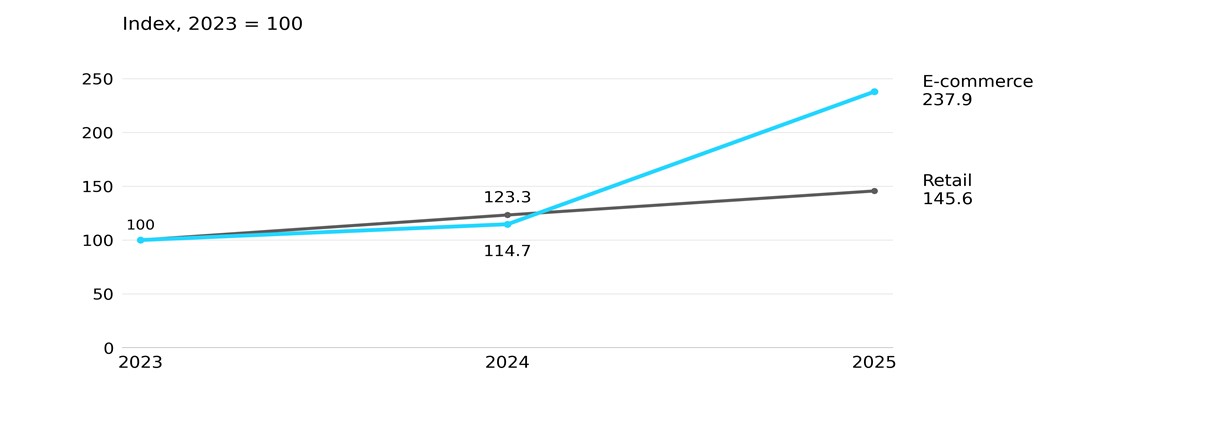
Source: National Statistics Committee, SIAT. Turnover at current prices; index, 2023 = 100. Retail; E-commerce
Fulfilment centres receive and store goods, pick and prepare online orders for dispatch. Regional sorting hubs bring orders closer to customers. Facility size and the degree of automation depend on order volumes, product range and peak loads. Processing capacity is becoming as important as storage area.
Agrilogistics preserves product value on the way to the customer
In food supply chains, reliable fulfilment must also ensure that products must retain their quality until they reach the customer. This gives agrilogistics a distinct investment role.
For producers, deterioration of product quality in transit means lost revenue. Agrilogistics therefore combines storage with preparation for sale, from pre-cooling to sorting and packaging to buyer specifications. EDB estimates that the segment could require around 1.0–1.4 million sq m by 2040. Key facilities should be located close to production areas and sales routes.
In H1 2026, Uzbekistan exported 1.09 million tonnes of fruit and vegetables worth USD 872.9 million. Fresh produce requires an uninterrupted cold chain: rapid cooling after harvest, appropriate storage conditions and coordinated refrigerated transport. Together, these preserve product quality over long routes to export markets.[8]
A regional agrilogistics centre consolidates output from several suppliers into consignments of the required volume and quality. A diversified product mix and a coordinated delivery calendar can spread utilisation across seasons. This full-service model, from storage and handling to certification, customs clearance and dispatch, is envisaged as a part of the ADB project in the Andijan and Samarkand regions.
For grains and oilseeds, preservation and inventory turnover are key. Grain elevators and warehouses with a combined capacity of 3.97 million tonnes were prepared for the 2026 harvest. Priority investments include receiving facilities, laboratory control, cleaning, drying and segregated storage. Proximity to processing plants and transport access help align seasonal grain inflows with year-round production.
Industrial companies need continuity of supply
Industry faces the same challenge of synchronising flows. Warehouses for raw materials and components support production continuity, while finished-goods warehouses allow shipments to be consolidated for dispatch. Such facilities should be located close to plants and industrial zones, with layouts and engineering systems tailored to the customer’s production processes.
Packaging, labeling and order assembly before dispatch are also in demand. For food, pharmaceutical and chemical cargoes, storage conditions and traceability requirements should be built in from the design stage. A facility has a sustainable commercial basis when its capacity is aligned with the production programme of a specific company or industrial cluster.
International flows create demand at cargo-handling nodes
Trade and industry require reliable access to international routes. In H1 2026, Uzbekistan’s foreign trade turnover reached USD 41.0 billion. Imports rose by 21% to USD 25.1 billion, while exports of goods excluding gold grew by 28.7% to USD 8.2 billion. These flows create a customer base for import distribution, preparation of export consignments and customs warehousing services.
Transit corridors create additional opportunities. In H1 2026, 9.7 million tonnes of transit cargo moved through Uzbekistan, 25% more than a year earlier. For investors, the most relevant nodes are those where transit cargo is transloaded, consolidated, cleared or placed in temporary storage, since these operations generate terminal revenue.
The commercial logic of a dry port or multimodal terminal begins with understanding where and why cargo needs to be handled. A project requires coordinated rail and road operations, convenient access and sufficient throughput capacity. Combining these functions at a single node allows consignments to be consolidated, transferred between transport modes and distributed within the country. As export, import and transit flows grow, temporary storage warehouses at border crossings and major transport hubs become increasingly important. They accommodate cargo during customs clearance, transloading and preparation for onward shipment, easing pressure on border infrastructure and making cargo flows more predictable.
Business investment decisions confirm the potential of the warehouse market
Companies in Uzbekistan are already implementing major projects to expand warehouse infrastructure. Investment comes from domestic retail and digital businesses as well as international logistics operators and investors. Projects span several segments, from transit and container logistics to retail, e-commerce, agrilogistics and specialised storage. This is consistent with the projected demand structure: EDB expects retail and e-commerce to generate the bulk of demand, with further demand from industry, agriculture and transport logistics.
International transport and transit logistics. One of the largest announced foreign projects is DP World’s multimodal terminal in the Yangi Avlod special industrial zone in Tashkent. The UAE-based operator established a joint venture with Tashkent Invest, with DP World holding 85% and its Uzbek partner 15%. Total investment exceeds USD 288 million. The project will be implemented in three phases on a site of about 82 ha. The first phase is expected to include a rail terminal with annual capacity of 150 thousand TEU and about 63 thousand sq m of Class A warehouses; subsequent phases envisage approximately 163 thousand sq m of additional warehouse space, subject to demand. The complex will combine a dry port, customs infrastructure, warehouses, cross-docking and a truck terminal, and will connect to the rail network, highways and Tashkent airport. Construction was scheduled to start in autumn 2026.
In the Yangiyul district of Tashkent region, Kazakhstan’s PTC Holding, together with Uzbekistan Temir Yollari, is implementing another major project, Silkway Central Asia. Construction of the first phase officially began in November 2025. The centre covers about 159 ha. The project includes a container terminal, warehouse infrastructure and an industrial zone; total warehouse area is expected to exceed 160 thousand sq m. In July 2026, a separate EPC contract was signed for about 60 thousand sq m of warehouse space, including a 41.5 thousand sq m Class A+ warehouse and an 18.4 thousand sq m multi-temperature complex. The project demonstrates foreign business interest not only in transit through Uzbekistan but also in domestic infrastructure for cargo handling, storage and distribution.
Retail and FMCG. Large retail chains are also moving towards centralised warehousing. In 2025, Korzinka commissioned a distribution centre of about 49 thousand sq m in the Yangi Avlod zone. The Class A facility has four temperature zones and 145 loading docks. It provides sorting, packaging and laboratory control. The project received international financing: IFC provided up to USD 25 million, and DEG provided a similar amount of long-term financing. The centre supports further expansion of the retail network and illustrates the shift of large retailers towards modern centralised supply chains and international warehouse operating standards.
E-commerce. International marketplaces view Uzbekistan both as a stand-alone market and as a base for cross-border trade. In October 2026, an investment agreement was signed with Wildberries to build a 180 thousand sq m Class A logistics complex in Tashkent region at an estimated cost of USD 140 million. Implementation is planned for 2027–2028. The company had previously identified Uzbekistan as one of its key international expansion markets; sales by Uzbek sellers on the platform exceeded USD 1 billion over two years.
At the same time, the domestic marketplace Uzum is rapidly expanding its own infrastructure. In 2026, the company reported that it had invested more than USD 500 million in digital solutions and infrastructure to date and planned to invest several hundred million dollars more in logistics and IT infrastructure. Capacity in Tashkent and the regions is expected to expand in 2026–2028; projects for a new sorting centre and a bulky-goods warehouse have already been launched. Following the expansion, Uzum expects to process up to 600 thousand items per day, while its regional network already includes cross-docking sites in Samarkand, Fergana, Jizzakh, Karshi, Namangan, Navoi, Bukhara, Urgench and Termez.
Agrilogistics and the cold chain. BMB–NRC Agrologistics in Jizzakh region is an example of a private cross-border project: an Uzbek–Russian complex covering 40 ha. The first phase was commissioned in 2023; the project comprises three phases with total design capacity of up to 810 thousand tonnes of products per year. The site includes refrigerated and ambient warehouses. It also provides sorting, processing and packaging, as well as customs, phytosanitary and laboratory services. The project is designed to consolidate products from farmers and processors for domestic and export markets.
Announced project scale still considerably exceeds the area actually under construction
In H1 2026, around 370 thousand sq m of warehouse space was under construction or at the design stage, equivalent to almost half of the existing quality stock. This estimate includes projects at different stages of preparation. The largest projects also use phased delivery: DP World has announced around 226 thousand sq m of warehouse space at full build-out, while the first phase includes about 63 thousand sq m; Silkway Central Asia envisages more than 160 thousand sq m, while the confirmed EPC contract covers about 60 thousand sq m. Wildberries has announced another 180 thousand sq m complex, but implementation is planned for 2027–2028.
Thus, despite the market’s substantial long-term potential, the amount of warehouse space investors plan to build in the initial phases remains relatively limited. This reflects a cautious approach by investors and developers: large projects are divided into phases, with subsequent expansion linked to actual utilisation, the emergence of anchor clients and confirmation of effective demand.
Tashkent's potential is complemented by a network of regional hubs
According to official estimates, 72% of warehouse space is concentrated in Tashkent and Tashkent region. The capital hub combines the country’s largest consumer market with national consolidation and import distribution. A regional network complements these functions by shortening the distance to customers, ensuring regular store replenishment and collecting goods closer to production areas.
Distributing functions among hubs makes it possible to align the scale of national centres with local demand. Priorities for each location depend on the combination of consumption, production and foreign-trade linkages.
Table 1. Most promising hubs for warehouse infrastructure development
|
Hub |
Economic role |
Priority facilities |
|
Tashkent and Tashkent region |
National consolidation, import distribution, largest consumer market |
Distribution and fulfilment centres, multi-client warehouses, urban sorting |
|
Fergana Valley |
Large consumer market, industry and agricultural production |
Regional distribution and sorting, cooling and packaging close to producers |
|
Samarkand |
Distribution in the central part of the country, consolidation of agricultural products |
Multi-temperature warehouses, sorting and preparation of export consignments |
|
Urgench and Khorezm |
Western consumption zone and local agricultural production |
Warehouses for retail chains and distributors, cold-storage capacity for the local product mix |
|
Termez and Surkhandarya |
Trade with Afghanistan and border cargo handling |
Transloading, temporary storage, customs services and temperature-controlled zones for cargo flows |
The first regional projects could include distribution and sorting capacity in the Fergana Valley and Samarkand. For agricultural products, the network should include collection and cooling points; for trade, regular routes for store replenishment and order delivery. The scale of each facility should be determined by the volume of customer operations within its service area.
Opportunities for developing Uzbekistan's warehouse infrastructure
Investment opportunities in Uzbekistan’s warehouse sector comprise a network of interconnected projects serving trade, industry and exports. The backbone of this network can consist of distribution and fulfilment centres linked to regional warehouses and sorting hubs. Agrilogistics complexes complement it by storing and preparing produce for sale, industrial warehouses ensure uninterrupted supply to enterprises, and terminals connect domestic distribution with international transport. For each facility, the combination of specialisation and location determines its customer base and the range of services required. Alongside greenfield development, there is also investment potential in upgrading existing warehouses to improve service quality and productivity at established sites.
These projects depend on long-term customer relationships and professional operations. Pre-leasing and built-to-suit development align facility specifications with business needs, while multi-client models and 3PL services broaden access to modern logistics. Digital management, automation and energy-efficient solutions improve investment returns when they match the planned use of the warehouse. The scale and phasing of investment should reflect confirmed demand, the availability of utility and transport infrastructure, and the time needed for projects to generate sustainable cash flow. This approach ties promising development areas to the conditions required for practical implementation.
Table 2. Warehouse infrastructure development areas and enabling factors
|
Investment priority |
What can be developed |
What can support development |
|
Distribution centres for retail |
Large Class A and B+ distribution complexes; multi-temperature warehouses; consolidation of supplies and servicing retail chains |
Long-term contracts with retailers; development of centralised distribution; built-to-suit (BTS) development and pre-lease agreements |
|
E-commerce and fulfilment |
Fulfilment centres; automated sorting and order picking; returns processing; last-mile logistics |
Modern warehouse and distribution solutions; long-term contracts with retail chains and digital platforms; WMS/TMS implementation; phased automation aligned with order intensity |
|
Regional warehouse network |
Distribution and sorting centres in Samarkand, the Fergana Valley, Urgench and other regional centres; regional warehouses for retail chains and distributors |
Locations close to consumer markets and transport hubs; coordinated development of central and regional warehouses; use of international multi-tier distribution network models |
|
Industrial and production logistics |
Warehouses for raw materials, components and finished goods; light-industrial production and warehouse units; logistics infrastructure in industrial zones |
Linking projects to industrial clusters and operating enterprises; shared infrastructure; long-term contracts with manufacturers; flexible facility layouts |
|
Agrilogistics and cold-chain infrastructure |
Regional agrilogistics centres; chilled and frozen warehouses; grain storage; sorting, packaging and primary processing |
Locations close to production and processing; contracts with suppliers and buyers; international food-safety and cold-chain standards; monitoring of storage conditions and batch traceability |
|
International transport and transit logistics |
Multimodal logistics centres; dry ports; container terminals; temporary storage warehouses; consolidation and transloading facilities |
Integration with rail and road corridors; development of containerisation; coordination of customs procedures; international practices for digital data exchange and multimodal transport |
|
Professional warehousing services and 3PL |
Contract warehousing; multi-client facilities; contract logistics; integrated storage, handling and delivery services |
Development of independent logistics operators; service standardisation; transparent tariff systems; entry of international 3PL companies and transfer of sector expertise |
|
Modernisation of existing warehouses |
Upgrading Class B and C warehouses; mechanisation of loading and unloading; racking systems; temperature control and digital inventory management |
Technical audits of existing facilities; selective upgrades based on customer requirements; improved energy efficiency; modern warehouse design and operating standards |
|
Specialised warehouse infrastructure |
Pharmaceutical warehouses; temperature-controlled zones; storage of chemicals and other goods with special requirements; specialized distribution centers |
Compliance with industry standards and safety requirements; development of monitoring and traceability systems; cooperation with specialized manufacturers and distributors |
|
Financing |
Built-to-suit (BTS) development; pre-leasing; project finance; PPPs for suitable facilities |
Confirmed cash flows and customer base; investor equity participation; phased capacity additions; start-up and working-capital reserves; risk allocation; specialised developers and real-estate investment funds (REITs) |
Source: EDB
Challenges facing the sector
A nationwide shortage of modern warehouses may coexist with local oversupply. The concentration of new projects in the Tashkent agglomeration can intensify competition for the same tenants, put downward pressure on rents and lengthen lease-up periods. At the same time, the limited supply of quality space in the regions lengthens supply routes and raises delivery costs. This creates a spatial mismatch between warehouse locations and the geography of demand from trade and industry. New projects therefore require careful assessment of local market capacity, the volume of space under construction and the ability of regional cargo flows to support commercially viable utilisation.
New space may also come on stream faster than effective demand grows. Growth in trade and e-commerce generates demand for logistics services, but companies need time to move to leasing modern warehouses and using professional operators. The absence of anchor clients, short-term contracts and reliance on a small number of major tenants make project income more vulnerable. For multi-client facilities, an additional challenge is the operator’s ability to balance different cargo flows, manage seasonality and maintain consistent service quality. Declared interest in a project and demand secured by contracts are therefore far from equivalent in terms of financial sustainability.
More sophisticated warehouses place higher demands on design quality and operating economics. Modern equipment and automation increase upfront capital requirements, while payback depends on the scale and nature of operations. Technical solutions that do not match tenants’ needs can result in either excessive capital expenditure or throughput bottlenecks. Cold-storage and automated facilities are particularly dependent on reliable power supply: limited grid capacity can constrain development, while outages create the risk of downtime and product spoilage. Grid connection costs, backup power, equipment maintenance and energy consumption can materially alter project economics relative to initial assumptions.
A separate challenge is that warehouse efficiency depends on infrastructure and procedures outside the facility itself. Limited access-road capacity, poor coordination between road and rail transport, and customs clearance delays can slow cargo turnover even in a modern complex. In Uzbekistan, these issues are amplified by the dependence of foreign trade on overland routes through neighboring countries, and hence on those countries’ tariff policies and border procedures. At the same time, proximity to an international transport corridor does not by itself guarantee demand for warehousing services. Terminal revenue depends on which cargo-handling operations are actually in demand at a particular node and on how competitive their cost and turnaround times are.
Taken together, these factors create a potential gap between investment outlays and the pace at which a project reaches sustainable cash flow. Major expenditure on land, utilities, buildings and equipment is incurred before full utilisation is achieved. Delays in infrastructure connections, higher construction costs or slower-than-planned tenant acquisition increase financing needs and lengthen payback periods. Further vulnerability arises from short loan tenors and currency mismatches between revenues and debt obligations. Projects whose financial sustainability depends on rapid lease-up, high rents and uninterrupted commissioning schedules warrant particular attention.