


Uzbekistan and the countries of Eurasia: investment cooperation
26 November 2026
Uzbekistan is among the leading countries in the Eurasian region in terms of foreign direct investment inflows. The country is strengthening investment ties with Central Asian countries and developing regional industrial cooperation. Key investors include China, the Gulf countries, Türkiye, the Republic of Korea and Japan.
SUMMARY
1. Uzbekistan ranks among the Eurasian region’s leaders in attracting foreign direct investment (FDI). Consistent government policies to improve the business and investment climate, attract foreign investors and protect their rights are supporting growth in FDI stock, infrastructure modernization and industrial cooperation.
2. The Eurasian region is an important source of investment for Uzbekistan. By mid-2026, investment stock reached $11.2 billion, up 17% from 2020. Russia remains the largest investor, while Kazakhstan’s role has strengthened in recent years. FDI stock is concentrated in the extractive and manufacturing sectors.
3. Uzbekistan is strengthening investment ties with Central Asian countries. Between 2020 and mid-2026, mutual FDI stock increased almost ninefold to $1.33 billion. Kazakhstan accounts for more than 90% of investment into Uzbekistan, mainly in construction and finance. Uzbekistan is also increasing investment in manufacturing in Kazakhstan and Kyrgyzstan, strengthening regional industrial cooperation.
4. Investment from Asian countries is the main driver of growth in Uzbekistan’s FDI stock. From 2020 to mid-2026, FDI stock from Asian countries rose more than sixfold to $33 billion. China and the Gulf states contributed most of the increase. FDI stock from Türkiye, the Republic of Korea, Japan, Indonesia, India and Vietnam is also growing.
5. China is the largest investor in Uzbekistan’s economy. Chinese FDI stock increased almost sevenfold to $13.8 billion by mid-2026. Greenfield projects account for a high share (92%), including power plants, vehicle assembly facilities and cement plants.
6. The Gulf states are among the fastest-growing sources of foreign capital in Uzbekistan. FDI stock expanded more than 25-fold to $11.3 billion by mid-2026, led by Saudi Arabia and the UAE. The power sector accounts for 92% of investment, mainly through large renewable energy projects.
7. Investment by Turkish companies in Uzbekistan is growing steadily, with investnebt stock rising almost sixfold to $3.3 billion. Around half of the FDI stock is in the power sector, with significant investment also in manufacturing and agribusiness.
8. The Republic of Korea has a substantial investment portfolio of $2.6 billion, concentrated mainly in gas chemicals, textiles and finance. Japan’s FDI stock has grown rapidly to $1.6 billion, driven by renewable energy projects.
1. Investment from the Eurasian Region
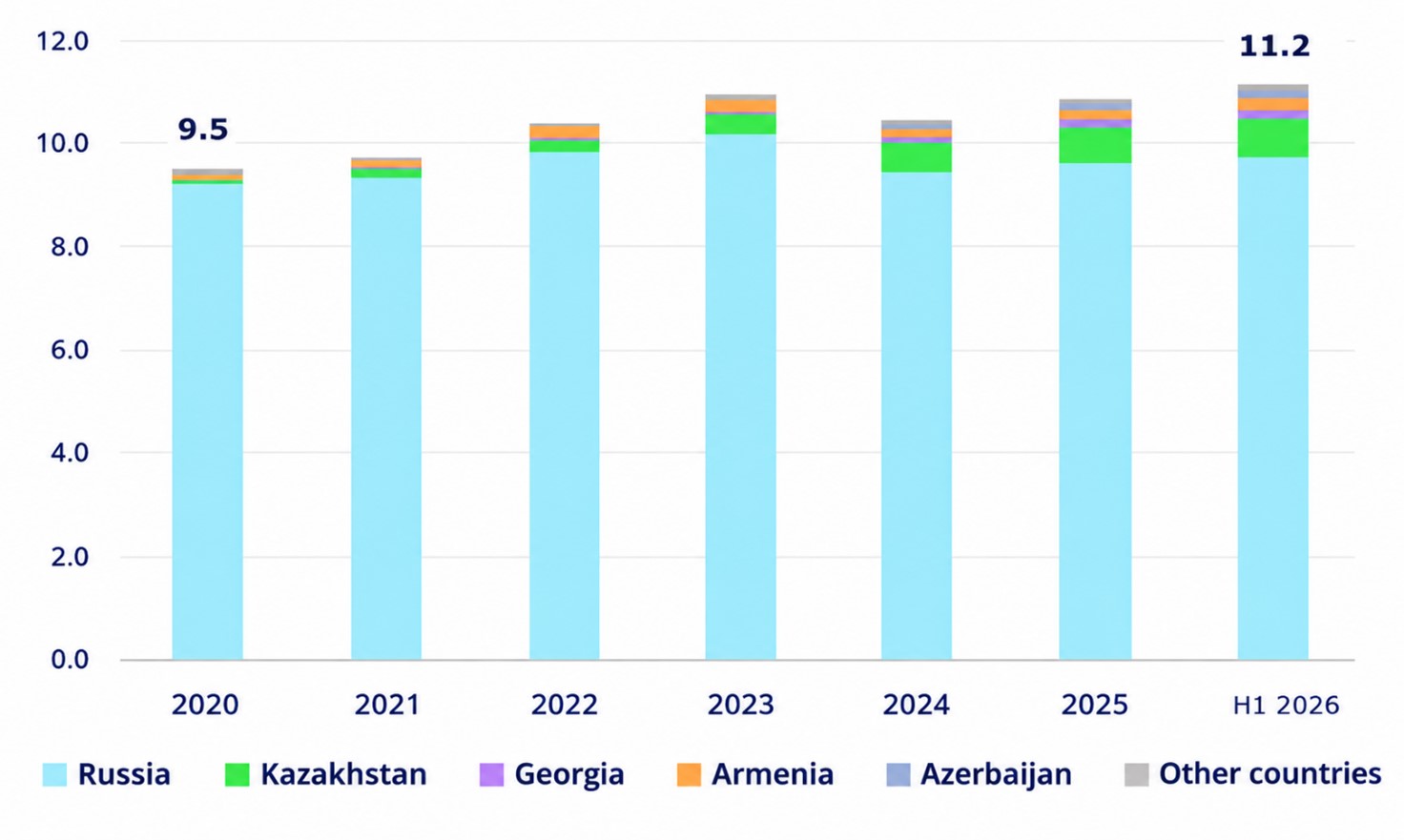
The stock of investment from the Eurasian region (CIS member states, Georgia and Mongolia) in Uzbekistan has shown a positive trend in recent years. It stood at approximately $9.5 billion in 2020 and reached $11.2 billion by the end of the first half of 2026 (H1 2026), an increase of around 17%.
Russia is the largest investor, accounting for the overwhelming share of investment stock originating from the Eurasian region. At the same time, the contribution of Kazakhstan has been increasing, particularly in 2024–2026. Companies from Georgia, Armenia, Azerbaijan and other countries in the region also invest in Uzbekistan.
Figure 1. Investment stock from the Eurasian region in Uzbekistan, $ billion
Source: EDB MMI database
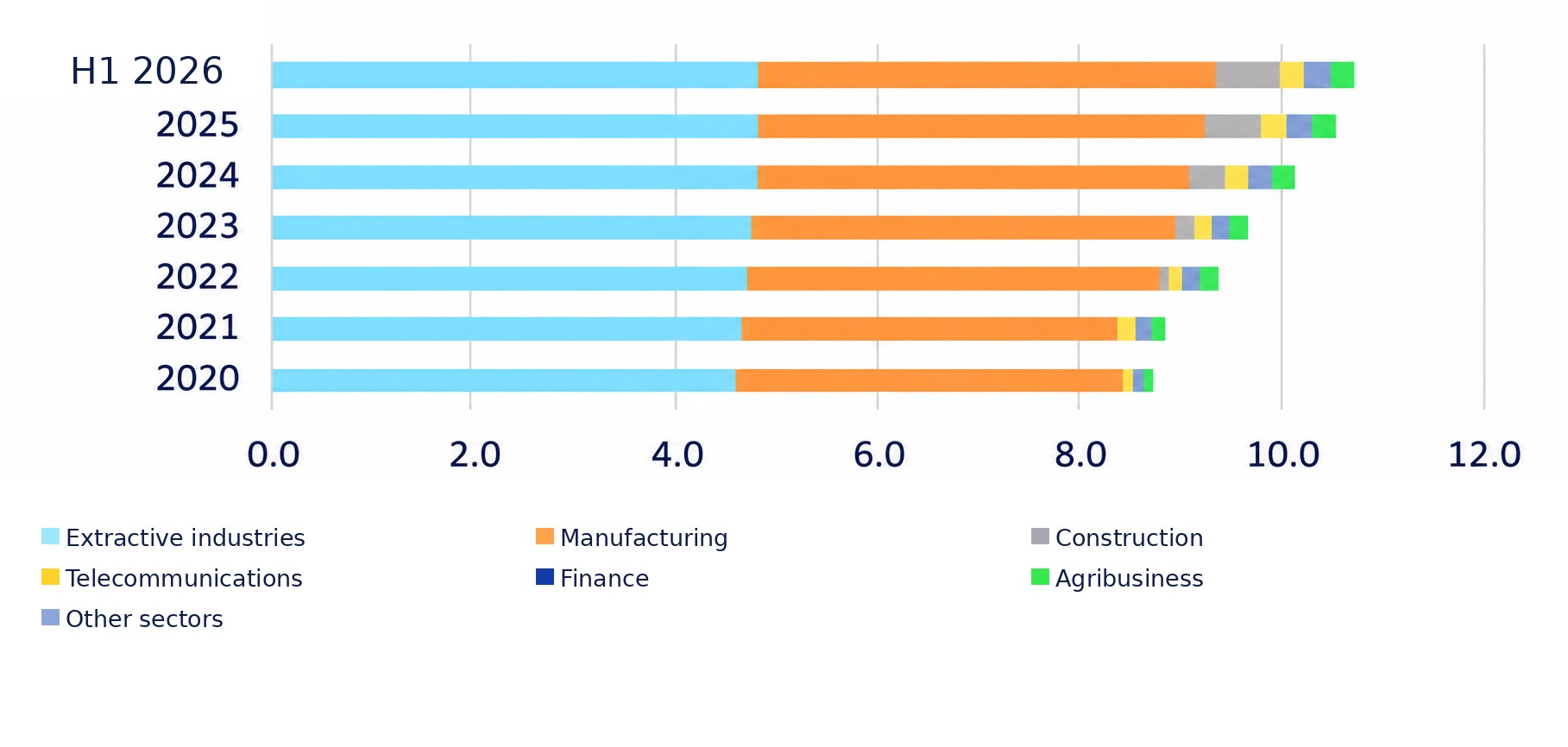
Investment stock from the Eurasian region is concentrated in the extractive and manufacturing sectors. Over the past six years, investment in extractive industries changed only marginally, from $4.6 billion to $4.8 billion, while manufacturing investment increased from $3.8 billion to $4.5 billion. Consequently, portfolio growth was driven primarily by processing industries and other non-extractive activities.
Sectoral diversification has also increased: by 2024–2026, construction, telecommunications, finance and agribusiness made a more visible contribution. Nevertheless, the extractive and manufacturing sectors continue to define the investment profile of Eurasian countries in Uzbekistan.
Figure 2. Investment stock from the Eurasian region in Uzbekistan by sector, $ billion
Source: EDB MMI database
The region’s largest investment projects in Uzbekistan are associated with the Russian oil company LUKOIL, including the Kandym Gas Processing Complex and the development of the Kandym–Khauzak–Shady and Gissar fields.
Greenfield investment accounted for 76% of the stock as of mid-2026. Private companies provided almost 90% of the FDI stock from the Eurasian region in Uzbekistan.
Central Asia
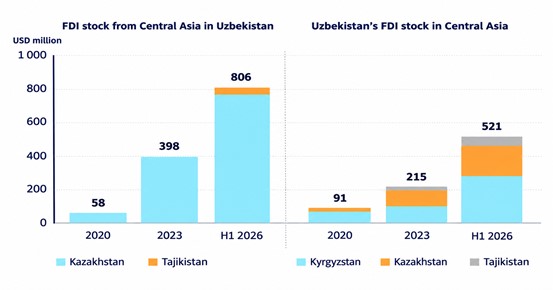
The stock of mutual investment between Uzbekistan and the countries of Central Asia increased almost ninefold, from $150 million in 2020 to $1.33 billion by mid-2026. Investment from neighboring countries into Uzbekistan grew particularly rapidly, almost 14-fold, to $806 million. Kazakhstan is the leading investor, accounting for more than 90% of this stock.
Uzbekistan’s investment stock in neighboring countries rose almost sixfold, from $91 million to $521 million. The main destinations are Kyrgyzstan (53%) and Kazakhstan (37%), which together account for 90% of Uzbekistan’s investment stock in the region.
Figure 3. Mutual investment stock between Uzbekistan and Central Asian countries by direction, $ million
Source: EDB MMI database
Construction dominates the sectoral breakdown of investment from Central Asian countries into Uzbekistan, accounting for around 70% of the total stock.
Kazakhstan’s BI Group plays a leading role, implementing large-scale residential development projects in Tashkent. Since 2020, the company has completed and continued developing dozens of projects, including the Yangi Baxt, Botanika Saroyi and Oybek residential complexes. Finance is the second-largest sector (15%). A landmark project was the establishment of Tenge Bank in 2019, a subsidiary of Halyk Bank. Investment cooperation is also expanding in transport and logistics: construction of the Silkway Central Asia logistics hub in Tashkent Region has begun with the participation of Kazakhstan’s PTC Holding. The total project cost is estimated at $300 million.
Alongside Kazakhstan, Tajikistan is gradually expanding its investment presence in Uzbekistan, primarily in manufacturing. Projects include fruit juice and metal briquette production in Surkhandarya Region, as well as cable and wire manufacturing in Fergana Region.
Manufacturing accounts for the largest share (78%) of Uzbekistan’s investment stock in Central Asia, reflecting the production capabilities of Uzbek companies and their growing presence in neighboring markets.
Major investment projects involving Uzbekistan in Central Asia include the development of cement production in Kyrgyzstan; Chevrolet Onix assembly at the SaryarkaAvtoProm plant in Kostanay; household appliance manufacturing in Saran with the participation of Artel; and the establishment of textile enterprises in Kazakhstan’s Turkistan Region.
Thus, Uzbekistan’s outward investment is mainly directed toward developing production capacity and localizing manufacturing, providing a successful example of industrial cooperation with neighboring countries.
2. Investment from Asian Countries
The stock of investment from Asian countries in Uzbekistan has expanded rapidly, rising from $5.4 billion in 2020 to $33 billion by the end of H1 2026, an increase of more than sixfold. China, the Gulf states, Türkiye, the Republic of Korea and Japan are the leading investors, underpinning the rapid expansion of Asian investment in the country.
2.1. China
Between 2020 and H1 2026, China’s investment stock in Uzbekistan increased almost sevenfold, from $2.1 billion to $13.8 billion. Growth accelerated particularly strongly from 2023, when large projects in power generation and manufacturing began to be implemented. Over the past two and a half years alone, the stock rose 2.6-fold, from $5.3 billion in 2023 to $13.8 billion by mid-2026.
Table 1. China’s investment stock in Uzbekistan, $ billion
|
2020 |
2021 |
2022 |
2023 |
2024 |
2025 |
H1 2026 |
|
2.1 |
2.5 |
2.8 |
5.3 |
8.2 |
11.5 |
13.8 |
Source: EDB MMI database
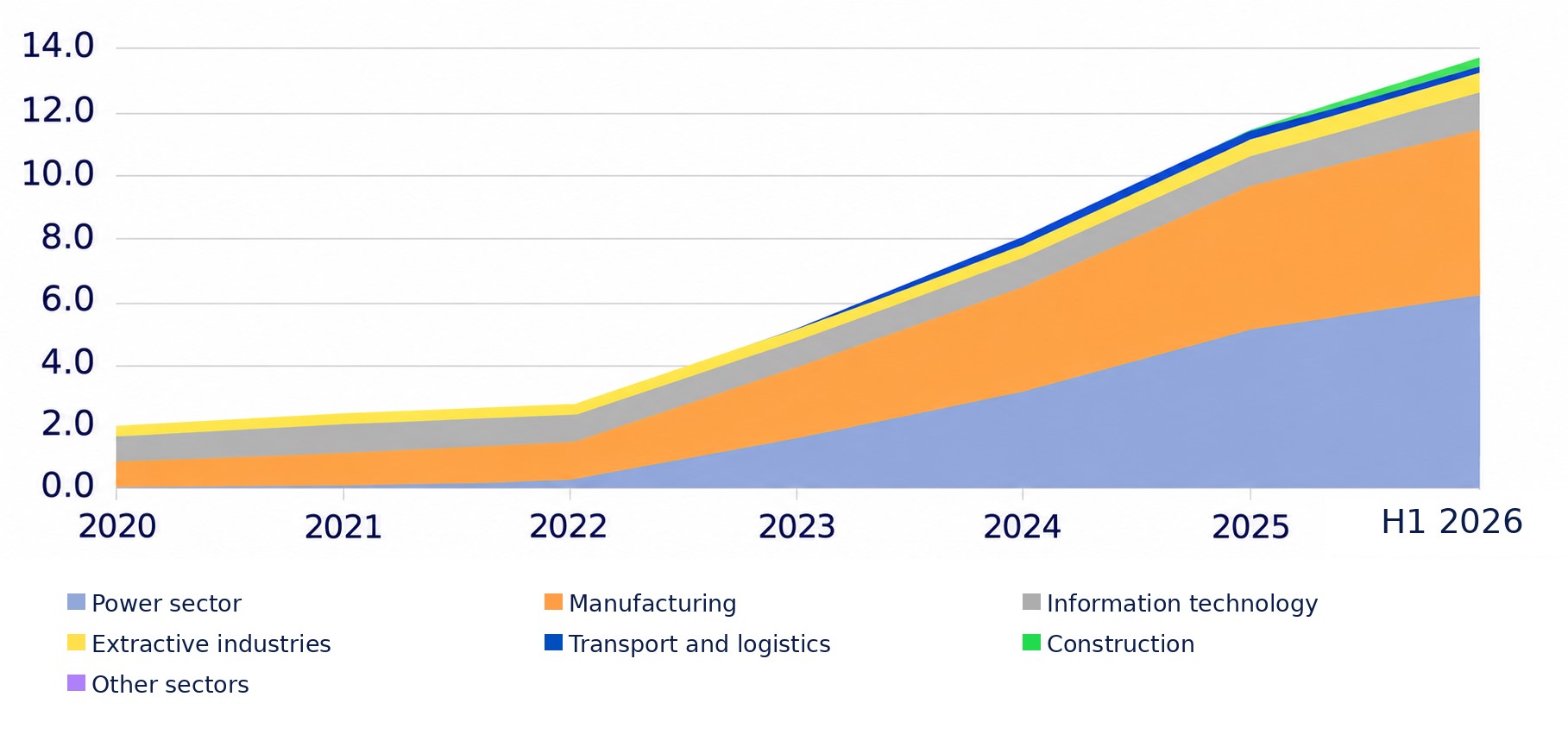
The power sector and manufacturing have become the main investment destinations, accounting for more than 80% of China’s total FDI stock in Uzbekistan by mid-2026. The most pronounced structural change occurred in the power sector: investment increased from a negligible level in 2020–2022 to $6.3 billion, or around 45% of the overall portfolio.
Manufacturing investment also expanded substantially, reaching $5.3 billion, or approximately 38% of the total. This sectoral profile is reflected in the mode of investment: 92% is attributable to greenfield projects, which create new production and infrastructure capacity.
Figure 4. China’s investment stock in Uzbekistan by sector, $ billion
Source: EDB MMI database
Major operating investment projects involving Chinese partners are concentrated in manufacturing and the power sector. Examples include BYD Uzbekistan Factory, a joint venture between China’s BYD and Uzavtosanoat JSC in Jizzakh Region; assembly of EXEED, Shineray and Wuling vehicles at Asaka Motors; and approximately ten cement plants across the country with the participation of leading Chinese investors, including Anhui Conch Cement and Huaxin Cement.
The EDB MMI database also records 30 projects in the power sector, around half of which are renewable energy projects.
2.2. Gulf States
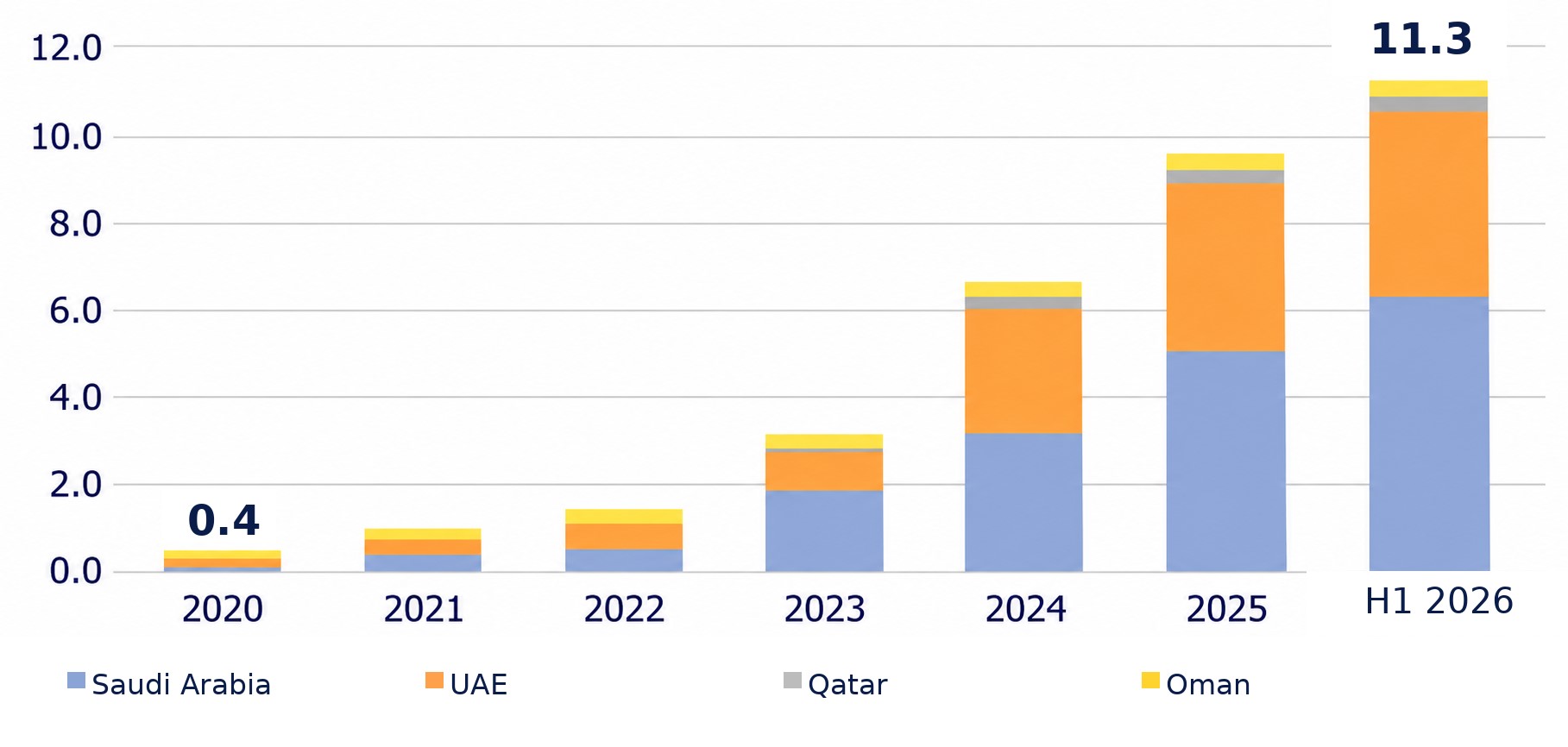
Investment stock from the Gulf states in Uzbekistan has grown particularly rapidly since 2022. From just $0.4 billion in 2020, it reached approximately $3 billion in 2023 and exceeded $11 billion by the end of H1 2026. Over the period, the portfolio expanded more than 25-fold, with most of the increase occurring in the past three years. Greenfield projects account for a dominant 88% of the investment stock.
The geographic composition of investment has also changed significantly. Saudi Arabia has become the leading investor, expanding its presence from a relatively low base to around $6.5 billion by mid-2026. Saudi investments now represent slightly more than 55% of Uzbekistan’s total FDI stock from the Gulf states.
Figure 5. Investment stock from Gulf states in Uzbekistan by investor country, $ billion
Source: EDB MMI database
The UAE is the second-largest Gulf investor in Uzbekistan. Its FDI stock also grew strongly, exceeding $4 billion in H1 2026, or roughly 40% of the Gulf portfolio. Oman and Qatar also invest in Uzbekistan, with each accounting for around $0.3 billion, or approximately 3% of the total stock.
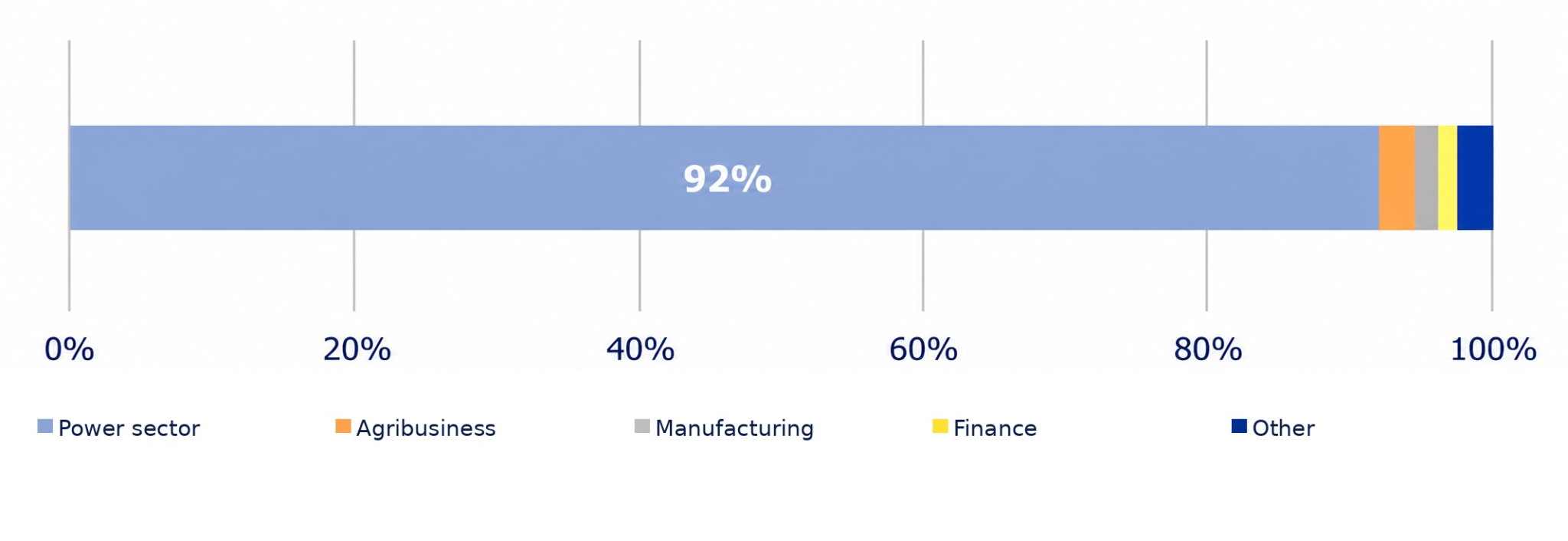
Figure 6. Sectoral breakdown of investment stock from Gulf states in Uzbekistan, H1 2026, %
Source: EDB MMI database
Investment stock from Gulf states in Uzbekistan is highly concentrated in the power sector, which accounts for around 92% of the total. Large solar and wind farms, gas-fired power plants and energy storage systems form the core of the portfolio.
The leading Gulf investors are Masdar (UAE) and ACWA Power (Saudi Arabia). Major completed projects include Masdar’s 500 MW wind farm in Zarafshan; the Bash and Dzhankeldy wind farms in Bukhara Region, with a combined capacity of 1 GW; and a 1.5 GW gas-fired power plant in Syrdarya Region involving ACWA Power. Work continues on Tepelen Group projects in Namangan Region, the 1.5 GW Kungrad Wind project in Karakalpakstan, and solar generation with battery energy storage systems in Samarkand Region.
Gulf investment is gradually diversifying across sectors. In digital infrastructure, Saudi Arabia’s DataVolt is completing construction of a data center in Tashkent. In 2025, Riyadh Cables Group acquired a controlling interest in Artikul Aziya Kabel, an Uzbek cable manufacturer. Transport infrastructure is another emerging area: Saudi Arabia’s Vision Invest is participating in an international consortium to build a new Tashkent airport, currently in preparation for the main implementation phase.
Thus, while the power sector continues to dominate, Gulf investment is gradually expanding into manufacturing, digital infrastructure and transport infrastructure.
2.3. Türkiye
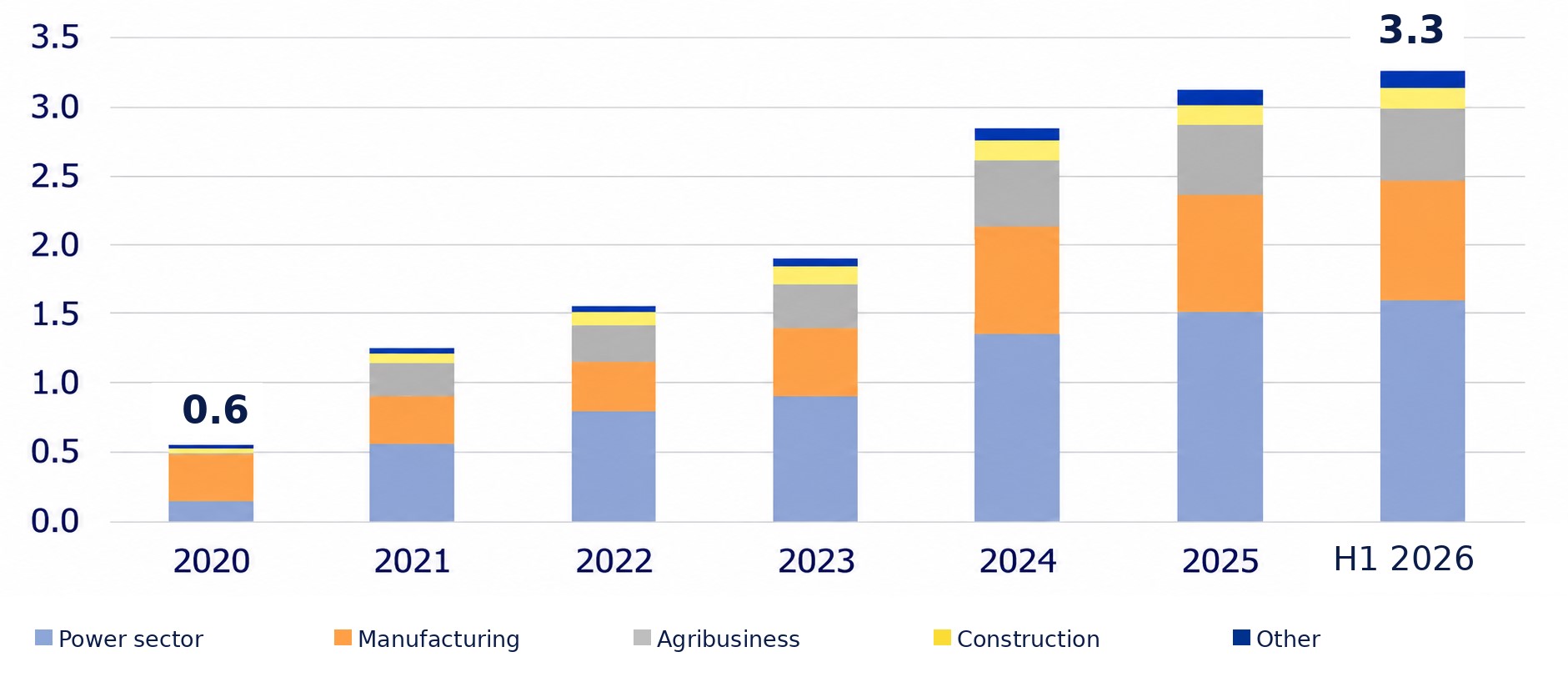
Investment stock from Türkiye in Uzbekistan has increased steadily in recent years, rising from approximately $0.6 billion in 2020 to $3.3 billion by the end of H1 2026. The Turkish portfolio therefore expanded almost sixfold over six years.
The power sector has been the main growth driver. Its share of the portfolio was relatively small in 2020, but by mid-2026 investment stock in this sector had reached around $1.6 billion, or approximately half of all Turkish investment in Uzbekistan. Manufacturing is the second-largest sector, with investment nearing $0.9 billion. Agribusiness investment has also grown, exceeding $0.5 billion. Construction and other sectors remain relatively small.
Figure 7. Türkiye’s investment stock in Uzbekistan by sector, $ billion
Source: EDB MMI database
A distinctive feature of Turkish investment is the high share of greenfield projects, accounting for almost 90% of the stock. Most capital is therefore directed toward establishing new facilities, expanding production capacity and creating jobs.
The largest Turkish investment projects in Uzbekistan include power-sector facilities, such as a 550 MW combined-cycle power plant in the Jizzakh region developed with the participation of Cengiz Enerji. Aksa Energy has commissioned four gas-fired power plants in Tashkent, Bukhara and Kashkadarya Regions, with a combined capacity of 1.22 GW.
Coca-Cola İçecek (Anadolu Group), which operates five beverage plants in different parts of the country, is a major manufacturing investor. The company opened a new plant in Samarkand in 2024 and another in Namangan Region in 2026. The Uzbekistan–Türkiye OSTIM Global industrial zone in Tashkent Region, valued at
$150 million, is also developing and hosts projects by Turkish manufacturing companies.
2.4. Other Asian Countries
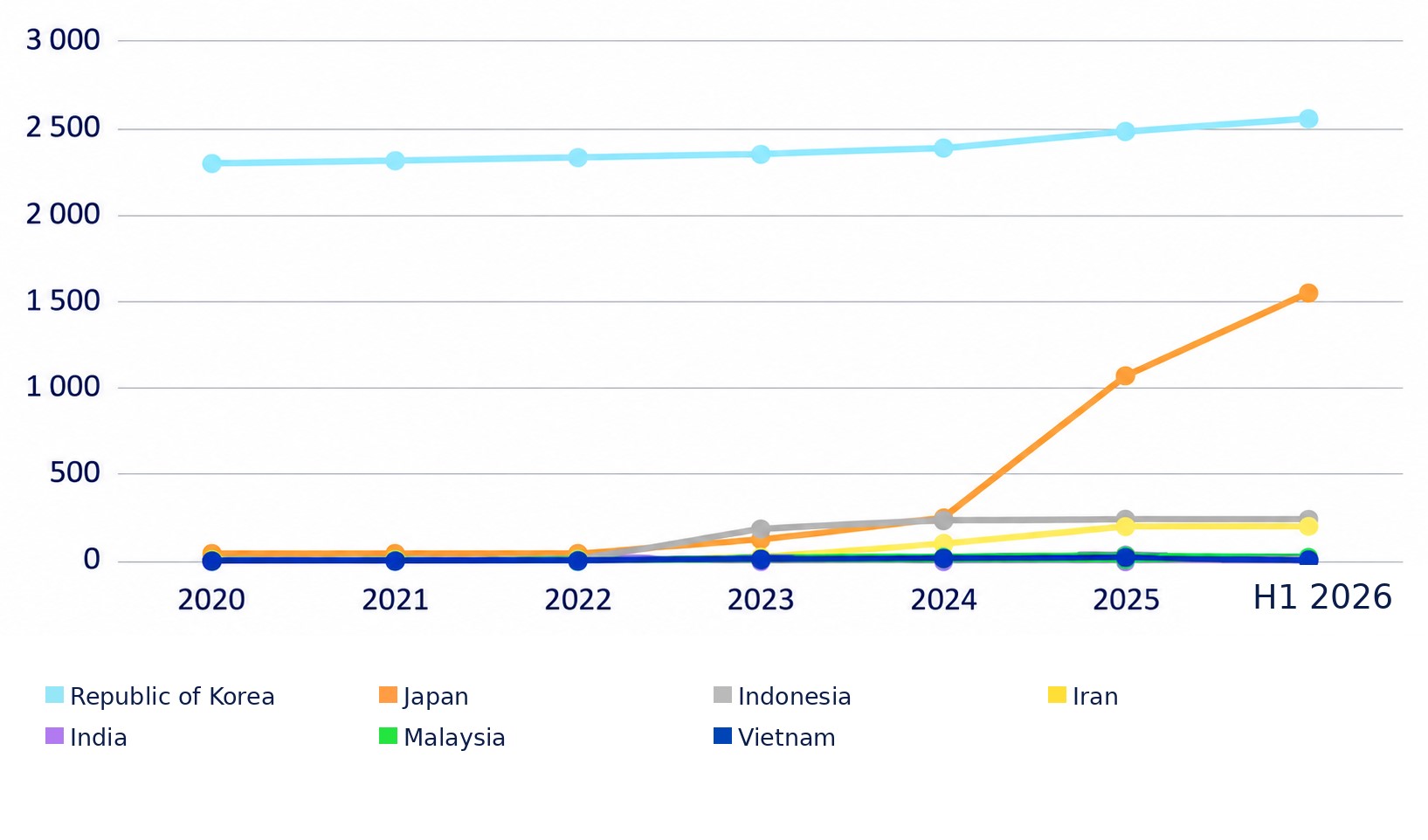
Investment stock from other Asian countries in Uzbekistan showed a marked upward trend between 2020 and H1 2026. The total nearly doubled, from around $2.3 billion in 2020 to more than $4.5 billion by the end of H1 2026. The composition of investment remained relatively stable until 2022, with most growth occurring from 2023–2024 onward.
Figure 8. Investment stock from other Asian countries in Uzbekistan, $ million
Source: EDB MMI database
The Republic of Korea has remained the largest investor in this group throughout the period. Its investment stock rose gradually from approximately $2.3 billion in 2020 to $2.6 billion by mid-2026. Korean investment has therefore been stable, but has grown more slowly than investment from Uzbekistan’s other Asian partners. As a result, Korea’s share of the group total has declined despite its continued lead in absolute terms.
One of the largest Korean projects is the Ustyurt Gas Chemical Complex (Uz-Kor Gas Chemical), valued at around $4 billion and implemented by a Korean consortium comprising Lotte Chemical, KOGAS and GS E&R, which owns 50% of the joint venture. The complex has operated since 2016 and is one of the country’s major producers of polymers. In finance, KDB Bank Uzbekistan is an important project in which Korea Development Bank holds a controlling stake. In the manufacturing sector, POSCO International Corporation is one of the key investors, developing textile production.
The most notable change concerns Japan. Japanese investment has risen sharply since 2023, exceeding $1 billion in 2025 and reaching approximately $1.6 billion by the end of H1 2026. The power sector is becoming the main driver of Japanese investment in Uzbekistan.
Major Japanese projects include construction of the Kungrad Wind farm in Karakalpakstan and Sazagan Solar plants in Samarkand Region. These are being implemented jointly with Saudi Arabia’s ACWA Power, with participation from Japan’s Sumitomo Corporation, Shikoku Electric Power and Chubu Electric Power. In the automotive sector, a major development was Sojitz Corporation’s acquisition of a stake in ADM Global’s vehicle distribution business in 2025, aimed at expanding automotive distribution and industrial cooperation.
Indonesia and Iran have also significantly expanded their presence. By mid-2026, Indonesia’s investment stock had reached $0.25 billion, while Iran’s stood at approximately $0.2 billion, making both countries notable investors in Uzbekistan.
Investment from India, Malaysia and Vietnam remains relatively small, generally not exceeding a few tens of millions of US dollars for much of the period. Although investment increased somewhat in 2023–2025, especially from India and Vietnam, their contribution to the overall portfolio remained limited by mid-2026.