


Central Asia’s Transport Links with China
19 November 2026
Freight between Central Asian countries and China is transported by rail, road, pipeline, and air, as well as through multimodal services. This review focuses on rail and road freight transport.
SUMMARY
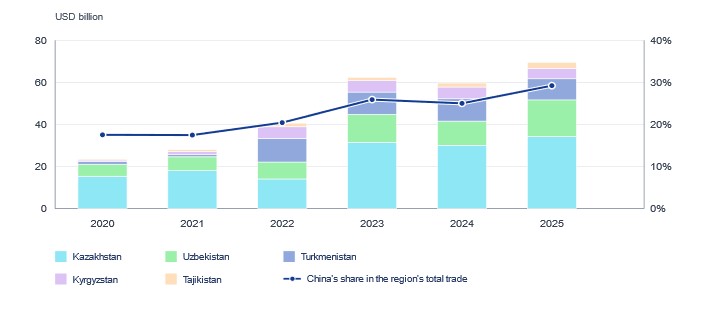
- Transport connectivity between Central Asia and China has expanded rapidly, driven primarily by growing trade. Between 2020 and 2025, trade between China and the five Central Asian countries increased approximately threefold, from US$23.5 billion to nearly US$70 billion. By 2025, China had become Central Asia’s leading trading partner, accounting for almost 30 per cent of the region’s merchandise trade.
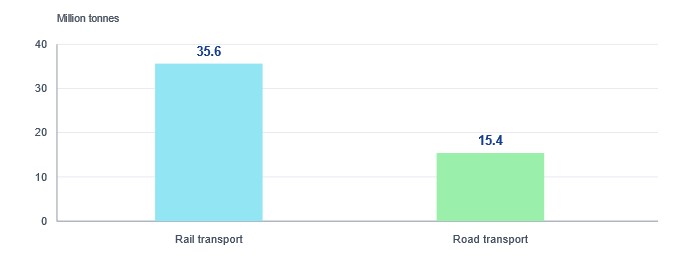
- In 2025, a total of 51 million tonnes of freight was transported between Central Asia and China by rail and road. Road freight accounted for 15.4 million tonnes, while rail freight amounted to 35.6 million tonnes. Freight flows continued to grow in 2026, increasing by 8 per cent in the first ten months compared with the same period in 2025.
- Kazakhstan accounts for 84 per cent of freight transported between Central Asia and China, including transit traffic originating in or destined for China. All rail freight movements between China and Central Asia pass through Kazakhstan, while international road freight uses border-crossing points between China and Kazakhstan, Kyrgyzstan and Tajikistan. Multimodal rail-road shipments to Uzbekistan, which totalled 1.8 million tonnes in 2025, transit through Kyrgyzstan.
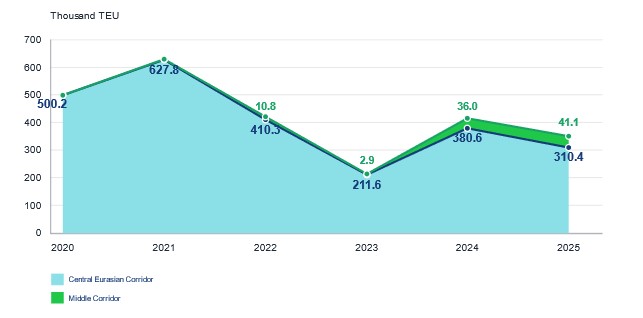
- Container transit along the China–Europe–China routes via Central Asia exceeded 351,000 twenty-foot equivalent units (TEUs) in 2025. According to the summary data, 310,000 TEUs moved along the Central Eurasian Corridor using UTLC-ERA services, while more than 41,000 TEUs were transported via the Middle Corridor.
- Growth in freight volumes is supported by substantial investment in transport infrastructure. In 2025, transport infrastructure projects with a total value of US$6 billion were commissioned across Central Asia. One of the largest completed projects was the modernisation of the 836-kilometre Dostyk – Mointy railway section in Kazakhstan.
- Construction of the China – Kyrgyzstan - Uzbekistan and Ayagoz - Bakhty railways, development of a third railway border crossing between Kazakhstan and China, and completion of the Mointy - Kyzylzhar railway are expected to increase freight capacity and strengthen Central Asia’s role as a Eurasian transport and logistics hub.
- China is actively involved in developing transport infrastructure in Central Asia. More than 20 projects involving Chinese companies, with a combined investment value exceeding US$12 billion, are under way. Funding provided by Chinese sources—including loans, grants and foreign direct investment—exceeds US$7 billion. Most of these projects are associated with the Belt and Road Initiative (BRI).
Historical Background
For much of the twentieth century, Central Asia and China remained relatively disconnected, with limited direct transport links between them until the 1990s.
A key constraint was the lack of transport corridors linking the Soviet Union and China through Central Asia. During the Soviet period, trade and freight movements between the two sides were routed primarily through border crossings in the Soviet Far East or via Far Eastern seaports.
The limited number of border-crossing points (BCP) reflected the underdeveloped state of cross-border transport connectivity at the end of the twentieth century. Until 2000, there were only three border crossings with China (Table 1): one railway BCP - Dostyk in Kazakhstan and two road BCPs—Torugart in Kyrgyzstan and Bakhty in Kazakhstan.
Table 1. The chronology of transport connectivity between Central Asia and China is directly linked to the opening of new BCPs
|
BCP* |
Mode of transport |
Country |
Year of opening |
|
Torugart / Turgut |
Road |
USSR, Kyrgyzstan |
1983 |
|
Druzhba (Dostyk) / Alashankou |
Railway |
USSR, Kazakhstan |
1990 |
|
Bakhty / Pokitu |
Road |
USSR, Kazakhstan |
1991 |
|
Kalzhat / Dulaty |
Road |
Kazakhstan |
2000 |
|
Irkeshtam / Irkeshtam |
Road |
Kyrgyzstan |
2002 |
|
Maikapchagai / Zimunai |
Road |
Kazakhstan |
2002 |
|
Kulma / Karasu |
Road |
Tajikistan |
2014 |
|
Nur-Zholy / Khorgos |
Road |
Kazakhstan |
2018 |
|
Altynkol / Khorgos |
Railway |
Kazakhstan |
2018 |
|
Bedel / Bedel |
Road |
Kyrgyzstan |
2024 |
|
Dostyk / Alashankou |
Road |
Kazakhstan |
2025 |
|
Bakhty / Chuguchak |
Railway |
Kazakhstan |
2027, expected |
|
Torugart / Turgut |
Railway |
Kyrgyzstan |
2028, expected |
*) The names of BCPs on the Central Asian side and those on the Chinese side.
Trade Growth as a Driver of Improved Transport Connectivity
According to data from the national statistical agencies of the Central Asian countries, trade between China and the five countries of the region—Kazakhstan, Kyrgyzstan, Tajikistan, Turkmenistan and Uzbekistan—increased approximately threefold between 2020 and 2025, from US$23.5 billion to nearly US$70 billion.
The export capacity of Central Asian economies has continued to strengthen amid sustained socioeconomic development. At the same time, demand for goods produced in China has increased.
Kazakhstan is China’s largest trading partner in Central Asia, accounting for approximately half of the region’s total trade with China. Trade between Uzbekistan and China has also expanded, reaching US$17.5 billion in 2025 (Figure 1).
Trade between Kyrgyzstan and China approached US$5 billion, while trade between Tajikistan and China reached US$2.9 billion. Both countries import substantially more from China than they export to it.
Turkmenistan’s trade with China is based primarily on natural gas exports, which largely determine the mode of transport used: pipeline plays a major role in supporting trade and economic ties between the two countries.
Figure 1. Trends in bilateral trade between Central Asian countries and China, in billions of dollars (left scale) and China’s share of Central Asian countries’ total merchandise trade, % (right scale)
Sources: National statistical agencies of Central Asian countries, TradeMap.
In 2025, China became Central Asia’s leading foreign trade partner, accounting for almost 30 per cent of the region’s merchandise trade, compared with 17–18 per cent in 2020–2021.
According to estimates by the International Trade Centre (ITC), a joint agency of UNCTAD and the WTO, the untapped trade potential between China and the Central Asian countries is estimated at approximately US$39.3 billion—equivalent to around 55 per cent of the value of trade in 2025.
International Freight Transport
Freight between Central Asia and China is transported by rail, road, pipeline and air, as well as through multimodal services. This brief focuses on rail and road freight transport.
In 2025, 51 million tonnes of freight were transported by rail and road. This total includes exports, imports and transit traffic moving through Central Asian countries (Figure 2).
Kazakhstan accounts for the largest share of freight flows between China and Central Asia, handling approximately 84 per cent of the total.
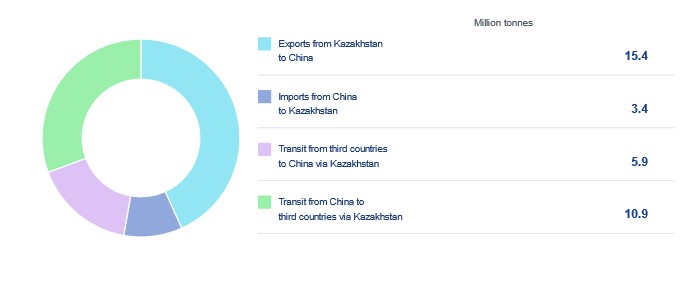
Railways accounts for approximately 70 per cent of freight volumes transported between Central Asia and China. All rail freight movements between the two sides currently pass through two railway BCPs between Kazakhstan and China: Dostyk and Altynkol (Figure 3).
Figure 2. Volume of freight traffic between Central Asia and China in 2025, in millions of metric tonnes
Source: EDB analysts’ calculations.
Figure 3. Volume of rail freight traffic with China via the Kazakhstan railways network in 2025, in millions of metric tonnes
Sources: KTZ National Company JSC, calculations by EDB analysts
Cargo transported by rail from Kazakhstan to China includes metal ore, agricultural products (including grain), chemicals, and foodstuffs. In the opposite direction, rail cargo includes machinery and equipment, electronics, construction materials and chemicals, as well as a wide range of consumer goods.
From January to October 2026, the volume of rail freight traffic totalled 31.8 million metric tonnes, marking an 8% increase compared to the same period in 2025.
In recent years, the volume of freight transported by road has increased.
In 2025, a total of 1.8 million metric tons of cargo was transported between China and Uzbekistan via Kyrgyzstan. This was over 50 times the volume transported along this route in 2020 (33,700 tonnes). These shipments are multimodal, with cargo transported by rail through China before being transferred to trucks.
Road transport between China and Central Asia is growing faster than rail freight. This trend is driven by several factors:
- The growth of small and medium-sized enterprises (SMEs) in Central Asia, many of which require transport services for smaller consignments.
- The liberalisation of international road transport with China. Over the past decade, China and countries across Eurasia have concluded new bilateral agreements on international road transport. These agreements allow road transport operators from Eurasian countries to deliver freight to destinations within China and Chinese carriers to operate in Central Asian countries. This has simplified cross-border operations and reduced the need for cargo transshipment near the border.
- China’s accession to UN transport agreements and conventions, including the 1975 Customs Convention on the International Transport of Goods under Cover of TIR Carnets (TIR Convention), which has facilitated customs transit.
- The digitalisation of international road transport, including the gradual introduction of electronic transport permits, the e-TIR system and other digital solutions.
Road transport is particularly suited to high-value, perishable and time-sensitive goods. These cargoes require reliable logistics services and high-quality warehousing and distribution facilities. A shortage of modern Class A warehouses in Central Asia could constrain the further development of international road transport with China.
Rail Container Transit
The vast majority of Chinese freight transporting westward overland passes through Central Asia. Destinations include Belarus, Russia, EU member states, Türkiye and the South Caucasus. Initial container trains from China to Iran are also under way. Almost all westbound rail freight from China is transported in containers.
Container transit is carried out primarily along two main corridors:
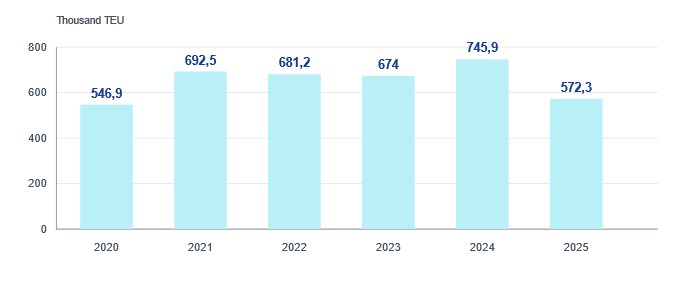
- The Central Eurasian Corridor, served by the United Transport and Logistics Company (UTLC-ERA). Freight from China is transported to the Eurasian Economic Union (EAEU) member states, including Belarus and Russia, as well as to European countries; shipments also move in the opposite direction (Figure 4).
- The Trans-Caspian International Transport Route (TITR), commonly known as the Middle Corridor, which runs from China through Kazakhstan, across the Caspian Sea, and onward through Azerbaijan and Georgia to Türkiye and European countries.
- The Central Eurasian Corridor, using the services of the United Transport and Logistics Company (UTLC-ERA). Shipments from China are transported both to EAEU countries (Belarus, Russia) and to European countries, as well as in the opposite direction;
- The Trans-Caspian International Transport Route (Middle Corridor) along the route China–Kazakhstan–Caspian Sea–Azerbaijan–Georgia–Turkey/European countries. The total volume of container traffic using OTLK ERA services along the Central Eurasian Corridor
A total of 572,000 TEUs of containers were transported by UTLC-ERA services along the Central Eurasian Corridor in 2025.
Figure 4. Container transit volumes through Kazakhstan along the Central Eurasian Corridor (total westbound and eastbound), thousand TEUs
Source: UTLC-ERA.
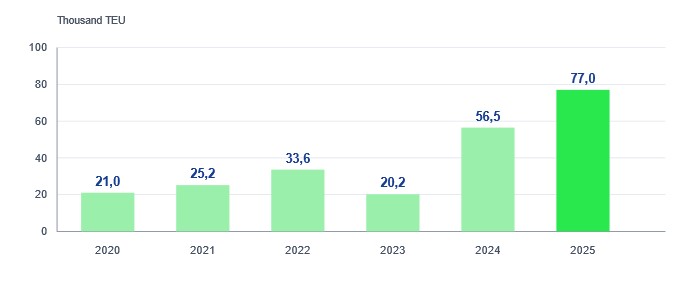
Container transportation along the Middle Corridor reached a record 77,000 TEUs in 2025, 3.7 times the volume recorded in 2020 (Figure 5).
Figure 5. Container transportation along the Middle Corridor, in thousands of TEUs
Source: EDB analysts’ estimates
Transit of containers between China and Europe via Central Asia totalled 351,500 TEUs in 2025 (Figure 6).
Figure 6. Transit of containers between China and Europe via Central Asia, in thousands of TEUs
Source: UTLC-ERA, EDB analysts’ estimates.
In 2025, overland rail routes through Central Asia accounted for 2.4 per cent of the total number of containers shipped from China to European countries. In the same year, Chinese ports handled 8.53 million TEUs destined for European ports.
Further growth in rail container transportation through Central Asia, including transit, will depend on expanding the capacity of existing corridors and developing alternative routes.
Promising Rail Corridors
Key projects to expand connectivity between China and Central Asia include the China – Kyrgyzstan - Uzbekistan (CKU) rail corridor, the Ayagoz - Bakhty railway and a third railway BCP between Kazakhstan and China at Bakhty, as well as the Mointy - Kyzylzhar railway construction in Kazakhstan.
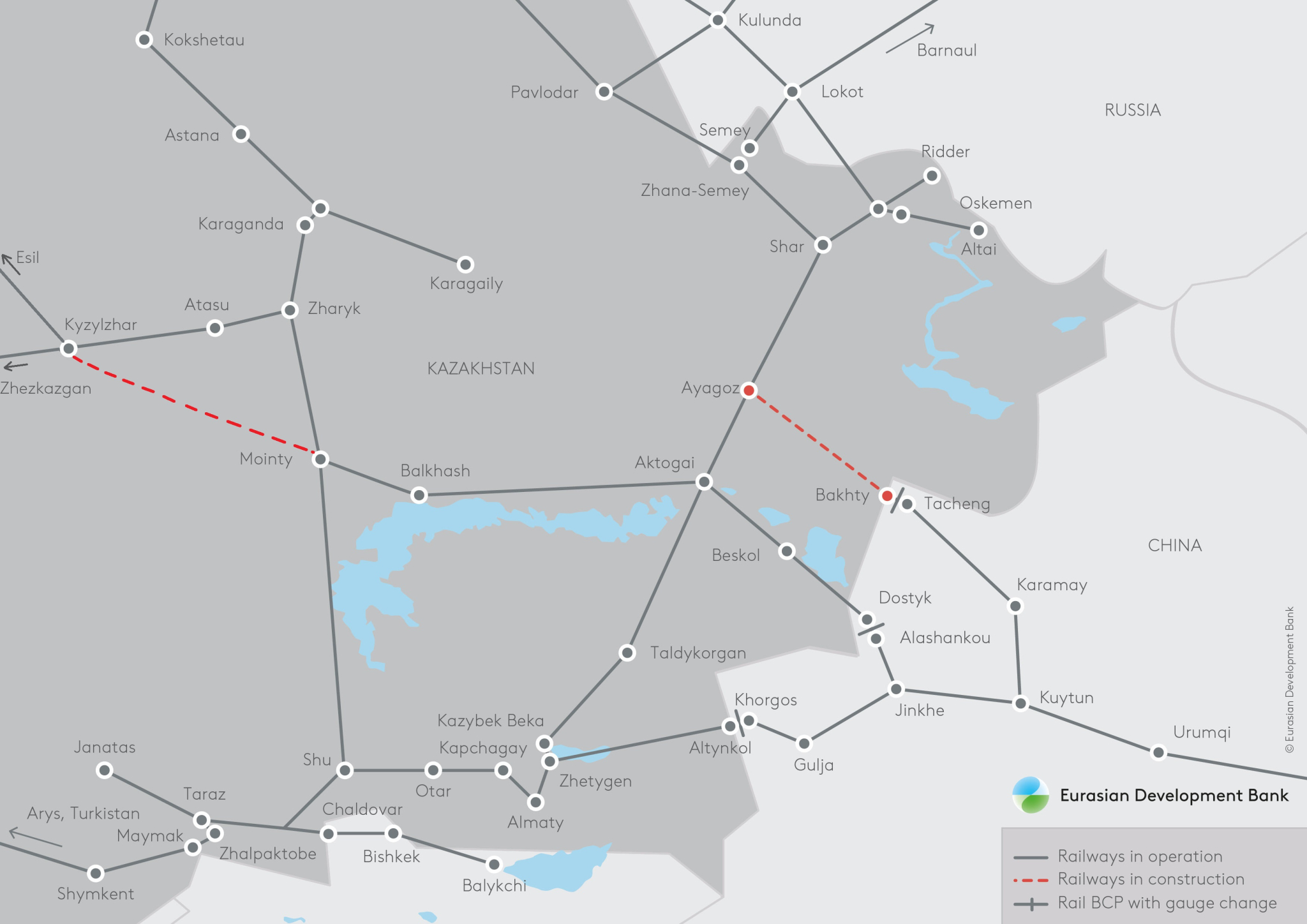
The Ayagoz - Bakhty railway is expected to significantly increase the capacity of the Central Eurasian Corridor and, more broadly, the capacity of Kazakhstan’s railway network to handle freight from China. According to the feasibility study financed through a grant from the EDB Technical Assistance Fund, the railway will be 272 kilometres long (Figure 7).
The single-track line is expected to enter into operation by the end of 2027, with a design capacity of 20 million tonnes per year. Five years after operations commence, plans envisage the construction of a second main track, additional passing loops, sidings and transshipment terminals at Bakhty border station, together with the axillary infrastructure.
The project is linked to the implementation of China’s Belt and Road Initiative (BRI) and is included in the President’s Address to the People of Kazakhstan, “Kazakhstan’s Current Tasks in a New Historical Cycle”
Figure 7. Projects for the Ayagoz–Bakhty and the Moyynty–Kyzylzhar railway sections
Source: EDB.
The Mointy–Kyzylzhar railway project is intended to shorten sections of the Middle Corridor and the Central Eurasian Corridor, reduce the transport distance by 149 kilometres and relieve capacity constraints on the Mointy–Zharyk section.
The 323-kilometre line is being constructed as a non-electrified single-track railway and is scheduled to enter into operation by the end of 2026.
The project is expected to improve the movement of container trains and increase transit volumes along both the Middle Corridor and the Central Eurasian Corridor, thereby strengthening the capacity and efficiency of these routes.
The largest railway project currently under way in Central Asia is the construction of the China – Kyrgyzstan - Uzbekistan rail corridor. This cross-border project aims to establish direct passenger and freight services between the three countries along a shorter route.
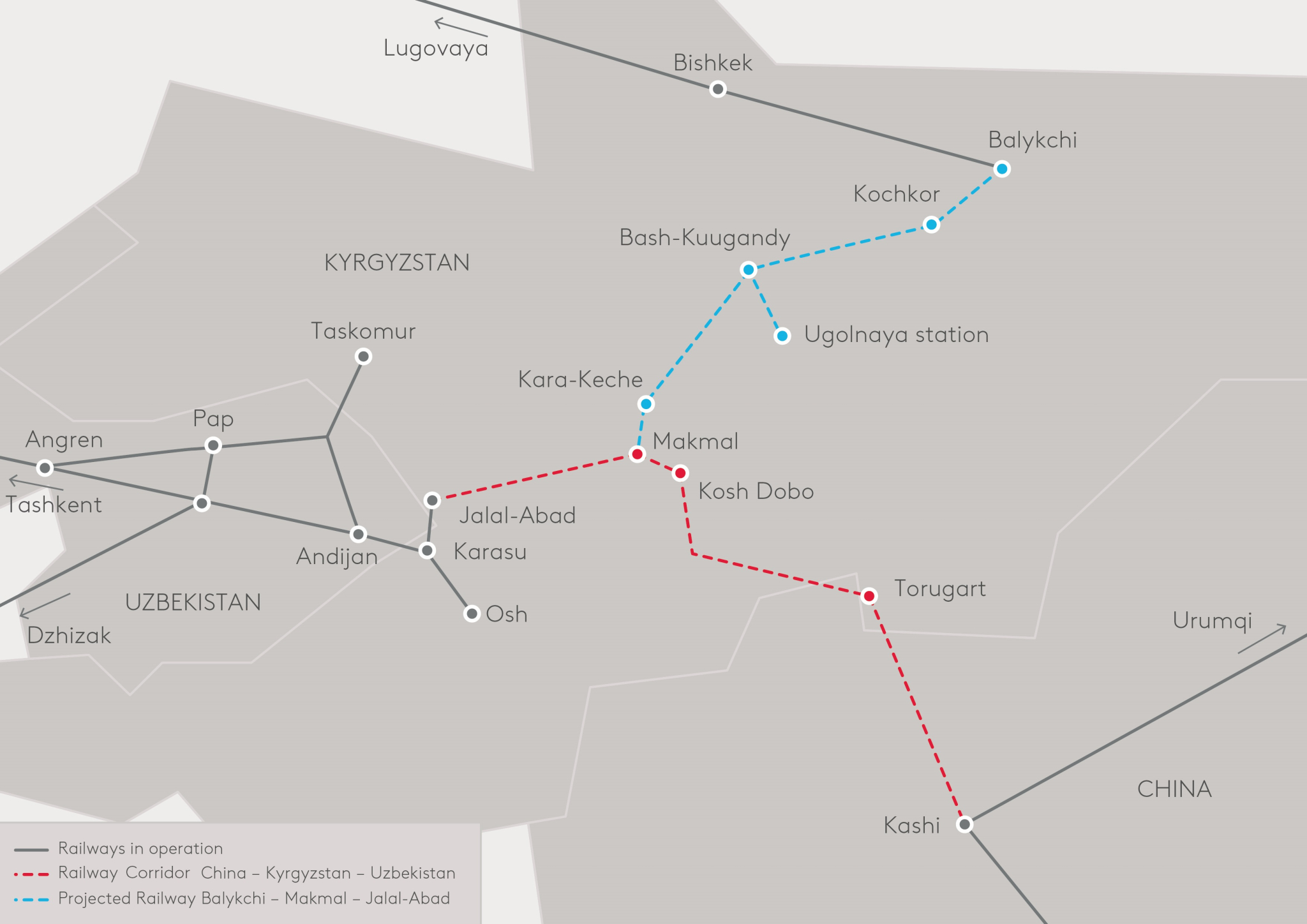
In the longer term, China views the corridor as an additional route for transporting freight to Türkiye and EU countries via Turkmenistan and the South Caucasus. The project is being implemented as part of the BRI. The planned route (Figure 8) runs from Kashgar in China through Torugart, Makmal, Jalal-Abad and Kara-Suu to Andijan in Uzbekistan. From there, it will connect to Uzbekistan’s railway network, providing onward links for freight transport to Afghanistan, Kazakhstan, Tajikistan and Turkmenistan.
Figure 8. Cross-border project for the construction of the China –Kyrgyzstan - Uzbekistan rail corridor
Source: EDB.
The project covers a total distance of 523 km, of which 213 km is in China, 260 km is in Kyrgyzstan and 50 km is in Uzbekistan. The project involves the construction of 27 tunnels (103 km), 48 bridges (16 km) and 20 local stations and passing loops, including two border and transshipment stations. According to the feasibility study, an initial single-track, non-electrified line will be built; however, the design of the bridges and tunnels will allow for a second main track to be constructed in the future. In the second phase, the line will become double-track and fully electrified.
The estimated freight transport capacity is 7 million metric tons per year for the single-track option and 20 million metric tons per year for the double-track line.
A transition between 1,435 mm and 1,520 mm track gauges is planned at Makmal station. Within Kyrgyzstan, the 1,435 mm gauge section will extend for approximately 167 km.
The benefits of the project for Kyrgyzstan include improved connectivity with China and other Central Asian countries, and between the country's northern and southern regions. Kyrgyzstan will also begin to receive a share of the revenue from freight transit.
The benefits of the project for Uzbekistan include improved logistics capabilities for trade with China, as well as the realisation of the potential for growth in container transportation. The volume of container transportation could increase fivefold by 2030, from 100,000 TEUs to 500,000 TEUs. Three railway projects will reinforce Central Asia’s position as a transport cross-road. The new lines will connect to existing routes, including the International North–South Transport Corridor (INSTC) and the Tajikistan – Uzbekistan - Turkmenistan multimodal corridor. In the future, they will also connect to the Trans-Afghan Rail Corridor.
Promising Road Routes
Alongside the existing road network within the TRACECA corridor, new road and multimodal routes are being developed in Central Asia, supported by investment in highways and border-crossing infrastructure with China.
Major construction projects are underway in Kazakhstan for the ‘Centre-West’ and Aral-Caspian highways.
Tajikistan, Uzbekistan and Turkmenistan are developing a multimodal route linking China with the three Central Asian countries, the South Caucasus and Europe via the Kulma BCP between China and Tajikistan. The route concept was presented at an international conference in Dushanbe. Project implementation and trial freight shipments began in early 2026.
Construction is under way on the Bedel BCP, the third crossing between Kyrgyzstan and China. The Barskoon–Bedel highway is also being built as part of the new cross-border Barskoon – Uchturfan - Aksu route. In 2024, a temporary 56-kilometre gravel access road to the BCP was completed, and a temporary crossing for pedestrians and passenger vehicles was opened. The planned 500-kilometre route includes 50 bridges and two tunnels with a combined length of more than nine kilometres.
Projects are also under way to develop four-lane highways connecting China with Kyrgyzstan, Uzbekistan and Turkmenistan. These include the completed Ashgabat - Mary - Turkmenabat highway in Turkmenistan; the Tashkent - Andijan and Tashkent - Samarkand highways, which are under construction or at the planning stage in Uzbekistan; and the Ashgabat - Turkmenbashi highway in Turkmenistan.
China’s Role in the Development of Transport Corridor Infrastructure in Central Asia
China is actively involved in the construction and modernisation of transport infrastructure in Central Asia, acting both as an investor and as a contractor on a number of projects. Its engagement aims to strengthen the region’s trade and logistics connectivity with the Chinese market, support Central Asia’s integration into the global economy and develop reliable overland routes for transporting Chinese goods to Europe and the Middle East.
Cooperation between China and the Central Asian countries on transport infrastructure is pursued within the BRI framework.
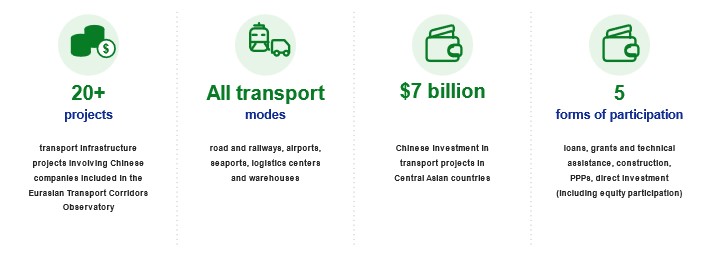
China participates in infrastructure projects in Central Asia through several channels, including loans and grants, foreign direct investment (FDI), and the engagement of Chinese companies as contractors for feasibility studies, design and construction (Figure 9). China’s role in the implementation of infrastructure projects in Central Asia is examined in greater detail in the EDB Working Paper “Transport Corridors Infrastructure: Project Observatory and Interactive Map of the Eurasian Transport Network – 2026”
Figure 9. China—a Participant in Transportation Infrastructure Development Projects in Central Asia
Source: EDB
A total of more than 20 projects are currently underway in Central Asia, with a combined investment volume exceeding $12 billion. Chinese banks and commercial companies have provided over $7 billion in loans, grants and foreign direct investment (FDI).
Major projects involving Chinese participation include:
- Construction of the China – Kyrgyzstan - Uzbekistan rail corridor.
- Construction of the Tashkent–Samarkand highway.
- Construction, in partnership with China’s Guoyou Materials Group, of a new multipurpose terminal complex at the Port of Kuryk.
- Construction and rehabilitation of the Barskoon - Bedel – Uchturfan - Aksu highway.
- Construction of the Serakhs – Mary - Serhetabat highway.
- Rehabilitation of the Murghab - Kulma highway, etc.