


How multilateral development banks finance the Eurasian region in local currencies: structure, drivers, and opportunities
28 October 2026
Local currency financing is particularly important in developing economies. In Eurasia, the share of LCY projects in the total portfolio of operations rose from 11% to 30% between 2015 and 2025, while annual financing volumes increased from USD 0.4 billion to USD 2.3 billion. This analytical brief examines changes in the geographical distribution of financing, the role of development banks, the factors constraining the expansion of such operations, and measures to scale up LCY financing.
SUMMARY
- Local-currency (LCY) financing by MDBs in Eurasia is growing rapidly. The share of LCY projects increased from 11% in 2015 to 30% in 2025. Annual volumes rose fivefold, from $0.4 billion to $2.3 billion (in US dollar equivalent).
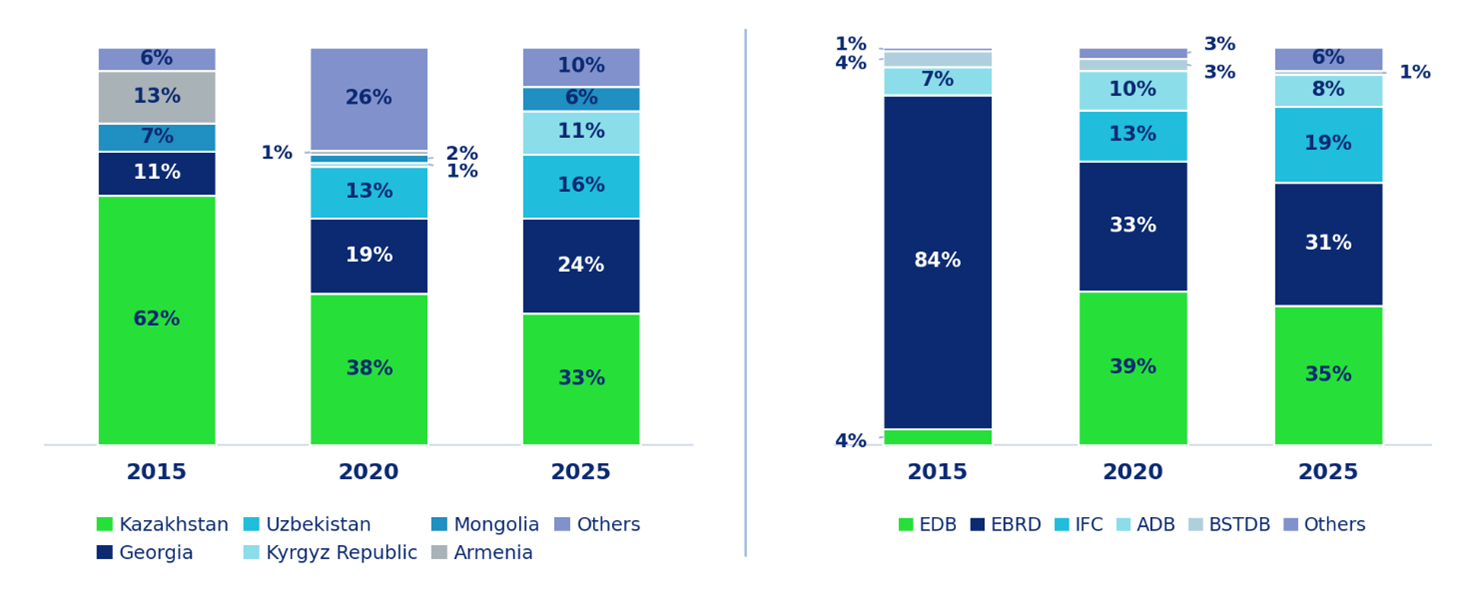
- The geography of financing is becoming more diversified. Kazakhstan remains the leader, but its share fell from 62% to 33% amid rapid growth in Georgia, Uzbekistan and the Kyrgyz Republic. Their combined share increased from 11% to 51%.
- The main investors in the region are the EDB, the EBRD and IFC. These institutions accounted for 85% of LCY financing in 2025. The EBRD and IFC have the broadest geographic coverage across the region, supported by dedicated local-currency financing programmes.
- The main channel for LCY financing is the financial sector and SME lending. In 2025–2026, this segment accounted for 54% of local-currency operations. One of the key advantages of SME lending is its relatively short maturity: about 4 years on average, compared with 10 years in infrastructure.
- LCY financing is becoming one of the pillars of the global MDB reform agenda. The G20, largely reflecting the priorities of major emerging economies, is calling on MDBs to expand local-currency financing, develop domestic markets and broaden hedging instruments. One of the global leaders in 2025 was the New Development Bank (NDB), where LCY financing accounted for 45.9% of new approvals.
- How can LCY financing be scaled up in the region?
-
Expand local-currency bond issuance.
-
Support the development of domestic markets: foster stock exchanges, bond and derivatives markets, and improve foreign-exchange market liquidity.
-
Use mechanisms to mitigate currency risk: expand the use of FX swaps and specialised hedging institutions such as TCX.
-
Integrate LCY financing into project preparation: treat LCY financing as a baseline option for projects generating revenues in local currency.
-
Use a mixed-currency financing structure: finance local expenditures in local currency and foreign-currency costs in hard currency.
-
Mobilizing private investors for LCY investments: pooling MDB loans denominated in national currencies into investment pools to attract institutional investors.
Why is LCY financing important for borrowers?
Local-currency financing is particularly important in emerging and developing economies. Many projects generate revenues in local currency, while a significant share of long-term financing is provided in hard currency.
For borrowers, the main advantage of LCY loans is lower currency risk because the currency of revenues matches the currency of liabilities. This makes project cash flows more predictable and reduces the risk of a sharp increase in debt burden following a devaluation.
Lower currency risk strengthens the resilience of projects and borrowers. This is particularly important for SMEs, long-term infrastructure projects and public-sector entities that do not earn foreign-currency revenues and are poorly positioned to endure exchange-rate volatility.
What constrains LCY financing?
- Macroeconomic risks. LCY financing does not always mean cheaper debt. One of the main constraints is the cost of funding. High inflation and interest rates can make an LCY loan substantially more expensive than foreign-currency financing.
- Underdeveloped domestic financial markets. Key barriers include short maturities, low liquidity, high costs and insufficient interbank liquidity. A shortage of long-term LCY funding limits both the size and tenor of transactions.
· Conservative MDB policies. Business models have historically focused on borrowing and lending in hard currencies. Balance sheets and treasury processes are still largely built around this model.
What has changed in the region over the past 10 years?
Local-currency (LCY) financing is growing rapidly across the Eurasian region. The share of LCY projects[1] in the overall portfolio of MDB operations increased from 11% in 2015 to 30% in 2025. Annual volumes rose fivefold, from $0.4 billion to $2.3 billion (local currencies in US dollar equivalent).
The geography of LCY financing has broadened considerably over the past decade. Kazakhstan remains the largest recipient by approved volume. Its annual LCY financing increased 2.7-fold and exceeded $750 million equivalent in 2025. At the same time, Kazakhstan's share of the regional total fell from 62% to 33% as financing grew faster in other countries of the region, particularly in Georgia, Uzbekistan and the Kyrgyz Republic. Their combined share increased from 11% in 2015 to 51% in 2025.
Georgia is one of the largest markets for MDB local-currency financing: in 2025, its share reached 24%, placing it second after Kazakhstan. Uzbekistan is also rapidly increasing its share. This has been supported by financial-market liberalisation since 2017 and the subsequent rise in MDB investment inflows.
The main investors in the region are EBRD, EDB and IFC. These institutions accounted for 85% of LCY financing in 2025. EBRD and IFC have the broadest geographic coverage across the region.
The EBRD remains one of the largest providers of LCY financing in the region. Over the past 10 years, its share declined from 84% to 31% as other MDBs expanded their activity, yet the annual volume of EBRD local-currency operations doubled to more than $700 million. Kazakhstan remains one of EBRD's largest markets for LCY operations. The Bank actively supports SMEs across the region through the SME Local Currency Programme, raises funding in domestic markets and works with national financial institutions. In 2025, for example, EBRD provided the Uzbekistan Mortgage Refinancing Company with a sum-denominated loan equivalent to $40 million to expand long-term mortgage lending through local banks.
Figures 1–2. Structure of LCY financing in the region by country and MDB, %.
Source: authors' calculations based on MDB data and the EDB NSF Database.
Over the past 10 years, the EDB has provided the largest volume of local-currency financing among MDBs in the region – more than $5 billion equivalent (Figure 3). The EDB's share increased substantially, from 4% to 35%. The EDB actively works in the markets of its member states to raise long-term funding. One of the Bank's notable projects is tenge-denominated financing for the reconstruction of Almaty CHPP-3. IFC is actively expanding its local-currency financing in the region. Its share increased from zero to 19%. The Local Currency Facility, launched in 2017, has played an important role by providing long-term local-currency financing in countries with shallow capital markets and limited currency-hedging options. In 2025, with support from this facility, IFC invested the equivalent of $15 million in Kyrgyz som in bonds issued by the Kyrgyz Investment and Credit Bank (KICB) to finance small businesses, housing microloans and green projects. In 2024, IFC invested the equivalent of $10 million in Tajik somoni in the first green bonds issued by Eskhata Bank (Tajikistan) to expand small businesses' access to climate finance. Both transactions were supported by currency swaps under the IDA Private Sector Window – Local Currency Facility.
The number of MDBs working with local currencies in the region has increased significantly. These include ADB, BSTDB, EIB and AIIB.
- ADB increased its share in the region to 8%. In 2023, for example, ADB provided Almaty Power Plants (Kazakhstan) with a tenge-denominated loan equivalent to $214 million to modernise CHPP-2.
- BSTDB actively finances countries in the South Caucasus. In 2025, for example, it provided Bank Respublika (Azerbaijan) with a manat-denominated loan equivalent to $15 million for onlending to meet SMEs' investment and working-capital needs.
- EIB provides local-currency financing to local banks. In 2020, EIB extended the equivalent of about $30 million in Georgian lari to Bank of Georgia to increase SME lending.
- AIIB's 2030 Corporate Strategy envisages expanding local-currency financing, particularly for infrastructure projects with local-currency revenues, while also supporting the development of domestic capital markets. In 2025, for example, AIIB approved an investment of up to $30 million equivalent in Georgian lari in social bonds issued by Georgia Healthcare Group to purchase equipment for regional hospitals.
MDBs use a broad range of LCY-financing instruments, including direct loans, onlending through local banks, bond and equity investments, and guarantees. In 2021, for example, EBRD announced an equity investment in TBC UZ in Uzbekistan equivalent to $9.4 million in Uzbek sum, while in 2025 IFC approved a guarantee of up to $5 million equivalent in Kyrgyz som for Demir Kyrgyz International Bank in the Kyrgyz Republic.
Figure 3. Matrix of countries and MDBs providing LCY financing in the region, 2015–2025, $ million.
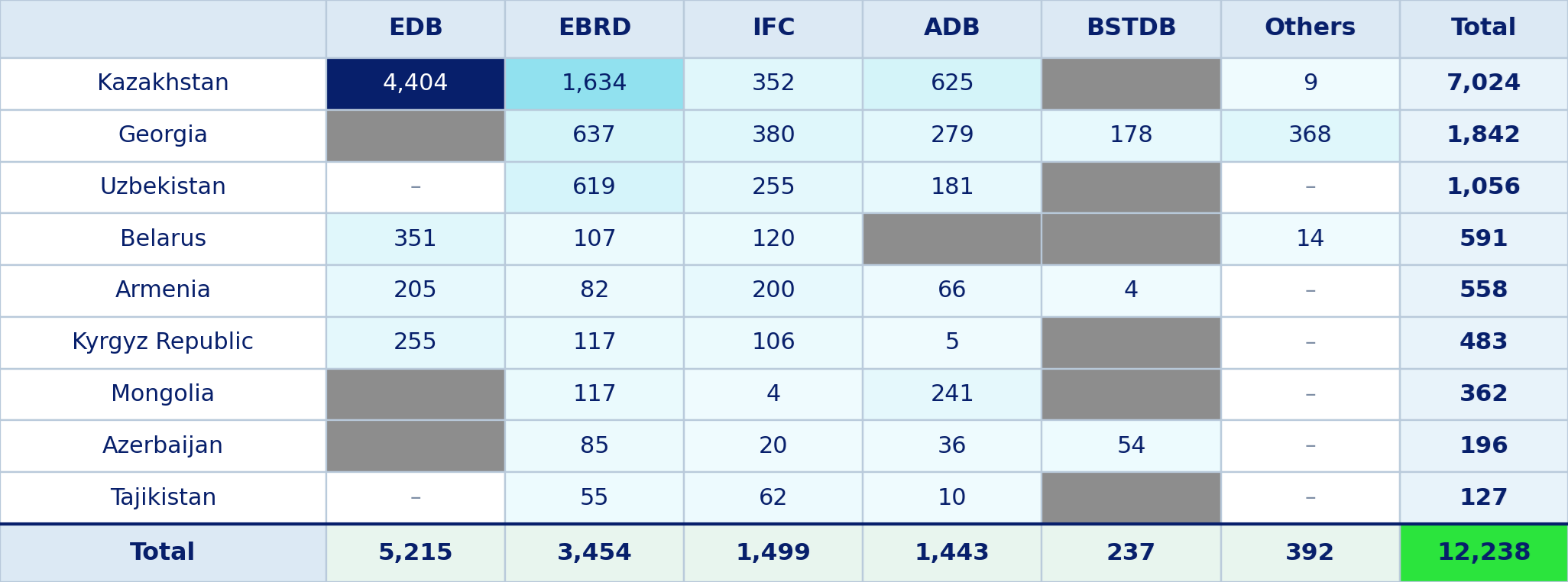
Note: countries that are not shareholders of the respective banks are highlighted in grey.
Source: authors' calculations based on MDB data and the EDB NSF Database.
Why are SMEs a key financing segment?
The financial sector accounts for the largest share of LCY financing. From 2025 through the first half of 2026, the sector received $2.0 billion equivalent, or 54% of all local-currency investment.
In the financial sector, lending to local banks for subsequent SME lending (onlending) plays a key role. Almost all operations in the financial sector are onlending transactions. Volumes are growing rapidly, doubling between 2020 and 2025. In March 2026, for example, the EBRD approved for Bank CenterCredit its largest-ever financing package to a bank in Kazakhstan – $200 million equivalent in tenge. The funds will support SMEs, youth and women entrepreneurs, as well as green lending.
Tenor is likely to be one of the key determinants of LCY financing. Tenors are shortest in the financial sector and do not differ substantially from those of hard-currency projects: average maturities are 3.8 years in local currency versus 4.7 years in hard currency. Across all sectors, local-currency project tenors averaged 3–5 years. By comparison, the average project tenor in transport is 10 years. The mismatch between relatively short LCY financing tenors and the long maturities required by infrastructure projects is one of the constraints on expanding LCY financing.
MDBs are working to lengthen LCY financing tenors, which would make it possible to finance a wider range of sectors. ADB, for example, has set a target to extend the maturity of its own local-currency borrowings to at least 10 years.
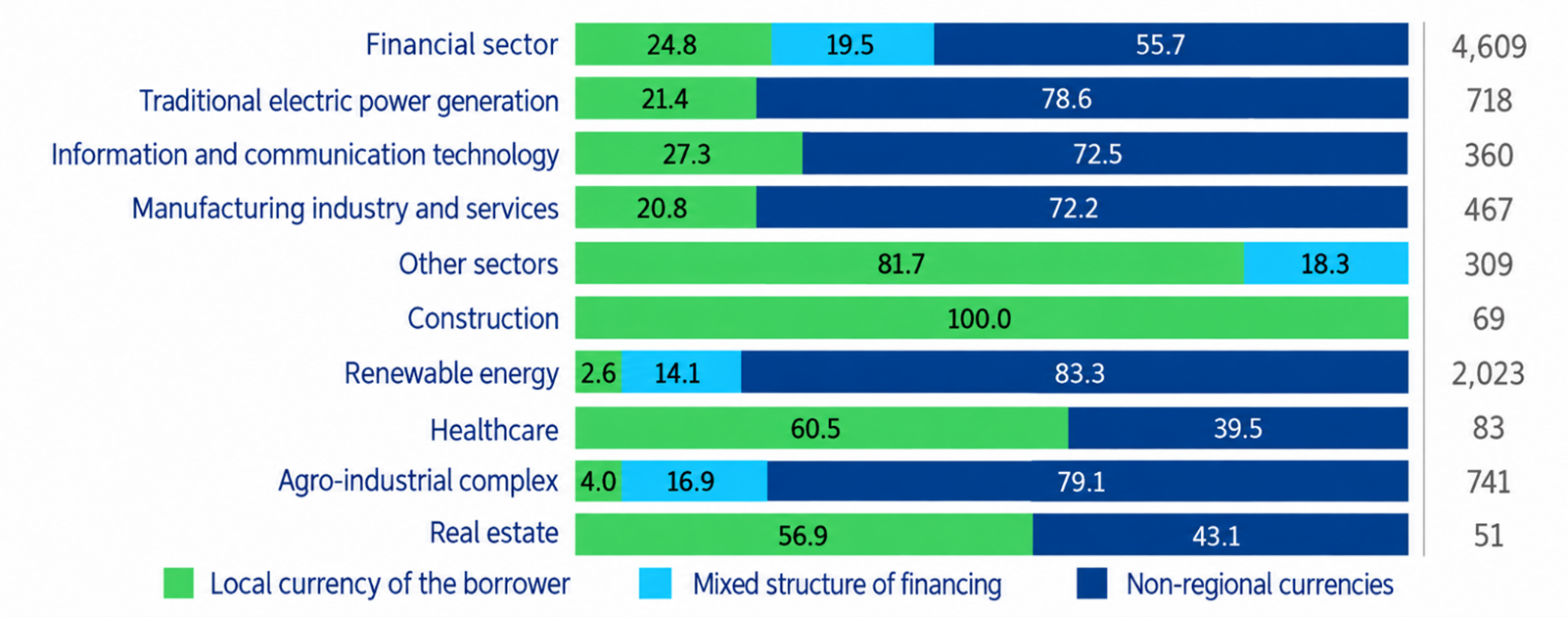
LCY financing is particularly relevant in sectors with a high share of local-currency costs. It plays a relatively larger role in conventional power generation, ICT, manufacturing and construction, where a significant portion of capital and operating costs is incurred domestically. By contrast, despite sizeable MDB investment in renewable energy, the share of local-currency financing remains among the lowest. This may reflect the high import content of equipment and, consequently, projects' need for foreign-currency financing.
Figure 4. Currency structure of MDB operations by sector, 2025–H1 2026, %, $ million.
Source: authors' calculations based on MDB data and the EDB NSF Database.
How do domestic financial markets affect LCY financing?
The depth and liquidity of domestic financial markets are key conditions for the development of LCY financing. They broaden MDB access to local savings, investors and hedging instruments, helping to reduce local-currency funding costs and extend lending tenors. External capital and hedging instruments can help manage currency risk, but they cannot fully substitute for a well-developed domestic market.
Across the Eurasian region, there is a relationship between financial-market development and LCY financing. More developed financial systems generally coincide with a higher share of LCY financing, with some country-level exceptions. Georgia and Kazakhstan record the highest index values and, at the same time, high shares of local-currency financing. Uzbekistan, Mongolia and several other countries show the opposite pattern (Figure 5).
Domestic-market depth does not always directly determine the level of LCY financing. In Tajikistan and the Kyrgyz Republic, the relatively high share of local-currency operations is largely linked to dedicated SME-support programmes. EBRD's SME Local Currency Programme, in particular, provides donor-funded first-loss cover, helping to reduce lending margins and bring the cost of EBRD LCY financing closer to market conditions. In 2016–2023, programme-supported operations accounted for 93% of EBRD's LCY volume in Tajikistan and 75% in the Kyrgyz Republic.
An important role of MDBs is to catalyse the development of domestic markets. MDBs issue bonds in local markets, establish yield benchmarks, broaden the investor base and support market infrastructure. In Armenia, for example, EDB financed most of the 2021–2022 project to modernise the infrastructure of the Armenia Securities Exchange through its own Technical Assistance Fund.
At the same time, despite Armenia's relatively advanced financial market, the volume of MDB local-currency financing remains comparatively low. One possible reason is local banks' access to relatively inexpensive domestic funding, which reduces their demand for MDB resources in Armenian dram.
Figure 5. Financial-market development indices and shares of MDB LCY financing (2020–2026).
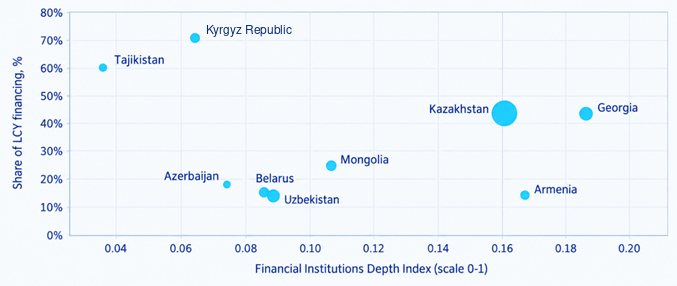
Notes: Bubble size corresponds to the volume of local-currency investment in US dollar equivalent. The IMF Financial Institutions Depth Index measures financial-market development in terms of private-sector credit, investment funds and insurance markets.
Sources: IMF Financial Development Index (2020); authors' calculations based on the EDB NSF Database.
What are the global trends?
The G20, largely reflecting the priorities of major emerging economies, has tasked MDBs with scaling up local-currency financing. This includes expanding technical assistance to borrowers for managing currency risk, strengthening domestic capital markets, and developing and scaling currency-risk hedging instruments and other innovative financial solutions. Leaders in implementing these measures include the World Bank Group, ADB, EBRD, NDB, IDB, AIIB and others. LCY financing is one of the key pillars of the MDB reform agenda set out in the Roadmap towards Better, Bigger and More Effective MDBs.
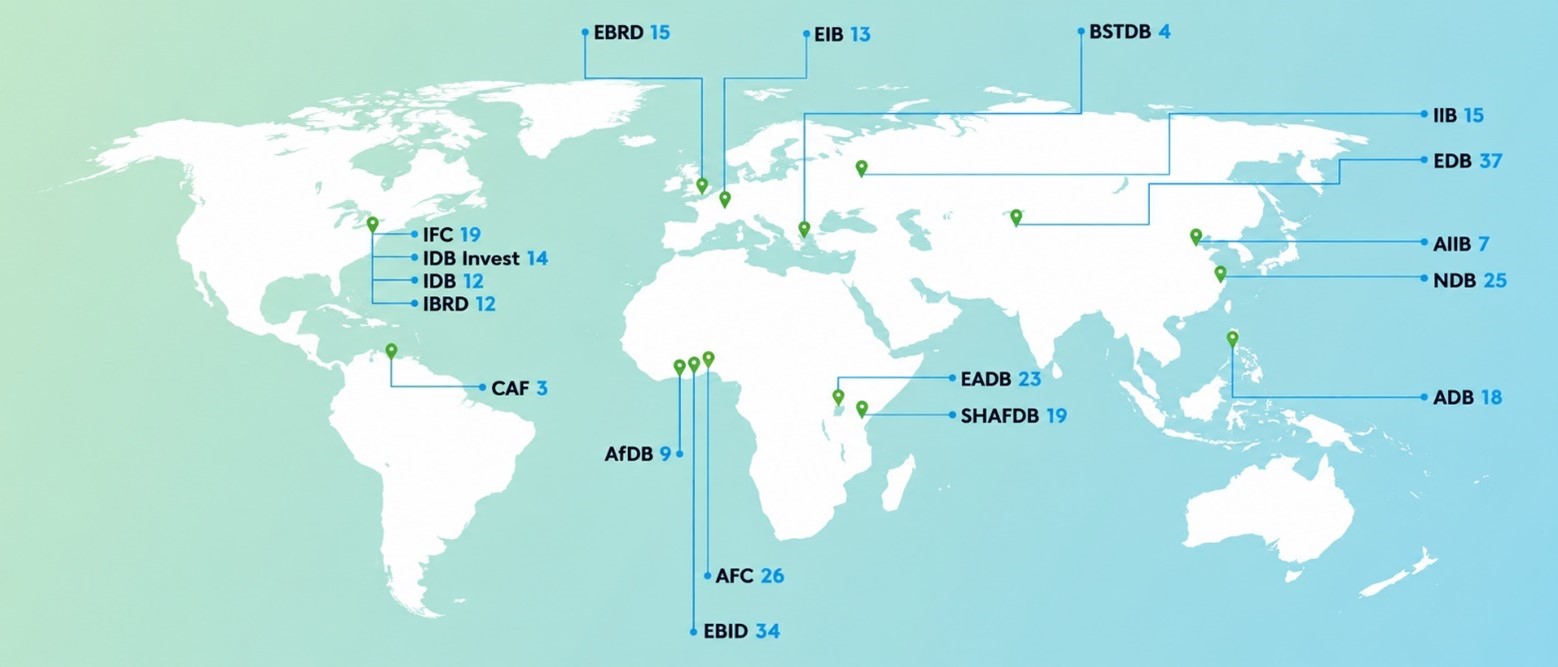
MDB priorities in LCY financing vary substantially. According to EDB estimates, the share of loan portfolios denominated in currencies other than the US dollar and euro ranges from roughly 3–7% for CAF and AIIB to 34% for EBID and 37% for EDB. This reflects differences in institutional mandates and geographic focus. The highest shares are typical of MDBs operating primarily in emerging markets, where the need to reduce currency mismatches is particularly acute.
The EDB is one of the global leaders in financing in currencies other than the US dollar and euro. The Bank is pursuing a strategy of diversifying its sources of long-term funding. One priority is to expand funding in Chinese yuan. In 2025, EDB also completed its debut bond issues denominated in UAE dirhams. Projects denominated in the national currencies of EDB member states accounted for 35.1% of the Bank's balance-sheet portfolio in 2025; including the yuan, the share reached 49%.
In 2025, NDB became one of the leading providers of LCY financing, expanding both local-currency funding and lending through direct access to member-country capital markets. LCY financing reached a record 45.9% of total new financing approvals in 2025. On a cumulative basis, LCY financing accounted for 34% of all approved financing, exceeding the 30% target under the 2022–2026 General Strategy. Under NDB's new strategy for 2027–2031, the target share of local-currency financing in the portfolio has been raised to 40–50%.
Figure 6. Share of the loan portfolio in currencies other than the US dollar and euro, 2024.
Source: EDB report ‘Multilateral Development Banks: How They Work and Where They Are Headed’ (2026).
How can LCY financing be scaled up in the region?
The global trend is shifting from individual transactions in borrower-country currencies towards building a comprehensive LCY-financing infrastructure. Expanding local-currency financing requires changes both within MDBs and in the financial markets of borrowing countries. Over time, LCY financing should be treated as an integral part of MDB business models.
What actions could MDBs take to expand financing in the national currencies of Eurasian countries?
- Expand local-currency bond issuance. Regular MDB bond issuance in local currencies is feasible in more developed markets. However, capital markets in developing countries often remain insufficiently deep. One solution is offshore issuance. ADB, for example, issues two types of bonds: onshore bonds, placed directly in a country's domestic market, and offshore bonds, issued outside the country but linked to the local currency.
- Support the development of domestic markets. MDBs could play a more active role in developing national financial infrastructure: support domestic exchanges through technical-assistance programmes, contribute to the development of bond and derivatives markets, and enhance foreign-exchange market liquidity. MDBs could also act as market makers for currency pairs involving the region's currencies.
- Use mechanisms to mitigate currency risk. MDBs can expand LCY financing through FX and cross-currency swaps, liquidity-exchange arrangements between banks, and specialised hedging institutions. TCX (The Currency Exchange Fund), for example, takes currency risk onto its own balance sheet and provides long-term hedging in emerging-market currencies where such markets are absent or underdeveloped. In theory, a government-backed currency risk-sharing mechanism could also be considered, under which part of a borrower’s losses resulting from a significant depreciation of the national currency could be compensated through tax relief, payment deferrals, or other fiscal instruments.
- Integrate LCY financing into the standard project-preparation process. For projects that generate revenues primarily in local currency, LCY financing can be considered a baseline option alongside hard-currency financing. Cost, currency risk and stress-test results should be compared at an early stage of transaction preparation.
- Actively use mixed-currency financing structures. Local currency can be used to cover wages, construction works, domestic procurement and other in-country expenditures, while hard currency can finance imported equipment and other foreign-currency costs. This structure better aligns the currency of financing with project cash flows and reduces currency mismatches.
- Mobilizing private investors for LCY investments. This strategy involves pooling MDB LCY loans for institutional investors through B-loans, funds, securitisation and other mechanisms. It could help scale up local-currency lending without increasing MDB balance sheets.