37 banks, $445 billion in capital, and $2 trillion in assets: EDB has systematised global knowledge on multilateral development banks
Almaty. The EDB presented a report titled ‘Multilateral Development Banks: How They Work and Where They Are Headed’ on 37 multilateral development banks. Their assets have reached $2 trillion, their share capital stands at $445 billion, and their annual disbursements amount to approximately $200 billion. At the same time, the share of MDBs’ assets in global GDP has declined from 2.0% to 1.8% over the past 25 years. The study outlines nine criteria for MDBs, four waves of their formation, a new geographical classification of the banks, the new term ‘non-investment triad,’ and an expert perspective on the development of MDBs over the next 10 years.
The report represents the first comprehensive ‘encyclopedia’ of the global system of multilateral development banks – from global to subregional institutions. The study systematizes a broad range of data on 37 MDBs and demonstrates the resources available to this system, how its role in the global economy is changing, and what mechanisms could increase the volume of financing.
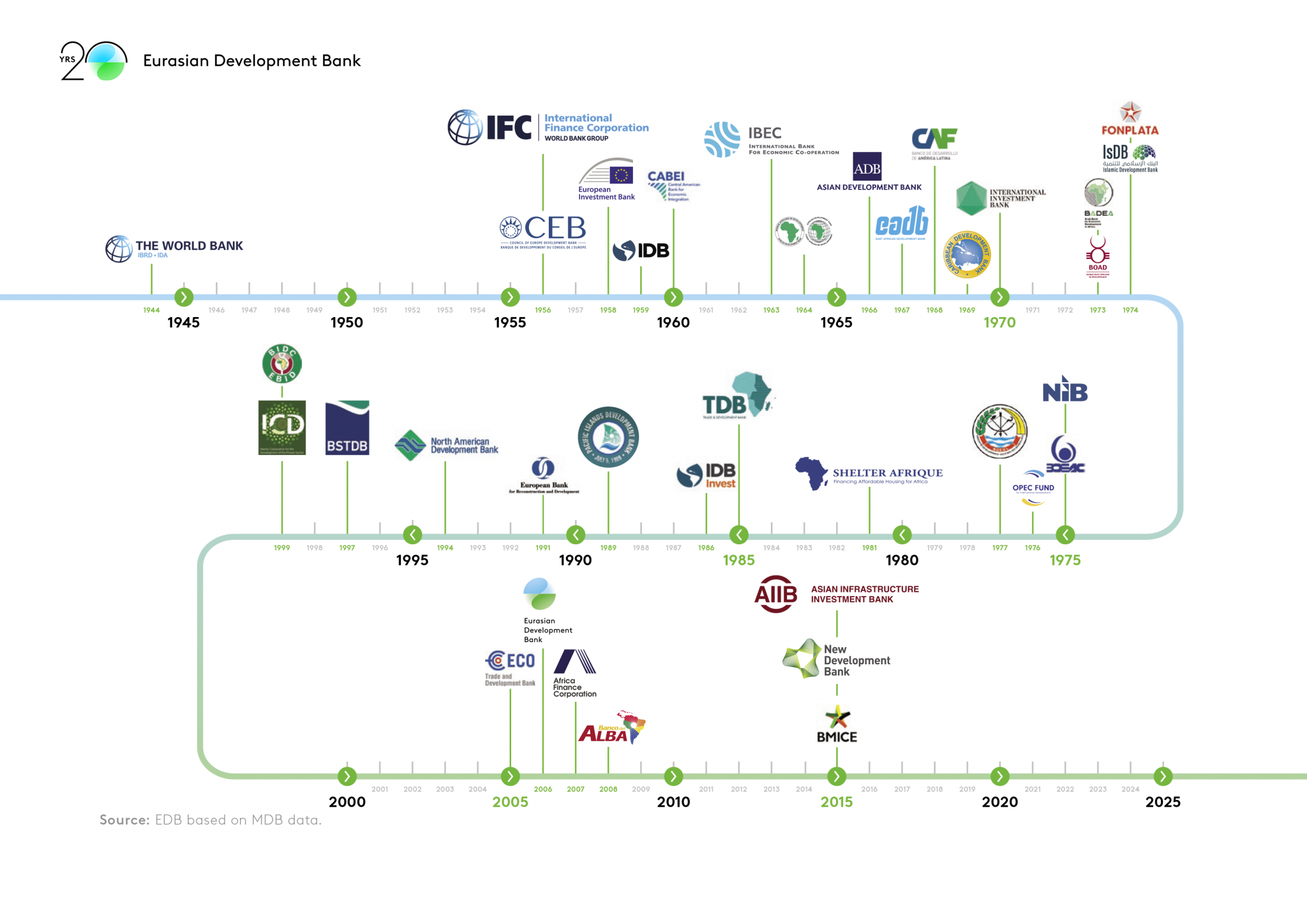
EDB analysts have formulated nine criteria for classifying organizations as MDBs. The authors show that the key characteristics of MDBs include intergovernmental status, financing of development projects, the long-term nature of operations, the use of market-based borrowing, a lack of focus on profit maximization, and government oversight.
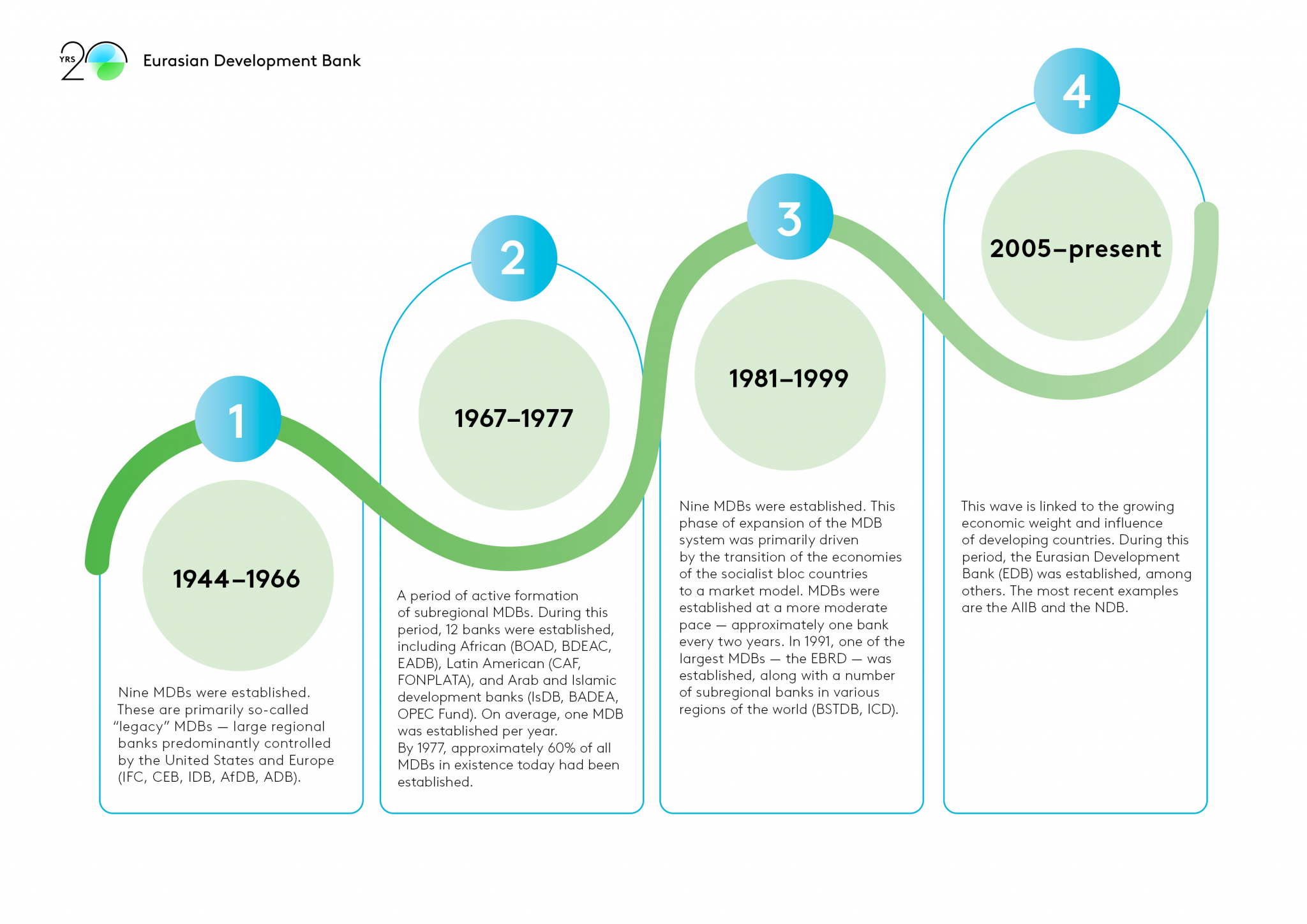
EDB analysts identify four waves in the formation of the MDB system. The first wave, from 1944 to 1966, is associated with the creation of the foundational ‘legacy’ institutions. The second wave, from 1967 to 1977, was a period of active formation of subregional banks: by 1977, approximately 60% of the MDBs in existence today had been established. The third wave, from 1981 to 1999, was driven by the transition of post-socialist economies to a market-based model. The current, fourth wave, which began in 2005, reflects the growing economic weight and institutional influence of developing countries.
According to EDB estimates, the total assets of the MDB system reached $2.0 trillion in 2024. Over the past 25 years, the total assets of multilateral development banks have roughly tripled. At the same time, their growth rate is showing signs of slowing down. The relative role of MDBs in the global economy is declining. Over the 25-year period, the ratio of MDB assets to global GDP fell from 2.0% to 1.8%.
The report devotes special attention to the geography of the MDB system. Today, 25 of the 37 MDB headquarters are located in developing economies. This reflects the growing role of Global South countries and their desire to establish their own long-term financing institutions.
EDB analysts have proposed a new geographical classification of MDBs. In the report, the banks are grouped into subregional, regional, interregional, and global categories. This classification highlights differences in the scale of assets, shareholders, mandates, and operating models. Most MDBs are subregional. Such banks are generally more closely aligned with national and local development objectives.
EDB analysts have introduced the term ‘non-investment triad’ for the first time. It refers to three areas of activity for MDBs beyond direct financing: technical assistance, research, and training programs. The tools of the non-investment triad help prepare investment projects, develop human and institutional capacity, support reforms, and transform MDBs not only into sources of capital but also into ‘knowledge banks.’
MDBs invest approximately $200 billion annually. However, this is not enough. MDB assets and investments must grow faster than the global economy to address infrastructure and other investment challenges. Developing economies continue to face limited access to long-term and affordable financing. To address this, the banks need new instruments, more capital, flexible financing, and an optimized project cycle.
The concluding section presents an expert perspective on key directions for the development of the MDB system over the next 10 years:
1. the emergence of three to four new MDBs focused on developing countries;
2. accelerated growth in non-sovereign financing volumes;
3. diversification of the sectoral structure of MDB financing;
4. diversification of MDB investment instruments;
5. the growing importance of the ‘non-investment triad’;
6. the development of new capital-raising mechanisms in addition to traditional ones;
7. the creation of new special-purpose capital funds;
8. expanding the participation of private capital in MDB investment activities;
9. expansion of financing in national currencies.
The full text of the EDB report is available on the Bank’s website.
For reference:
The Eurasian Development Bank is a multilateral development bank engaged in investment activities across the Eurasian region. For 20 years, the EDB has been promoting the strengthening and expansion of economic ties and the comprehensive development of its member countries. As of the end of December 2025, the EDB’s cumulative portfolio comprised 326 projects with a total investment volume of $19.6 billion. The majority of the EDB’s portfolio consists of projects with an integration effect in the areas of transportation infrastructure, digital systems, green energy, agriculture, industry, and mechanical engineering. The Bank’s activities are guided by the UN Sustainable Development Goals and ESG principles.
As part of its 2022–2026 Strategy, the EDB is implementing three megaprojects: the ‘Central Asian Water and Energy Complex’, the ‘Eurasian Transport Framework,’ and the ‘Eurasian Commodity Transport Network.’
EDB Press Center Contacts:
+7 (727) 244 40 44, ext. 4774 and 2160