
A “Middle Path” for Central Asia’s Power Sector : EDB Presents a Balanced Energy Transition Strategy
Almaty, March 19, 2026. - The Eurasian Development Bank (EDB) has presented a report titled “Power Sector of Central Asia: modernization and energy transition.” By 2030, electricity consumption in the region will grow by 40%, and by 2035, 62.8 GW of new capacity are planned to be commissioned. Under these conditions, the Bank’s experts propose a “middle path” strategy - a balanced approach that combines the modernization of conventional generation with the development of renewable energy. Calculations show that this scenario is 30–45% cheaper than “green maximalism” and reduces the carbon footprint by a factor of 5 compared to a conservative development path.
Key findings of the report:
- The region is growing, but infrastructure is aging: by 2030, electricity consumption in Central Asia will increase by 40%, and by 2035, 62.8 GW of new capacity are planned to be deployed. Meanwhile, more than half of the grids and power plants are already worn out.
- Extremes do not work: a conservative approach perpetuates risks and a high carbon footprint, while “green maximalism” threatens reliability and leads to rising tariffs.
- The EDB’s “middle path” is a balanced strategy combining the modernization of conventional generation, the development of renewable energy, the deployment of energy storage, and the digitalization of grids.
- Impact on the region: capital costs are 30–45% lower than under “green maximalism,” the cost of electricity is 25–35% lower, and the carbon footprint is five times smaller than under the conservative scenario.
More about the report
The global energy transition is gaining unprecedented momentum. In 2024, record volumes of solar and wind power plants were commissioned, and investments in clean energy have already surpassed investments in fossil fuels. However, these achievements are accompanied by new challenges. Demand for electricity is growing faster than low-carbon generation can keep up with. As a result, global CO₂ emissions continue to rise. Before our very eyes, electricity is rapidly becoming the foundation of new industries—artificial intelligence, data centers, electric vehicles, and a multitude of connected devices. All these technologies require a guaranteed 24/7 energy supply. Today, this can only be ensured by stable, controllable sources, supplemented by reliable grids and reserve capacity.
An analysis of the energy policies of different countries reveals two main approaches to energy sector development. Some countries (predominantly rich in fossil fuel) focus on preserving and expanding the existing generation mix, relying on the availability of fossil fuels and existing infrastructure, but at the same time reinforces technological inertia, asset depreciation, and vulnerability to future environmental and market risks. On the other hand, ruling parties in other countries advocate for rapid decarbonization, a radical pivot from conventional generation, and an aggressive scale-up of renewable energy sources. This approach may be hampered by insufficient development of grid infrastructure and reserves, an overall decline in energy supply reliability, and higher energy costs. A balanced energy policy should be based on a set of optimal technological and investment solutions that reduce systemic risks across all planning horizons and take into account financial and environmental constraints.
Central Asia clearly demonstrates the complexity of the energy transition, facing a unique combination of challenges and opportunities. Electricity consumption in the countries of the region is growing rapidly and could increase by another 40% by 2030. At the same time, much of the infrastructure is outdated: more than a half of power grids and stations need to be refurbished, and technical losses in the grids are several times higher than in developed countries. Recent winters have brought severe energy crises to the region, ranging from rolling blackouts in major cities to outages at old CHP plants.
At the same time, Central Asia has the resources for a successful energy transition. Southern Kazakhstan and the deserts of Uzbekistan are among the best solar zones in Eurasia, Kyrgyzstan and Tajikistan have powerful mountain rivers for hydropower, and western Kazakhstan and the Caspian coast have strong winds. Central Asia also has huge reserves of natural gas and uranium, and fundamental decisions have been made on the development of nuclear energy.
The new EDB report formulates a rational ‘middle path’ strategy for energy transition. The practical application of this approach is illustrated by the example of Central Asia. This balanced strategy does not require a choice between environmental sustainability and energy security. It simultaneously takes into account the goals of environmental sustainability, energy security, and affordability. This course is based on pragmatism and flexibility: climate goals are commensurate with the capabilities of infrastructure and society; otherwise good intentions can turn into turmoil.
Evgeny Vinokurov, EDB Chief Economist:
The ‘middle path’ is an economic and technological strategy that allows Central Asia to complement the reliability of conventional energy with the environmental benefits of new technologies. We should take advantage of all available sources – from sun and wind to gas, hydro and nuclear energy. It means active expansion of renewable energy capacity, while not forgetting to modernize conventional plants, develop new grids and energy storage facilities, and launch full-fledged regional trade. Such a flexible approach will provide the region with a solid foundation for economic growth."
The implementation of the strategy requires coordination between governments, businesses, and international institutions. EDB experts identify five key areas of action:
1. Modernization of existing power plants and grids. Upgrading equipment at existing coal, gas, and hydroelectric power plants increases their efficiency, reduces emissions, and extends their service life. At the same time, the grid infrastructure needs to be reconstructed: technical losses must be reduced, and modern control and monitoring systems must be introduced so that the infrastructure can reliably integrate increasing volumes of renewable energy sources.
2. Increasing the flexibility of the power system. Much more flexible capacity will be needed in the region to compensate for the variability of solar and wind generation. It is necessary to add modern gas turbine units, energy storage facilities to the generating fleet, and introduce demand management systems. A promising solution is the creation of hybrid parks that combine renewable energy sources, gas generation, and battery storage on a single site for round-the-clock power supply. However, flexible capacity operates differently from baseload, thus needs to be incentivized by market reforms.
3. Market and tariff reforms. A gradual, measured transition to economically justified tariffs (with mandatory targeted protection for low-income consumers) will ensure an influx of investment and sufficient financing for the energy sector. At the same time, the electricity market should be modernized by introducing trading in capacity, reserves, and other ancillary services. As highlighted above, this will create market incentives for the construction of flexible gas-fired plants, large battery parks, and other technologies that guarantee the reliability of energy supply.
4. Grid expansion. The development of solar and wind power generation must go hand in hand with the strengthening of grid infrastructure. It is important to plan new solar and wind power plants from the outset in areas where the grid is capable of accepting additional capacity, and to lay power lines to promising generation areas in advance, rather than after shortages arise. Where possible, renewable energy facilities should be equipped with energy storage systems and improved generation forecasting methods to smooth out fluctuations in power output.
5. Regional power system integration. A closer integration of the power systems of Central Asian countries and expansion of electricity trade can improve the reliability of power supply and reduce costs. Investments in interconnector capacity expansion, joint power system coordination, transparent markets are needed to enable countries to exchange electricity at large and, in particular, to utilize full potential of the region’s “green battery” - hydropower resources. The ability to balance the system through cross-border flows (especially intraday peaks) is becoming particularly important, but requires the development of regional electricity markets, interconnectors, and the establishment of agreed standards.
A high-level comparative assessment of three scenarios for the development of Central Asia’s electricity sector indicates that it is the “middle path” integrated strategy that offers the most sustainable profile across the entire energy trilemma. Based on the plans of Central Asian countries as stated in their strategic reports, the expected total new power generation capacity amounts to at least 62.8 GW by 2035, equivalent to 230 billion kWh of new annual generation. Comparative modeling shows that this scenario results in capital costs 30–45% lower than the “green maximalism” scenario and comparable to the conservative scenario. In terms of normalized electricity generation costs, the “middle path” is also comparable to the conservative approach and 25–35% lower than “green maximalism,” yet it comes with a carbon footprint five times smaller.
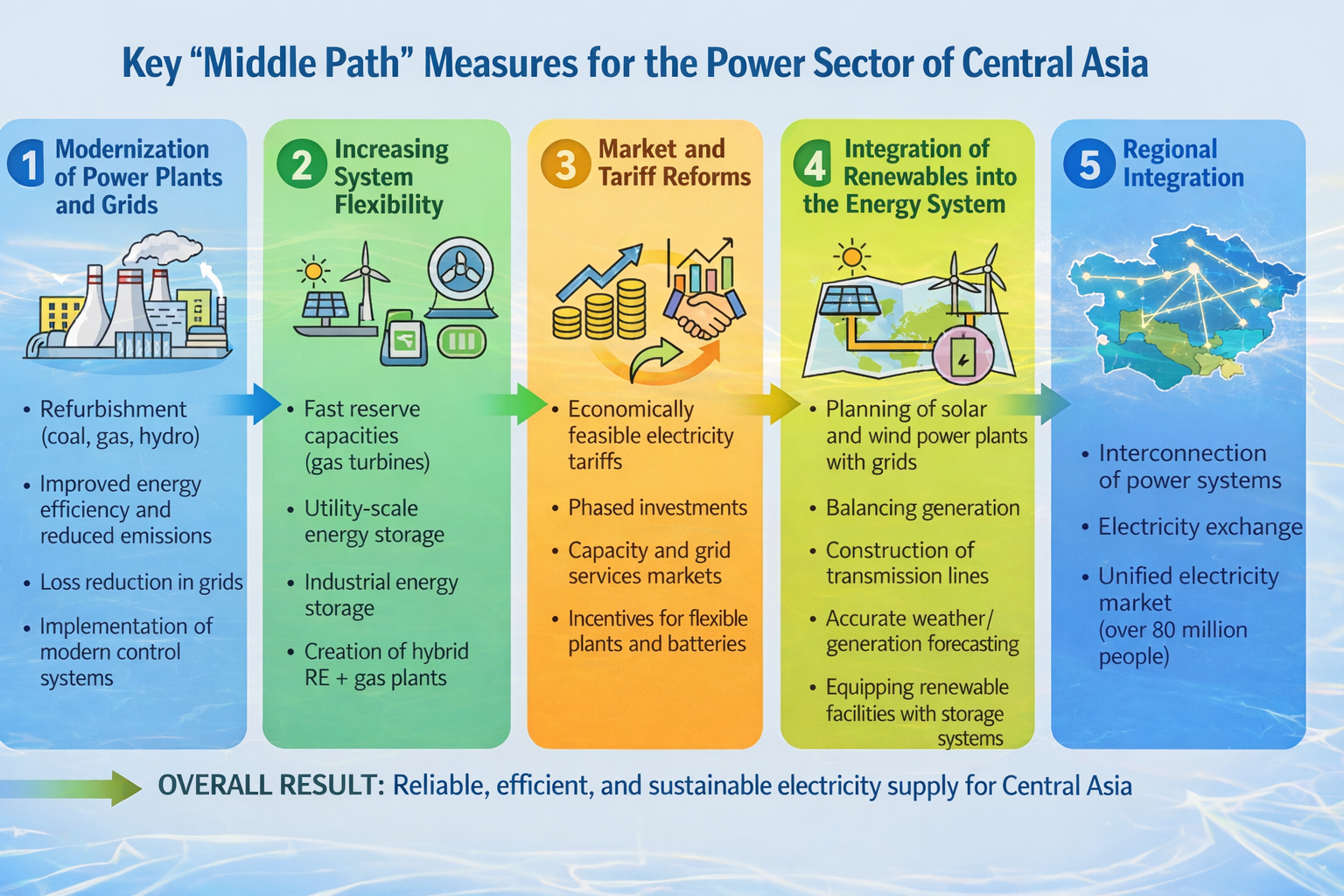
A balanced "middle path" strategy could provide a solid foundation for the modernization of Central Asia's power sector. Such a comprehensive approach would ensure reliable and affordable energy supply, significantly reduce the carbon footprint, and enable a smooth energy transition that benefits the economy and meets climate commitments.
Further details on the report “Power Sector of Central Asia: modernization and the energy transition” and other analytical materials are available on the Bank’s website.
Reference:
The Eurasian Development Bank (EDB) is a multilateral development bank engaged in investment activities across the Eurasian region. For 20 years, the EDB has been contributing to the strengthening and expansion of economic ties and the comprehensive development of its member countries. As of the end of December 2025, the EDB’s cumulative portfolio comprises 326 projects with a total investment volume of $19.6 billion. The majority of the EDB’s portfolio consists of projects with an integration effect in the areas of transport infrastructure, digital systems, green energy, agriculture, industry, and mechanical engineering. In its activities, the Bank is guided by the UN Sustainable Development Goals and ESG principles.
As part of its 2022–2026 Strategy, the EDB is implementing three megaprojects: the “Central Asian Water and Energy Complex,” the “Eurasian Transport Framework,” and the “Eurasian Commodity Transport Network.”
EDB Press Center Contacts:
+7 (727) 244 40 44, ext. 4774 and 2160