New Players and Major Projects: International Financial Institutions’ investments in the Q3 2026
5 November 2026
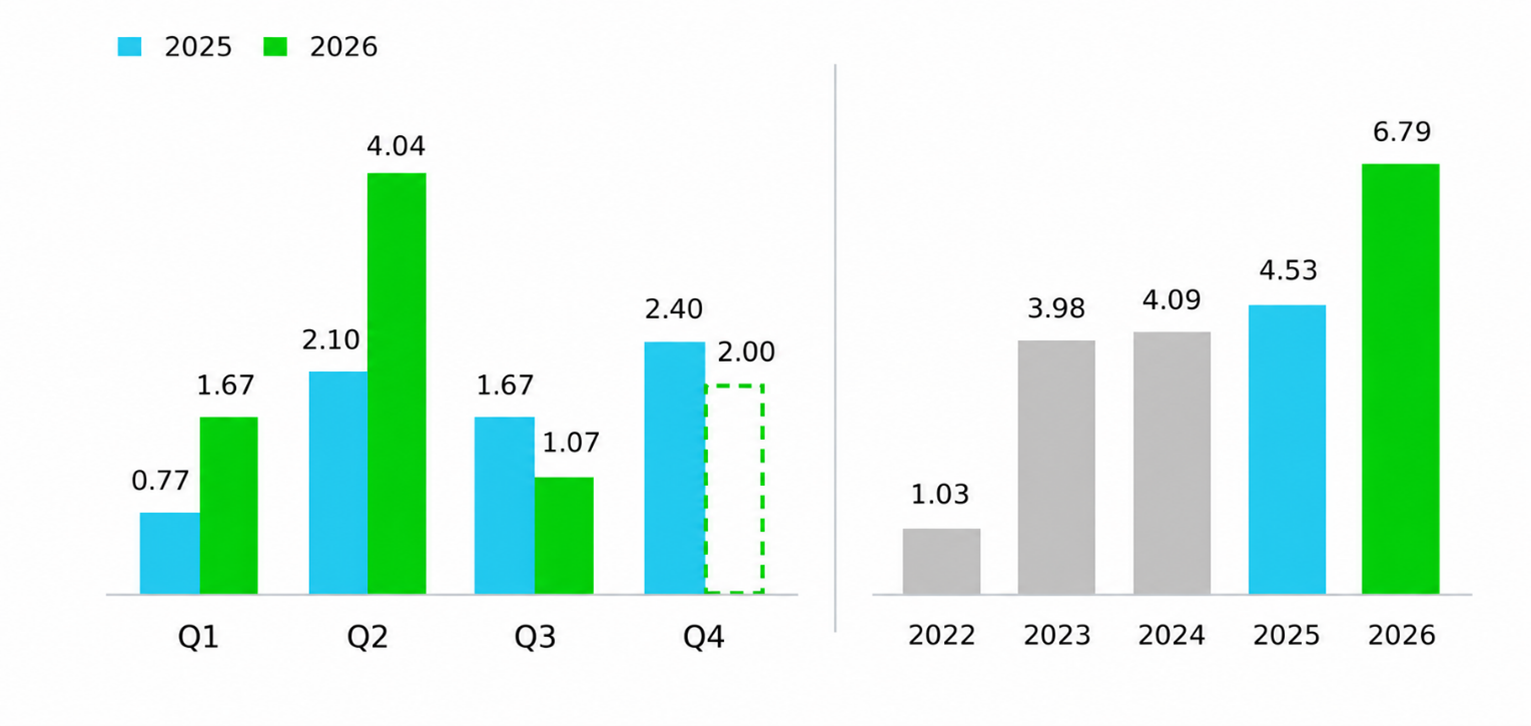
In Q3 2026, non-sovereign financing by international financial institutions (IFIs) in the Eurasian region totaled $1.07 billion, down 36% YoY. It fell by 74% from $4.04 billion in Q2 2026. Financing increased in Kazakhstan, Azerbaijan and in Mongolia. But these gains only partly offset declines in Uzbekistan, Armenia and Georgia.
SUMMARY
1. IFIs invested $1.1 billion in new projects in the region in Q3 2026. IFI financing declined by 36% year-on-year (YoY), while the year-to-date trend remained positive: over the first nine months, it rose by 50% to $6.8 billion. The quarterly decline was driven primarily by fewer large transactions.
2. Kazakhstan became a focal point for new IFIs and partnership mechanisms. Its financing increased by more than $200 million in Q3. The OPEC Fund approved its first non-sovereign operation in the country, while the Turkic Investment Fund began its financing activity with non-sovereign projects in Kazakhstan.
3. The OPEC Fund broadened the geographic and sectoral scope of its Eurasian investments. Its quarterly financing rose from $10 million to $90 million. New operations covered SME lending in Kazakhstan and a desalination infrastructure project in Azerbaijan.
4. Guarantees are becoming an important tool for mobilizing capital. MIGA provided $190 million of guarantee coverage for KfW financing to the Development Bank of Kazakhstan, while the EBRD provided a portfolio guarantee of up to $86 million to AccessBank in Azerbaijan to expand SME lending. The share of guarantees in IFI financing in the region rose from 4% in the first nine months of 2025 to 22% in the same period of 2026.
5. Investment in modern private-sector warehousing is expanding. The International Finance Corporation is financing the 29,000 m² LogoPark distribution centre in the Kyrgyz Republic. The EDB is supporting the approximately 120,000 m² Griffin Logopark Almaty logistics park in Kazakhstan. The EDB and Mercury Properties also signed a memorandum of cooperation on the Mercury Logistics hub construction in Kazakhstan.
IFIs are increasingly establishing investment platforms and funds. The launch of the GIRAF fund in Mongolia, with announced financing of $117.6 million, creates a platform to pool resources from IFIs, the government and commercial banks. The World Bank approved a loan for the ALEM project in Kazakhstan, which includes a venture fund-of-funds mechanism.
Regional investment fell by $0.6 billion year-on-year
In Q3 2026, non-sovereign financing by international financial institutions (IFIs) in the Eurasian region totaled $1.07 billion, down 36% YoY. It fell by 74% from $4.04 billion in Q2 2026. The main drivers were fewer large transactions and lower financing in Uzbekistan, Armenia and Georgia.
Large transactions became less frequent, while the volume of operations below $100 million increased. In Q3 2025, IFI transactions of $100 million or more totaled $981 million. In Q3 2026, there was just one such transaction: a $190 million MIGA guarantee to the German development bank KfW covering its loan to the Development Bank of Kazakhstan (DBK) for renewable energy projects. Meanwhile, the combined volume of transactions below $100 million rose from $685 million to $882 million, an increase of 29%.
Over the first nine months of 2026, financing reached $6.79 billion, up 50% YoY. Q2 accounted for around 60% of that amount. A $998 million MIGA guarantee linked to DBK financing was a major contributor to the previous quarter’s total.
The share of guarantees in the IFI financing structure in the Eurasian region rose from 4.1% in the first nine months of 2025 to 21.9% in the same period of 2026. The volume of guarantees increased from $0.2 billion to $1.5 billion. MIGA, EDB, EBRD and Proparco were the main providers of guarantees in the region.
Financing is expected to recover in Q4. Given the within-year volatility of IFI investment, new operations by the EDB, EBRD, AIIB and ADB could be the principal sources of an increase. In 2022–2025, new operations in the final quarter of the year averaged $2 billion.
Figures 1–2. Non-sovereign financing by IFIs in the Eurasian region, $ billion.
Sources: Authors’ calculations based on MDB data and the EDB NSF database.
IFI investment increased in Kazakhstan, Azerbaijan and Mongolia
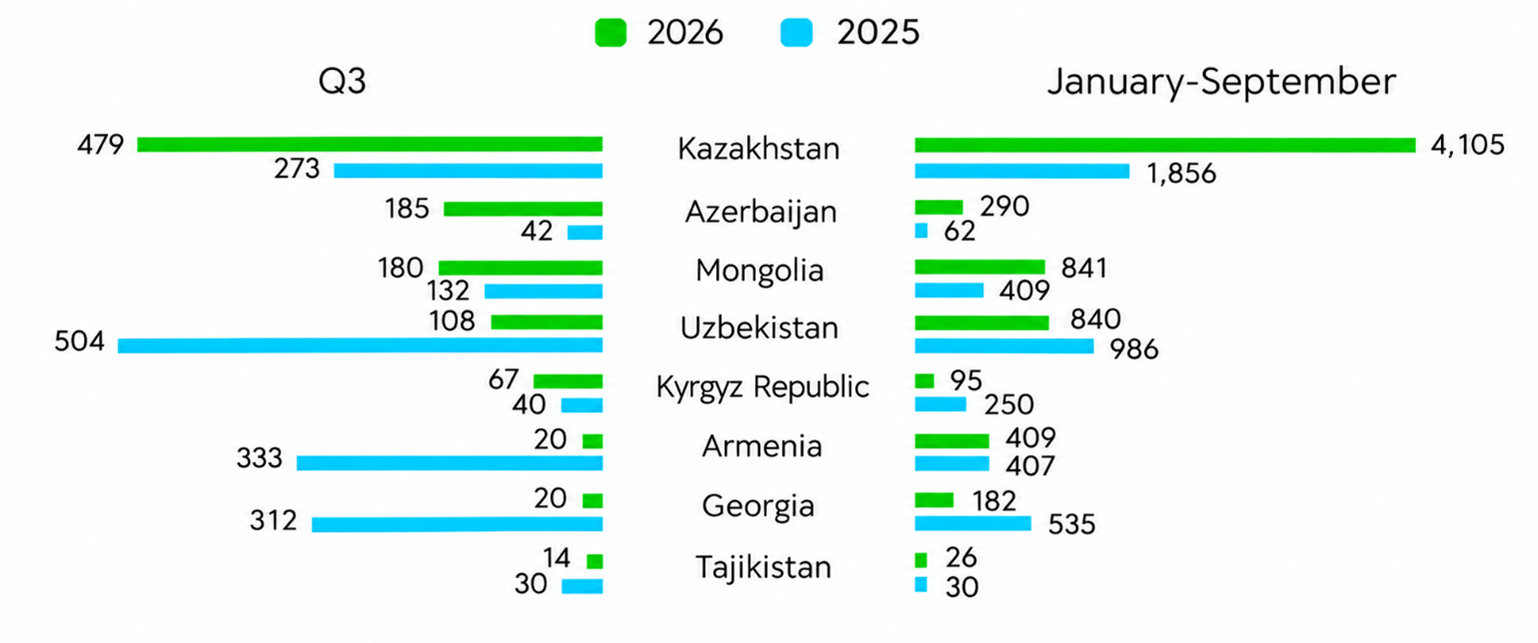
Financing increased in three countries: by $207 million in Kazakhstan (76% YoY), $143 million in Azerbaijan (4.4 times) and $48 million in Mongolia (36%). These gains only partly offset declines in Uzbekistan, Armenia and Georgia.
Kazakhstan attracted a wider range of institutions supporting private businesses. It was the largest recipient of non-sovereign IFI financing both in Q3 and over the first nine months of 2026. Its principal financiers were MIGA, the EDB, Proparco, the OPEC Fund and the Turkic Investment Fund (TIF). The OPEC Fund[3] approved its first non-sovereign operation in Kazakhstan: a $30 million loan to a Kazakh financial institution for SME and agribusiness lending. TIF approved its first operations in Kazakhstan: $10 million for KMF Bank and $20 million for the modernisation of Almaty Airport.
In Azerbaijan, the increase was linked to guarantee operations. Financing reached $185 million, with the EBRD, AIIB, OPEC Fund and Black Sea Trade and Development Bank (BSTDB) participating. A notable operation was an EBRD portfolio guarantee for AccessBank of up to €75 million ($86 million), covering up to 50% of the credit risk on SME loans.
Mongolia attracted substantial financing in local currency. Operations covered agribusiness, infrastructure and the financial sector. For example, the ADB approved a MNT 107 billion ($30 million) loan to Tavan Bogd Group companies to develop value chains in the cashmere industry and create jobs. In August 2026, Mongolia also launched GIRAF[4], a specialised fund for individuals, SMEs and agricultural enterprises that draws on financing from international organisations, the government and commercial banks. The ADB was among its first partners.
Financing in Uzbekistan, Armenia and Georgia fell by a combined $1 billion. Uzbekistan and Georgia also recorded declines over the first nine months of 2026. One notable Q3 transaction in Uzbekistan was a $60 million syndicated facility arranged by the Islamic Corporation for the Development of the Private Sector (ICD) for Asakabank.
Figure 3. Non-sovereign IFI financing by country in the region, $ million.
Sources: Authors’ calculations based on MDB data and the EDB NSF database.
The EBRD and AIIB accounted for most of the decline
The five largest IFIs by approved non-sovereign financing in Q3 were the EBRD, MIGA, EDB, Proparco and OPEC Fund. Most IFIs reduced financing YoY: the EBRD by $448 million, AIIB by $335 million, IFC by $155 million and ADB by $153 million.
EBRD projects were concentrated primarily in the financial sector. Azerbaijan and Uzbekistan were its main recipient countries. Alongside the portfolio guarantee for AccessBank in Azerbaijan, one of its largest operations was a loan to Davr Bank in Uzbekistan, provided in Uzbek soum in an amount equivalent to $25 million for micro, small and medium-sized enterprise (MSME) financing.
AIIB approved its first water-sector project in Azerbaijan. Its only operation in Q3 was a $45 million loan for a Caspian Sea desalination plant. The OPEC Fund is also co-financing the project. The facility, with capacity of around 300,000 m³ per day, will be the country’s first large-scale desalination plant and its first public–private partnership in the water sector.
The EDB actively financed infrastructure. It provided loans for construction of the Griffin Logopark Almaty logistics complex and a new generating unit at the Ust-Kamenogorsk combined heat and power plant.
Proparco financed financial institutions across the region. Recipients included KMF Bank in Kazakhstan and Khan Bank and XacBank in Mongolia. The financing supports small businesses, climate projects and women entrepreneurs.
The OPEC Fund increased its quarterly financing from $10 million to $90 million. New operations included a $40 million loan for an Azerbaijani desalination plant and a $30 million loan to a Kazakh financial institution for SME and agribusiness lending.
The Turkic Investment Fund (TIF) approved its first operations. It provided a loan of up to $10 million to Kazakhstan’s KMF Bank alongside an EBRD facility of up to $50 million. In September, it also approved up to $20 million for the modernisation of Almaty Airport as part of a syndicated loan package arranged by Bank of America with EDB participation.
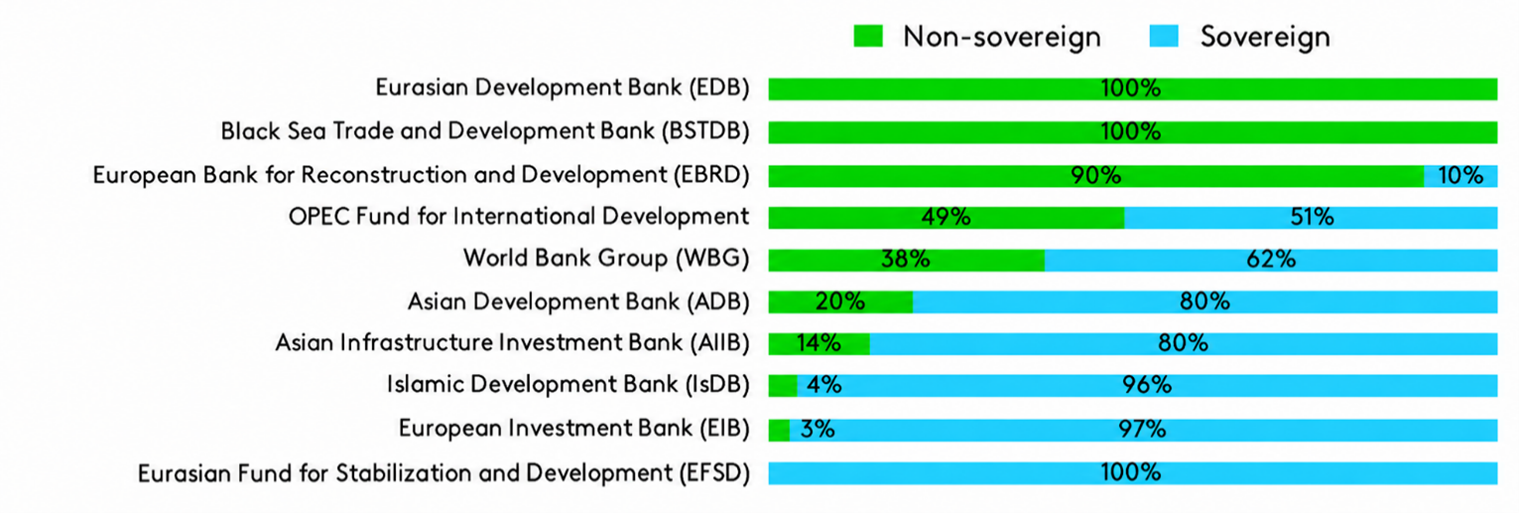
The EDB, BSTDB, EBRD and OPEC Fund stood out for the high share of non-sovereign operations in their financing structure.
Figure 4. Financing structure of the principal IFIs in the region in the first nine months of 2026.
Sources: Authors’ calculations based on MDB data and the EDB NSF database and the EFSD SFD database.
Water and conventional energy became new areas of investment growth
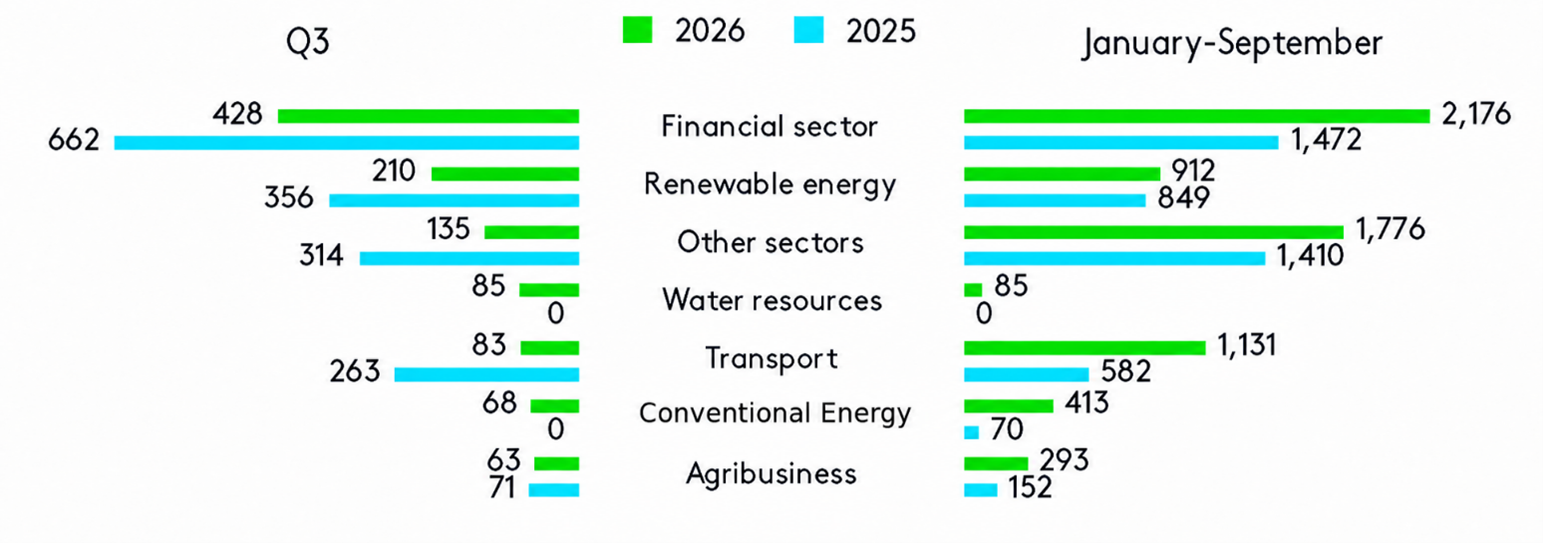
The water sector emerged as a new area of IFI financing. Investment in water resources reached $85 million in Q3 2026. The principal operation was construction of a desalination plant in Azerbaijan with AIIB and OPEC Fund participation.
The financial sector remained the largest destination for investment. It received $427.6 million, or 40% of the total. Financial-sector operations were recorded in seven of the eight countries with financing.
The largest declines in investment were in the financial sector (down $235 million), transport (down $180 million) and renewable energy (down $147 million).
As renewable energy investment declined, financing for conventional power generation increased. In particular, the EDB and Halyk Bank supported a new generating unit at the Ust-Kamenogorsk combined heat and power plant, which will raise heat capacity by 130 Gcal/h and electricity capacity by 100 MW.
IFC and the EDB are expanding investment in modern warehousing infrastructure. IFC provided up to $50 million for the Umai Group investment programme in the Kyrgyz Republic, including the construction of a 29,000 m² class A LogoPark distribution centre near Bishkek. The EDB supported construction of the approximately 120,000 m² class A+ Griffin Logopark Almaty in Kazakhstan. The EDB and Mercury Properties also signed a memorandum of cooperation on construction of the Mercury Logistics hub in Kazakhstan.
There were no new non-sovereign IFI operations in digital infrastructure. In September, however, the World Bank approved a $75 million sovereign loan to Kazakhstan for the ALEM[6] project, which aims to develop technology startups and includes a venture fund-of-funds mechanism.
Figure 5. Financing by sector across the countries of the region, $ million.
Sources: Authors’ calculations based on MDB data and the EDB NSF database