


Macroeconomic Outlook 2026-2028
15 June 2026
The Eurasian Development Bank (EDB) has presented its Macroeconomic Outlook for the seven member countries. The analysis examines economic developments in early 2026 and outlines key macroeconomic projections for late 2026, as well as forecasts for 2027 and 2028.
The EDB has published a report assessing developments in the global economy and the Eurasian region. According to EDB analysts, the global economic situation changed dramatically in March 2026. The escalation of the conflict in the Persian Gulf led to rising oil prices, increased inflationary pressure and a slowdown in global economic activity. Under these conditions, US economic growth will slow to 1.7% in 2026. However, government spending and investment inflows into the oil and gas sector will mitigate the scale of the slowdown. The eurozone remains more vulnerable to the energy shock: according to our forecasts, its growth will slow to 0.9% in 2026, down from 1.4% in 2025. China’s economy will grow by 4.6% in 2026, driven by fiscal policy measures, increased investment in artificial intelligence and expanding electronics exports.
Inflation has accelerated significantly against the backdrop of the energy shock. Consumer price inflation is expected to reach 3.6% by the end of 2026 in the US and 3.0% in the eurozone. The Fed is likely to maintain a longer policy pause, while the ECB may raise rates to limit the entrenchment of the inflationary shock in expectations.
Eurasian region
The impact of the conflict in the Middle East on EDB member countries will vary depending on whether they are net exporters or net importers of energy resources.
For Russia and Kazakhstan, rising energy prices will, in the short term, contribute to higher export earnings and budget revenues. Higher oil and gas prices will support the rouble and tenge exchange rates in 2026. For Belarus, rising global demand for fertilisers may create additional opportunities to increase exports of potash and nitrogen fertilisers in value terms. The Bank’s other countries of operations, being net importers of energy resources, will primarily face inflationary risks associated with rising oil and food prices on global markets.
In 2026, the economy of the EDB’s region of operations will continue to grow steadily, with GDP growth forecast at 2.0%. The moderate aggregate growth rate is largely due to Russia’s GDP growth remaining at 1.0% for two consecutive years. At the same time, analysts forecast high growth rates for a number of Central Asian countries by the end of 2026, thanks to strong investment activity. In 2027, the region’s GDP growth rate may rise to 2.4%, primarily due to an acceleration in economic activity in Russia and Belarus. Other countries in the region will maintain high growth rates close to current levels. In the absence of further shocks, we forecast a slowdown in inflation in the region to 6.1% in 2026 and 5.3% in 2027, following 6.5% in 2025, thanks to the prudent monetary policies of EDB member states’ monetary authorities.
Key macroeconomic projections for EDB member states in 2026
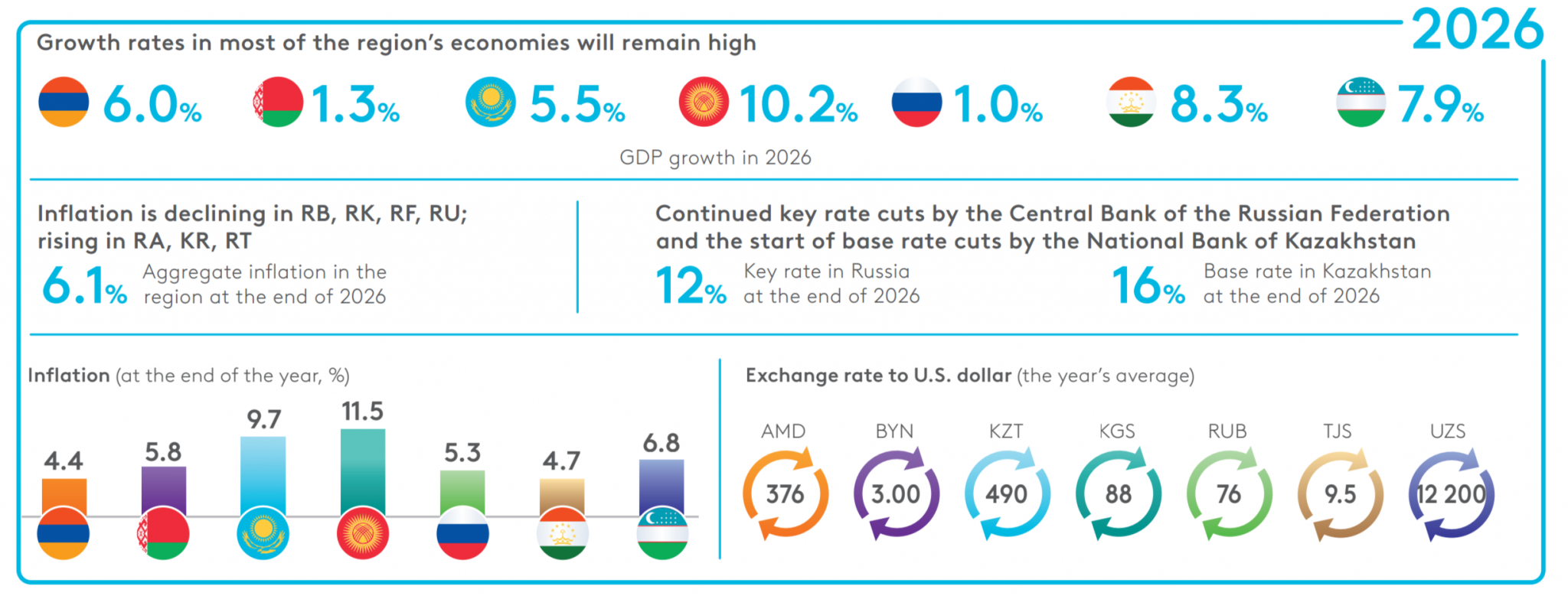
Source: EDB analysts’ calculations.
Armenia
According to EDB forecasts, Armenia’s economic growth rate will remain high at 6.0% in 2026. The main drivers remain domestic consumer and investment demand, supported by government investment. Inflation is forecast to rise to 4.4% y/y in 2026, following 3.3% y/y in 2025, due to rising energy and food prices on global markets. The average annual exchange rate of the dram will strengthen to 376 drams per US dollar, against the backdrop of a recovery in exports and high tourist activity.
Belarus
In Belarus, economic growth is forecast at 1.3% in 2026 against a backdrop of rising real household incomes, positive investment trends, a gradual easing of credit conditions and an expansion in service exports. Inflation in Belarus will continue to slow and will not exceed the 7% target in 2026. This slowdown is linked to the strong exchange rate of the Belarusian rouble and administrative price controls. The average exchange rate of the Belarusian rouble in 2026 is forecast at 3.00 BYN/USD. The strengthening of the national currency will be driven by growth in service exports and the maintenance of high interest rates on household deposits.
Kazakhstan
EDB analysts expect Kazakhstan’s economy to maintain steady growth of 5.5% in 2026. One of the key drivers of GDP growth will be the expansion of manufacturing output, alongside construction, transport and trade. Inflation is forecast to fall to 9.7% by the end of 2026 against a backdrop of tight monetary conditions, a stronger tenge and stabilising consumer demand. According to EDB analysts’ forecasts, the average tenge exchange rate in 2026 will be 490 tenge per US dollar. The exchange rate will be supported by a high base rate and higher oil prices.
Kyrgyz Republic
In 2026, the economy of the Kyrgyz Republic will remain the region’s leader in terms of GDP growth, at 10.2%. This growth will be driven by increased investment in industry, the energy sector and housing construction. EDB analysts expect inflation to rise to 11.5% by the end of 2026, driven by mounting pressure on global food markets and rising global commodity prices. The average exchange rate of the som in 2026 is expected to be 88 soms per US dollar, supported by rising rates in the interbank credit market and measures by the National Bank of the Kyrgyz Republic aimed at smoothing sharp fluctuations in the exchange rate.
Russia
In Russia, economic growth is forecast at 1.0% in 2026. An improvement in the external trade environment will boost growth through increased export revenues. Inflation will slow to 5.3% by the end of 2026, but will remain above target due to a combination of heightened inflation expectations, rising regulated tariffs and wage pressure. EDB analysts expect a moderate weakening of the Russian rouble exchange rate to 79 roubles per US dollar by the end of 2026 and note the risk that the rouble may remain stronger than forecast if oil prices remain high.
Tajikistan
Tajikistan’s economy will maintain high GDP growth rates in 2026, at around 8.3%. This will be driven by strong consumer and investment activity. Inflation will remain within the NBT’s target range (5±2%) throughout the forecast period. The exchange rate will strengthen to an average of 9.5 somoni per US dollar in 2026. Growth in export revenues against a backdrop of high gold prices, as well as a further increase in remittances, will support the somoni exchange rate.
Uzbekistan
EDB analysts forecast that Uzbekistan’s GDP growth will accelerate to 7.9% in 2026. This will be driven by strong domestic demand, an upturn in investment activity and increased output in industry and construction. Inflation will continue to decline towards the Central Bank of Uzbekistan’s target 5%. This will be facilitated by tight monetary conditions and a strengthening of the exchange rate to an average of approximately 12,200 soums per US dollar in 2026. The national currency will be supported by an inflow of foreign investment and high volumes of remittances.