
Waves of Investment Megahype. Digital, ESG, AI: What’s Next?
-
Report
PDF, 3.88 Mb -
Key findings
PDF, 2.11 Mb -
Summary
PDF, 586.72 Kb
The report identifies the most likely areas of focus for the next phase of global interest in new technologies. Following on from digital, ESG and AI, EDB analysts cite biotechnology, robotics and autonomous systems, the space economy, and virtual reality as the most promising candidates for a new investment boom in the coming years.
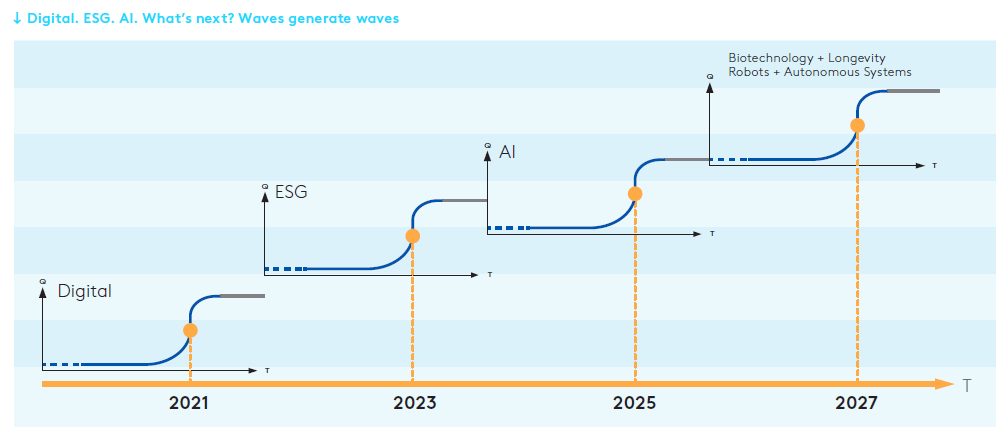
In recent years, the global economy has experienced several powerful investment waves. The digital boom peaked in 2021, interest in ESG peaked in 2023, and interest in AI is set to peak in 2025. However, each new wave does not supplant the previous one, but builds upon the foundations it has laid: certain technologies provide the infrastructure, data and demand for those that follow.
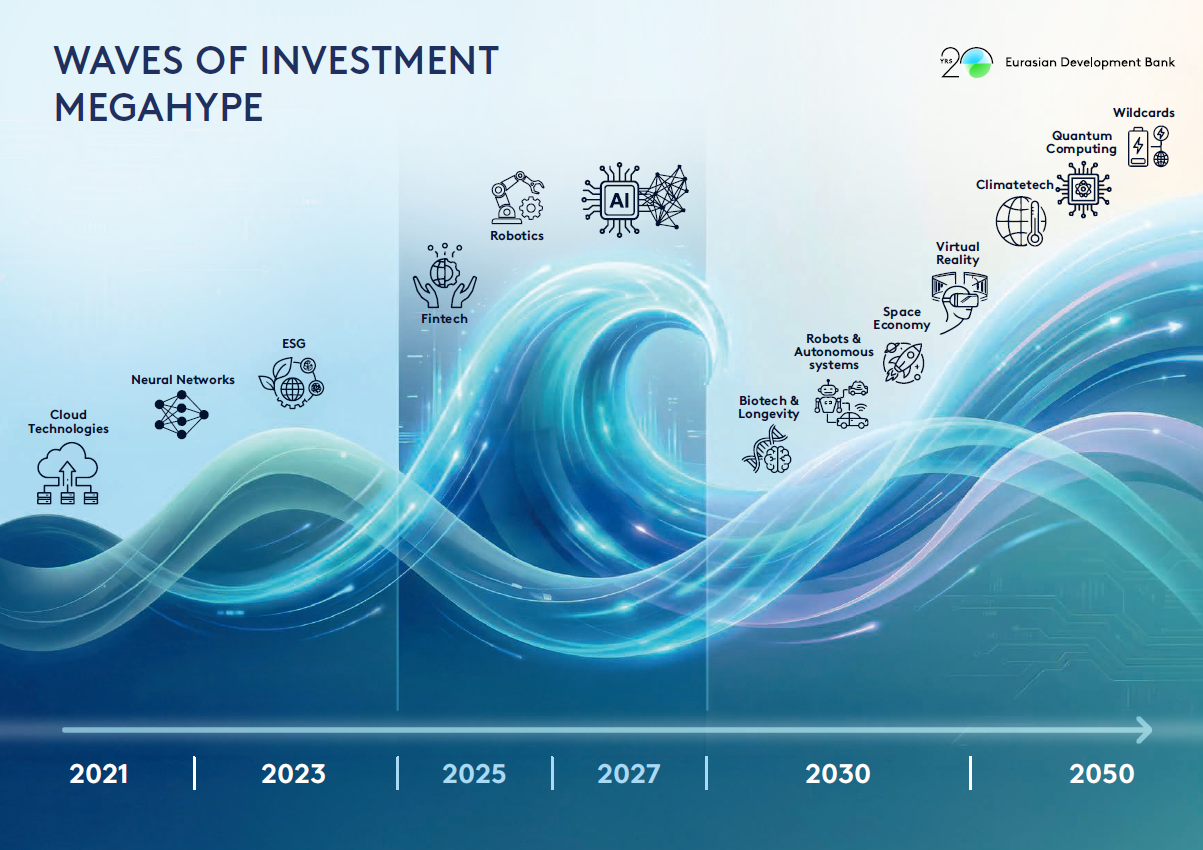
Looking ahead to the next 20 years, EDB analysts identify seven most likely investment waves: biotechnology and longevity, robots and autonomous systems, the space economy, virtual reality, energy storage and networks, climate technologies, and quantum computing. In the shorter term, according to the authors, the most likely candidates for a new wave are the following megatrends: biotechnology, robotics, virtual reality and the space economy.
The report places particular emphasis on biotechnology. This is due not only to the scale of the potential market, but also to the fact that biotech could become one of the answers to a key challenge of the coming decades — the labour shortage. As the population ages, the ability to extend the period of healthy and productive life is becoming increasingly valuable in economic terms.
It is estimated that the global biotechnology market was worth around $1.9–2.2 trillion in 2024–2025, and could grow to nearly $5.9 trillion by 2034. Robotics also has significant growth potential: the market could grow from $64.8 billion in 2025 to $376 billion by 2035. For virtual reality, estimates stand at around $75 billion in 2025 and up to $693 billion by 2035.
The authors of the report also assess the potential macroeconomic impact of longevity on the world’s largest economies. According to their calculations, one additional year of healthy and productive life could yield a significant cumulative effect on GDP: around $18.2 trillion for China, $15.1 trillion for the US and $3.4 trillion for Russia over a 20-year horizon. This means that investment in healthcare, anti-ageing measures and biotechnology could become not only a social priority but also a significant focus of economic policy.
At the same time, any new wave of technology brings with it not only opportunities but also the risk of inflated expectations. The report uses the term ‘creative self-deception’ to describe a situation where the stated status of a technology significantly outpaces its actual level of maturity. In other words, the key issue for investors and the state is not only to identify a promising direction, but also to correctly assess the stage of its development.
In the new technological environment, the ability to rapidly adopt and scale promising solutions is becoming a key resource. For developing economies, this means that competition will unfold not only for capital, but also for the speed of integration into new markets, for competencies, and for institutional readiness for the next growth cycle.